
IBM has introduced sub-1 nm semiconductor technology based on a new NanoStack transistor architecture that vertically stacks and staggers transistors to increase density and improve efficiency. The company says a chip the size of a fingernail could integrate nearly 100 billion transistors and reach commercial production within five years. For ISVs, silicon engineers, and CIOs, the announcement highlights the next phase of transistor scaling and raises new considerations for AI infrastructure, HPC systems, software optimization, and long-term platform planning.
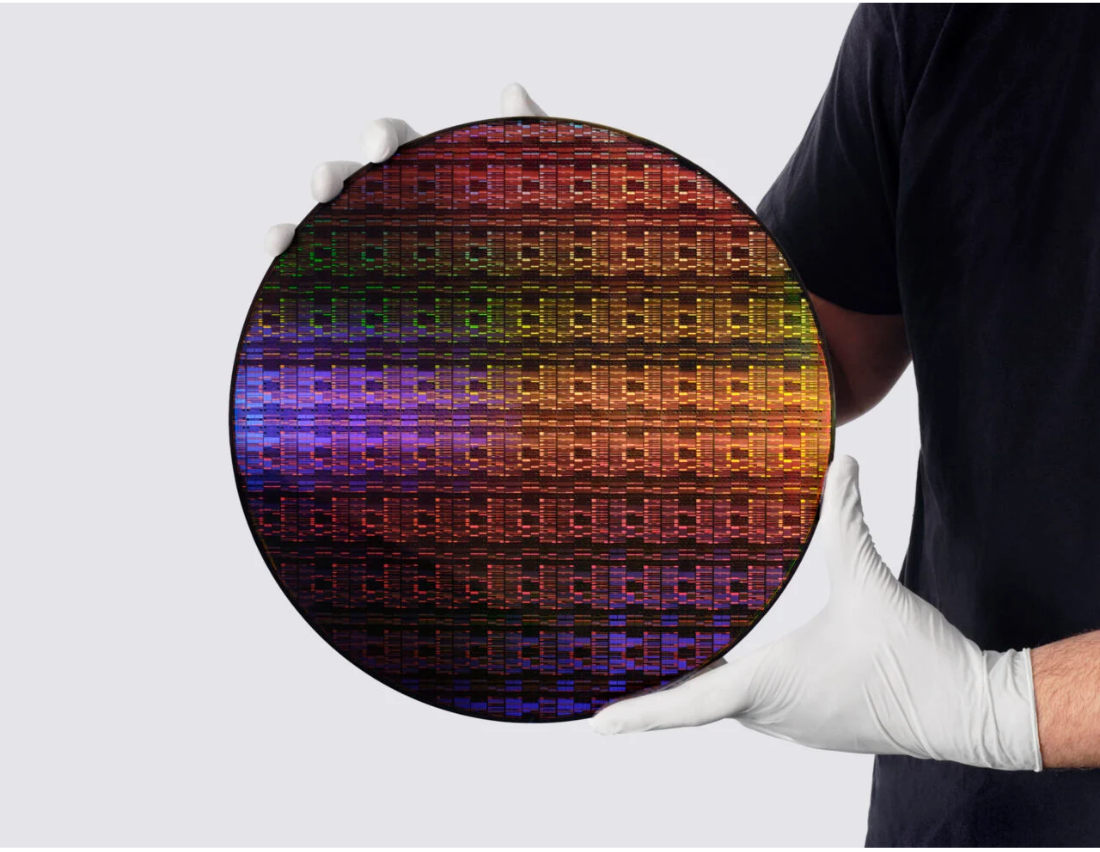
Researcher holding IBM’s sub-1 nm node wafer. (Source: IBM)
IBM has unveiled a sub-1 nm semiconductor technology built around a new transistor architecture called NanoStack. The company says the design packs nearly 100 billion transistors into a chip roughly the size of a fingernail. IBM believes commercial deployment could arrive within five years if engineering teams complete the remaining work around manufacturing, thermal management, packaging, and large-scale integration.
The announcement addresses one of the semiconductor industry’s biggest challenges. Traditional transistor scaling no longer delivers the steady gains that defined previous generations of process technology. Chip designers now rely on new device architectures, advanced materials, packaging innovations, and sophisticated design methodologies to sustain improvements in performance, power efficiency, and transistor density.
IBM positions NanoStack as the next evolution after nanosheet gate-all-around (GAA) transistors. In 2021, the company introduced a 2 nm-class process based on GAA technology, demonstrating a successor to FinFET devices that have powered leading-edge processors for more than a decade. IBM later licensed that technology to Rapidus in Japan, while TSMC, Samsung, and Intel continued developing their own GAA roadmaps.
NanoStack shifts the focus toward complementary field-effect transistor (CFET) technology. CFET vertically integrates n-type and p-type transistors, allowing engineers to increase transistor density without relying solely on planar scaling. IBM describes NanoStack as a staggered sequential CFET implementation that joins two wafers containing nanosheet-style transistor layers into a vertically integrated logic structure.
The architecture introduces another scaling option for future AI accelerators, CPUs, networking silicon, and specialized processors. Device engineers gain additional flexibility in floor planning while preserving logic density gains that conventional shrinking alone can no longer deliver.
IBM compared NanoStack with its own 2 nm technology and reported the following improvements.

Table 1. Comparison of IBM chips. (Source: IBM)
These figures immediately attract attention across AI infrastructure. Modern AI workloads consume enormous amounts of compute capacity, memory bandwidth, electrical power, cooling resources, and rack space. Higher transistor density allows designers to build more capable accelerators, CPUs, networking devices, memory controllers, and chiplet-based systems while improving overall system efficiency.

Figure 1. The new chip technology packs nearly 100 billion transistors into a fingernail-sized chip. (Source: IBM)
IBM also notes that NanoStack incorporates transistor features smaller than the width of a DNA strand, which measures approximately 2.5 nm across. The comparison illustrates the physical scale of the technology. Process node names no longer correspond to a single transistor dimension. Today’s node designations represent a combination of density improvements, electrical characteristics, power efficiency, design rules, and manufacturing advances. Silicon teams will evaluate NanoStack using measurable characteristics that include switching performance, leakage, interconnect behavior, SRAM density, defect rates, reliability, and EDA ecosystem support.
Jay Gambetta, director of IBM Research, described NanoStack as a redesign of chip construction rather than another transistor shrink. He said IBM changed how chips are built to increase computing performance while improving energy efficiency. Huiming Bu, vice president of IBM’s Silicon Technology Research organization, said the industry continues to overcome perceived scaling limits through new architectural approaches instead of incremental process improvements.
For silicon engineering teams, manufacturability remains the central question. Sequential CFET production requires extremely accurate wafer alignment, high-precision bonding, thermal control throughout fabrication, and dependable interconnects between vertically stacked transistor layers. Engineers must also address heat removal, defect inspection, repair strategies, yield optimization, and process complexity before production becomes economically viable.
SRAM scaling deserves equal attention. IBM reports a 40% improvement in SRAM density, an important metric for AI processors, and high-performance CPUs. On-chip SRAM supports caches, activation buffers, scheduling engines, and data reuse mechanisms that reduce dependence on external memory. Higher SRAM density improves latency, lowers power consumption, and increases effective compute utilization. Designers will closely examine how NanoStack supports SRAM arrays, peripheral circuitry, and mixed logic-memory layouts across a complete manufacturing flow.
Independent software vendors should also monitor developments closely. Denser processors with larger on-chip memory resources create opportunities for software optimization across AI inference engines, compilers, HPC applications, database acceleration, and edge computing platforms. Software stacks will need to extract greater value from increased transistor budgets while balancing thermal limits and heterogeneous computing resources.
For CIOs and enterprise IT leaders, NanoStack represents a strategic development rather than an immediate procurement decision. No production systems based on this technology will appear in enterprise data centers this year. Enterprise infrastructure planning increasingly spans several hardware generations, especially for AI deployments that require long-term investment decisions. If IBM and its ecosystem commercialize NanoStack within five years, organizations may evaluate denser compute nodes, revised cooling strategies, different server architectures, and updated software validation processes.
Energy efficiency remains another critical consideration. IBM reports up to 70% greater efficiency at equivalent performance compared with its 2 nm process. Many data centers already face electrical capacity constraints that limit AI expansion. More efficient processors could enable organizations to deploy additional inference and training capacity within existing power budgets. Hyperscalers, HPC facilities, financial institutions, research organizations, and enterprises building private AI infrastructure all stand to benefit from improved compute efficiency.
NanoStack also aligns with the industry’s broader transition toward three-dimensional integration. Advanced packaging, chiplets, hybrid bonding, HBM stacks, and heterogeneous integration already extend system performance beyond conventional scaling. CFET architectures extend vertical integration directly into the transistor layer, giving chip designers another mechanism for increasing density while supporting future generations of AI hardware.
IBM still faces several milestones before NanoStack reaches production. The company must demonstrate reliable thermal pathways, acceptable manufacturing yields, defect control, robust testing methodologies, packaging compatibility, and integration with commercial design flows. Foundry partners must also prove they can manufacture the architecture at production volumes while maintaining competitive cost structures.
IBM’s NanoStack announcement illustrates how semiconductor innovation now depends on architectural engineering alongside process technology. The work provides silicon teams with a practical CFET implementation to evaluate, while giving CIOs another indicator that future AI infrastructure will require closer coordination across device physics, packaging, power delivery, cooling systems, and software optimization. If IBM successfully commercializes NanoStack, sub-1 nm technology could shape the next generation of AI accelerators, CPUs, networking silicon, and HPC platforms later this decade.
NanoStack expands the industry’s roadmap beyond conventional transistor scaling and reinforces the shift toward vertically integrated device architectures. The announcement gives hardware developers a tangible technology milestone to assess, while providing enterprise technology leaders with an early view of the platforms that could define future AI infrastructure. Commercial success will depend on manufacturing execution, ecosystem support, and production economics, though the underlying architectural direction now appears increasingly clear.
What do we think?
IBM has established a credible reference point for the post-GAA era. NanoStack presents a practical CFET architecture with measurable performance and density targets that engineers can evaluate against competing roadmaps. Manufacturing challenges remain substantial, particularly around yield, thermals, and production cost. ISVs and enterprise planners should monitor this technology because future AI infrastructure will increasingly depend on vertically integrated transistor designs.
NanoStack may represent an inflection point for AI hardware because future performance improvements increasingly depend on transistor architecture rather than traditional process shrink. The industry continues pushing against power, cooling, and density constraints as AI workloads expand. This inflection point suggests that vertically integrated transistor designs, denser SRAM, and advanced packaging will shape the next generation of AI systems. IBM’s work signals a broader transition toward three-dimensional semiconductor engineering that could influence future compute platforms across enterprise AI and HPC.
LIKE WHAT YOU’RE READING? INTRODUCE US TO YOUR FRIENDS AND COLLEAGUES.