
Mobilint’s Regulus brings Ceva’s sensing and neural processing IP into a commercial edge AI platform. The companies report 10 TOPS at less than 3 W, with support for up to 8 GB of memory, and identify Regulus as the first production deployment of Ceva’s NeuPro family. The chip also powers Mobilint’s MLD-R1 USB accelerator. For developers and IT buyers, the announcement raises practical questions about workload allocation, software compatibility, power consumption, and performance under real operating conditions.

Ceva has secured a production reference for its NeuPro neural processor family through Mobilint’s Regulus edge AI SoC. The companies announced the deployment on November 2, 2026. Regulus integrates Ceva’s SensPro AI DSP and NeuPro-Nano NPN32 NPU alongside Mobilint’s proprietary AI processing architecture.
The companies report 10 TOPS of AI throughput at less than 3 W, with support for up to 8 GB of memory. Mobilint identifies dense INT8 as the precision for its throughput rating. These specifications provide an initial performance target for silicon teams and system integrators. Application results depend on model characteristics, memory access, scheduling, and the surrounding hardware.
Assigning work across engines
Regulus divides processing among specialized engines. SensPro handles programmable sensing and signal processing, including operations associated with camera, radar, audio, and other sensor inputs. NeuPro-Nano targets neural inference and low-power, always-on applications. Mobilint adds its own processing architecture for additional AI workloads.
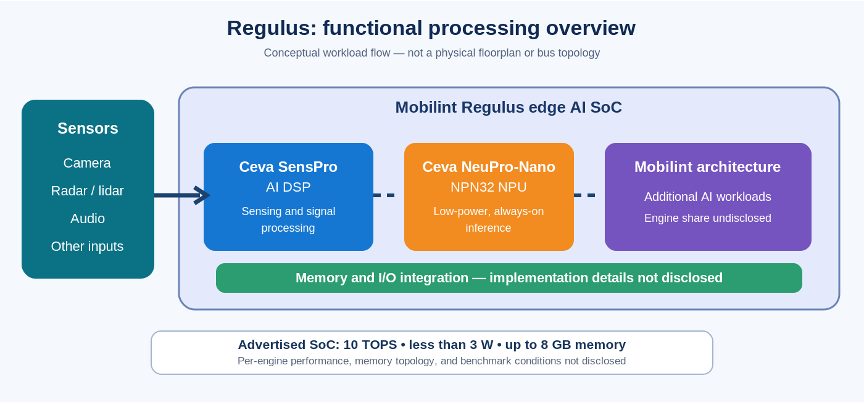
Figure 1. Regulus distributes sensing, low-power inference, and AI processing across engines.
This arrangement lets developers assign functions based on computational requirements and energy budgets. A machine vision system, for example, can capture camera data, prepare images, run an inference model, and return results to application software.
The companies have not disclosed the contribution of each engine to the 10 TOPS specification. Developers should request individual engine benchmarks, supported data formats, and workload scheduling information. They also need to understand how the engines exchange information and access memory.
A DSP can perform filtering, normalization, and sensor preprocessing before inference. A low-power NPU can handle continuously active detection functions. Larger inference engines can execute computationally intensive models when applications require them. Actual efficiency depends on how Mobilint implements these functions in Regulus.
A stand-alone chip and a USB product
Mobilint describes Regulus as a stand-alone processor capable of running Linux and applications. The company also identifies an integrated image processor, 4K video encoding at 60 fps, and interfaces for cameras, displays, Ethernet, USB, and sensors.
These capabilities support robotics, drones, industrial cameras, security systems, and other embedded applications. They also make Regulus relevant to developers who need local processing with limited power and cooling capacity.
Mobilint incorporates the processor into its MLD-R1 USB accelerator, which it introduced at Computex 2026. Ceva reports that the accelerator now ships. The USB configuration gives developers a way to evaluate the architecture using existing host systems.
The MLD-R1 connects through USB 3.1 Gen1 Type-C and supports Windows and Linux hosts using x86 or Arm processors. Its available memory configurations include 4 GB and 8 GB of LPDDR4X.
Buyers should distinguish the stand-alone SoC’s power and interface specifications from those of the complete USB accelerator. Memory, regulators, interfaces, and board components contribute to total device consumption.
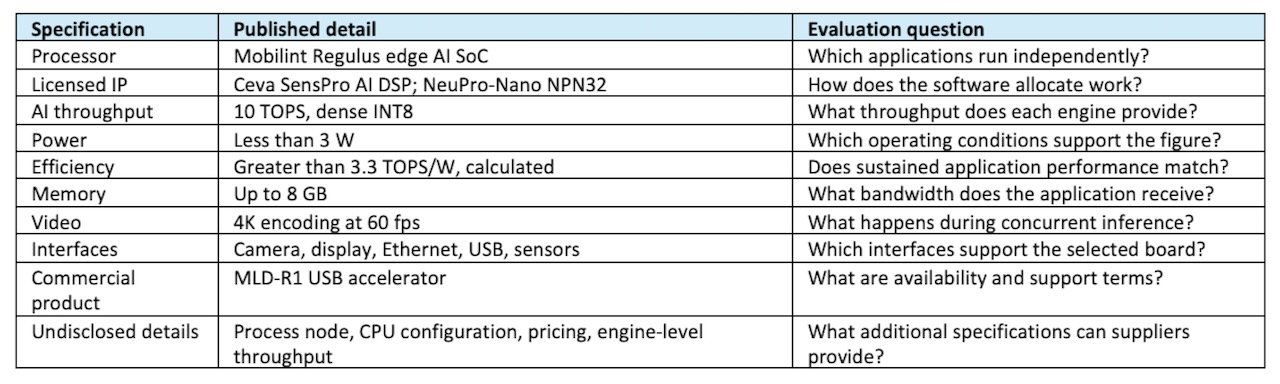
Table 1. Regulus capabilities and evaluation boundaries. (Source: Ceva)
Software carries the integration burden
Mobilint supports PyTorch, ONNX, Hugging Face, TensorFlow, TFLite, and Keras workflows. Its software environment includes the QB compiler and SDK, Yocto-based Linux tools, and components such as GStreamer and OpenCV. These interfaces give ISVs familiar starting points for deploying trained models. Developers still need to establish operator compatibility, quantization accuracy, compiler behavior, and memory requirements.
An effective evaluation should begin with a representative application model. Teams can measure inference accuracy and latency using recorded inputs, then introduce live sensors, video encoding, and application processing. This approach exposes memory contention, preprocessing overhead, and software scheduling effects. It also helps engineers determine whether performance limitations originate in the neural engine or elsewhere in the application pipeline.
Generative AI introduces additional requirements. Mobilint identifies generative workloads among the accelerator’s applications. Developers should measure model loading, token generation, memory consumption, and sustained response latency before selecting the hardware for production.
Power claims need system measurements
Regulus’ advertised throughput and power figures establish a useful reference. The supplied announcement does not identify the precise benchmark workload, operating frequency, or measurement boundary.
Silicon teams should examine concurrent sensing and inference, sustained thermal behavior, memory bandwidth, and transitions between active and idle states.
Always-on applications require measurements across realistic duty cycles. A camera that performs periodic object detection may consume considerably different average power from one executing continuous video analysis.
For CIOs, deployment planning must also include firmware maintenance, model updates, security controls, diagnostics, and operational support. USB accelerators offer a practical evaluation route, while production installations require consistent configuration management.
Teams should establish recovery procedures for interrupted updates, restart failures, and network disruptions. They should also document software versions and maintain reference workloads that detect performance or accuracy changes following updates.
Commercial evidence and next checks
Ceva identifies Regulus as the first production deployment of its NeuPro family. Mobilint’s MLD-R1 provides a commercial implementation that customers can evaluate.
The announcement supplies no shipment volumes, named customer installations, independent application benchmarks, or pricing. These details will determine how effectively the design moves from commercial availability into wider deployment.

Table 2. Due diligence priorities by audience.
Regulus gives customers a tangible platform for evaluating a multi-engine edge AI architecture. Engineers can now test representative models and sensor workloads against measurable power, latency, and accuracy requirements. Commercial adoption will depend on the software experience, sustained performance, component availability, and cost of deploying and maintaining these systems.
Ceva is a publicly traded semiconductor IP company, so its financing history differs from that of a venture-backed AI processor start-up. Its funding includes private capital before its IPO, proceeds from its public offering, and subsequent financing transactions.

Figure 2. (Left) Gideon Wertheizer, chief executive officer prior to January 2023, and (right) Amir Panush, chief executive officer since January 2023.
I would distinguish capital raised by Ceva itself from the proceeds that shareholders received when selling existing shares. I would also exclude licensing revenue, customer payments, and acquisitions from the funding total.
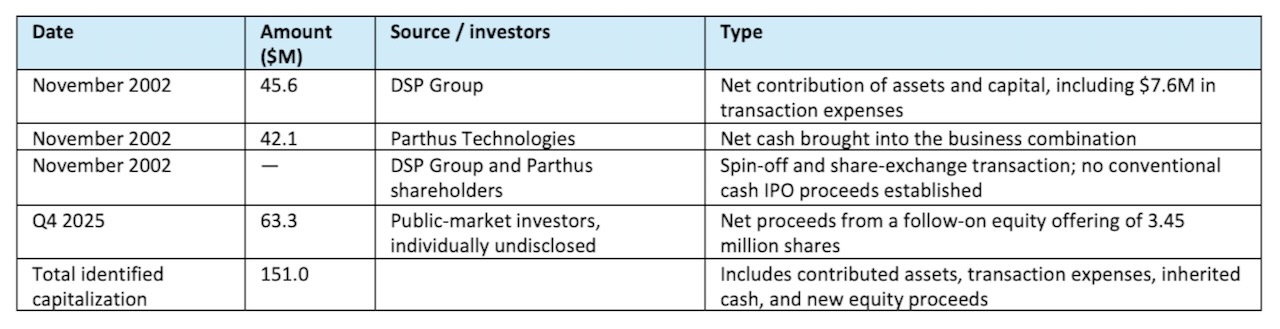
Table 3. Ceva funding history.
What do we think?
Regulus gives Ceva a production reference and Mobilint a commercial evaluation platform. We see practical value in coordinating sensing, signal processing, and inference around application requirements. The commercial test now involves compiler behavior, sustained performance, and complete-system energy. ISVs should bring their own models; CIOs should request deployment costs, support commitments, and evidence from representative field operations.
Inflection point. This announcement does not establish an inflection point in AI. It marks a production milestone for Ceva’s neural IP and demonstrates Mobilint’s integration of licensed processing engines into a commercial SoC. A broader shift would require repeatable application improvements, accessible development tools, and evidence that customers can deploy these systems economically. Regulus offers a platform for those measurements. Its significance will increase as developers demonstrate sustained local inference within practical energy budgets and as customers expand deployments across cameras, robots, and industrial equipment.
LIKE IT? THINK YOUR FRIENDS AND ASSOCIATES MIGHT? PLEASE SEND IT TO THEM WITH OUR BEST WISHES.