
AMD reported third-quarter 2026 revenue of $13.377 billion, up 45% year over year and 16% sequentially. GAAP gross margin reached 54%, operating income rose to $2.832 billion, and net income reached $2.428 billion, or $1.46 per diluted share. Non-GAAP gross margin was 56%, operating income reached $3.923 billion, and net income climbed to $3.471 billion, or $2.09 per diluted share. Data Center supplied almost two-thirds of company revenue as Instinct GPU shipments and Epyc server processor demand accelerated.
AMD increased revenue by $1.841 billion from the second quarter and $4.131 billion from a year earlier. GAAP operating income rose 42% sequentially and 123% year over year. The 21% GAAP operating margin gained four percentage points from Q2 and seven points from Q3 2025. Non-GAAP operating margin reached 29%, up two points sequentially. Those figures indicate that higher Data Center sales contributed to improved operating leverage as AMD expanded its product and systems portfolio.
“We delivered a record quarter, with revenue exceeding the high end of our guidance as Data Center segment sales nearly doubled year over year,” said Lisa Su, AMD chair and CEO. “Demand for our Instinct and Epyc products continued to strengthen, and we expect growth to accelerate further in the fourth quarter as we scale Helios and Venice production. With our leadership product portfolio and deep customer and supply chain relationships, we are confident in our ability to sustain very strong revenue growth and expanding profitability over the coming years.”
GAAP net income rose 6% sequentially, trailing the increase in operating income. AMD recorded a $1.097 billion change in the fair value of customer warrant liabilities during the quarter. That item enters the GAAP reconciliation and complicates comparisons between operating performance and bottom-line results. Non-GAAP net income rose 26% sequentially, while non-GAAP-diluted EPS increased from $1.66 to $2.09. Analysts should use the GAAP and adjusted measures together when comparing profitability.
“Third quarter revenue grew 45% year over- year to a record $13.4 billion, while non-GAAP earnings per share grew 74%, demonstrating the significant operating leverage in our business model as our Data Center business drives scale,” said Jean Hu, AMD executive vice president, chief financial officer, and treasurer. “Our fourth-quarter outlook reflects accelerating revenue and earnings growth, driven by strong demand across our Data Center portfolio.”
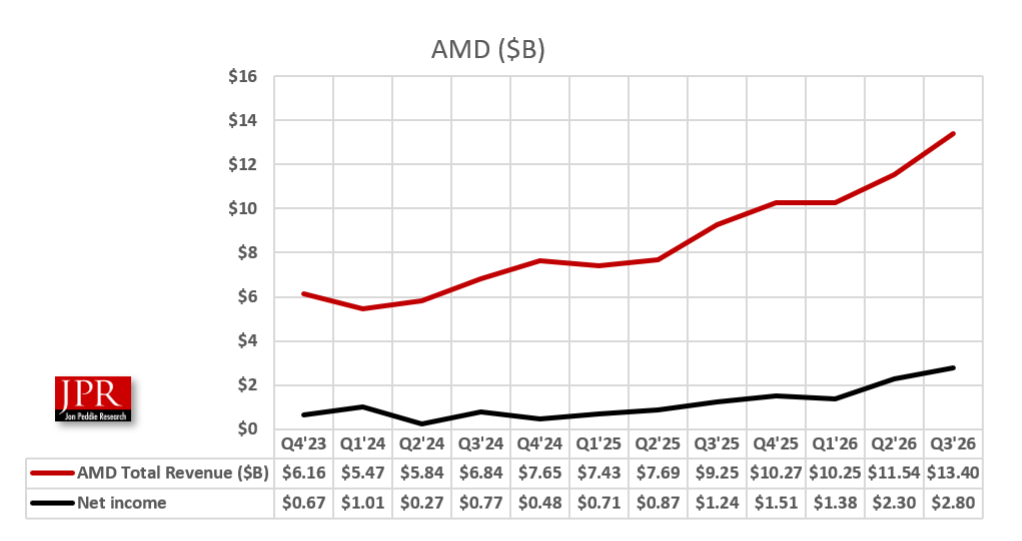
Figure 1. AMD revenue and net income over time. (Source: AMD and JPR)
Data Center revenue reached $8.546 billion, up 97% year over year and 27% from Q2. Segment operating income climbed to $2.882 billion from $2.103 billion in Q2 and $1.074 billion a year earlier. Operating margin increased to approximately 34%, compared with 31% sequentially and 25% a year ago. AMD attributes growth to Epyc demand and the launch of Instinct MI450-series GPUs. Data Center accounted for 63.9% of company revenue, compared with 58.2% in Q2.
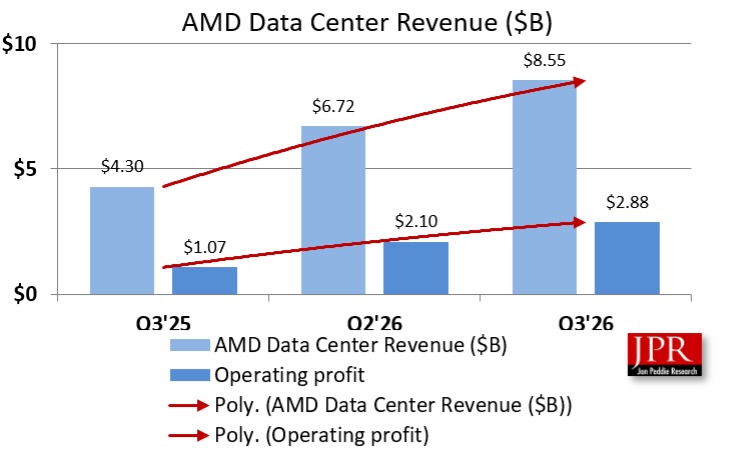
Figure 2. AMD’s Data Center results—sequential and year over year. (Source: AMD and JPR)
AMD says Anthropic, Meta, Microsoft, OpenAI, and Oracle Cloud Infrastructure now run workloads on the first Helios rack-scale systems. Helios combines Instinct MI450 GPUs with 6th-generation Epyc processors. The company also introduced its Helion reference architecture for configurable CPU and GPU infrastructure, and released ROCm 10 with updated libraries, compilers, frameworks, and ROCm.AI development capabilities. These moves extend AMD’s competitive effort beyond individual accelerators into rack-level integration and the software stack that determines usable application performance.
The company also announced agreements to acquire World Labs and Taalas. World Labs would add model research capabilities; Taalas would bring specialized inference silicon technology. Both transactions remain subject to closing conditions. For silicon teams, the proposed acquisitions illustrate AMD’s interest in combining general-purpose accelerators with specialized hardware and software capabilities. For hyperscalers, the critical measures remain delivered capacity, networking behavior, software portability, and total system cost.
Client and Gaming segment revenue totaled $3.722 billion, down 8% year over year and 3% sequentially. Segment operating income fell to $573 million from $582 million in Q2 and $867 million a year earlier. The consolidated figure masks different trends. Client revenue reached approximately $2.949 billion, up 7% year over year, supported by Ryzen mobile processors. Gaming revenue fell to $773 million, down 40% year over year, reflecting lower semi-custom and graphics sales.

Figure 3. AMD’s new consolidated client results—sequential and year over year. (Source: AMD and JPR)
AMD expanded the Ryzen AI Halo platform with Ryzen AI Max Pro 400-series systems for developers and creators running local models. HP, Lenovo, Framework, and GMKtec broadened system availability. AMD also introduced the Threadripper Halo Station, pairing a Threadripper 9955WX processor with Instinct MI350p graphics for large local-model workloads. These products address workstation and developer requirements, including memory capacity, software support, and local inference economics. The reported client sales increase offers evidence of demand for Ryzen products; AMD has not separated revenue attributable specifically to AI PC features.
Gaming represented approximately 5.8% of AMD’s total revenue in Q3, compared with 6.7% in Q2 and about 13.5% a year earlier. Semi-custom sales remain sensitive to console product cycles, while discrete graphics faces its own pricing and product competition. The lower gaming contribution changes AMD’s overall revenue mix and increases the importance of Data Center execution for consolidated growth.
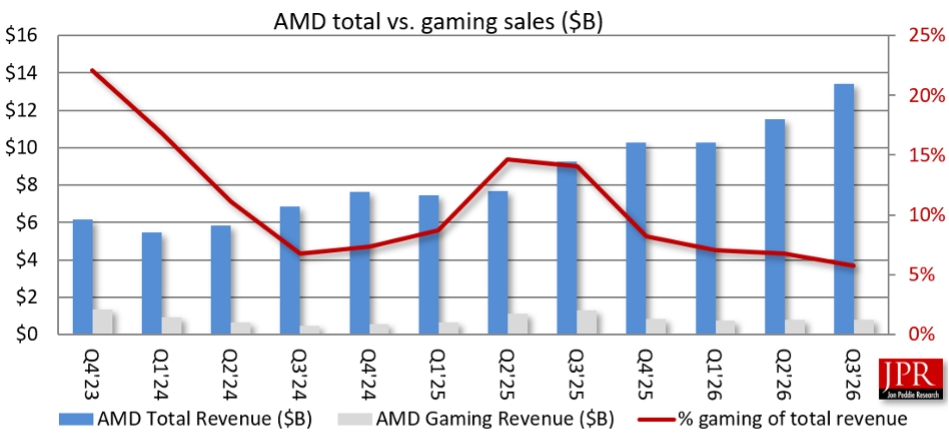
Figure 4. Total sales versus gaming sales over time. (Source: AMD and JPR)
Embedded revenue reached $1.109 billion, up 29% year over year and 14% sequentially. Segment operating income increased to $453 million, compared with $386 million in Q2 and $283 million in Q3 2025, citing aerospace and defense, automotive, communications, and industrial markets. It also began sampling a space-grade Versal AI Core adaptive SoC and introduced Ross, an agentic tool for embedded system design. Embedded now contributes a smaller share of company sales than Data Center, although its 41% operating margin provides a meaningful contribution to profitability.
Outlook
For Q4 2026, AMD forecasts approximately $17 billion in revenue, plus or minus 3%, implying a range of $16.49 billion to $17.51 billion. The midpoint represents 66% year-over-year growth and 27% sequential growth. AMD expects a non-GAAP gross margin near 55% and operating expenses around $3.75 billion. The outlook assumes continued expansion in Data Center products and the production ramp of Helios and Venice. Meeting that forecast will require substantial quarterly growth in supply, customer deployments, and system integration.
At quarter end, AMD held $15.776 billion in cash, equivalents, and short-term investments, and reported $7.079 billion in total debt. Inventories reached $11.463 billion, up 35% from Q2, while receivables climbed 26%. These balance-sheet movements warrant attention as AMD scales its GPU and rack-level business. Inventory availability can support shipments, while inventory composition, conversion into revenue, and collection timing will determine working-capital efficiency. The earnings release does not provide sufficient detail to assign those changes to particular product families.
What do we think?
AMD’s Data Center business now drives revenue growth and operating leverage. Epyc demand and Instinct deployments lifted the segment to nearly 64% of sales. Client growth continues, while gaming contracted. We will watch Helios shipments, ROCm adoption, GPU margins, inventories, and customer concentration. Q4 guidance calls for another substantial step in revenue, making delivery and supply execution central to the investment case.
Inflection point. AMD’s Q3 results strengthen the case for an inflection point in its business mix: Data Center now generates nearly two-thirds of sales, with GPU systems and server CPUs supporting rapid growth. The results alone do not establish an industrywide AI inflection point. That would require sustained deployment economics, broad software compatibility, and competitive supply across multiple vendors. Helios adoption, MI450 shipment volumes, and the conversion of AMD’s Q4 outlook into realized revenue will help determine whether this quarter marks a lasting change.
AND IF YOU LIKED WHAT YOU READ HERE, DON’T BE STINGY, SHARE IT WITH YOUR FRIENDS.