
Across three CES announcements, Ceva is telling a coherent story: Its edge-AI IP isn’t an NPU in search of a socket, it’s a set of deployable building blocks that show up exactly where latency, determinism, and power budgets require. On the automotive side, SensPro lands in both NXP’s real-time SDV processors and BOS Semiconductors’ next-gen ADAS SoC, framing Ceva’s AI DSP as the glue between raw sensors and safety-critical control. In parallel, Ceva broadens NeuPro-Nano’s ecosystem with Sensory’s on-device wake word, reinforcing that always-on UX is becoming a default requirement in tiny, battery-first silicon.
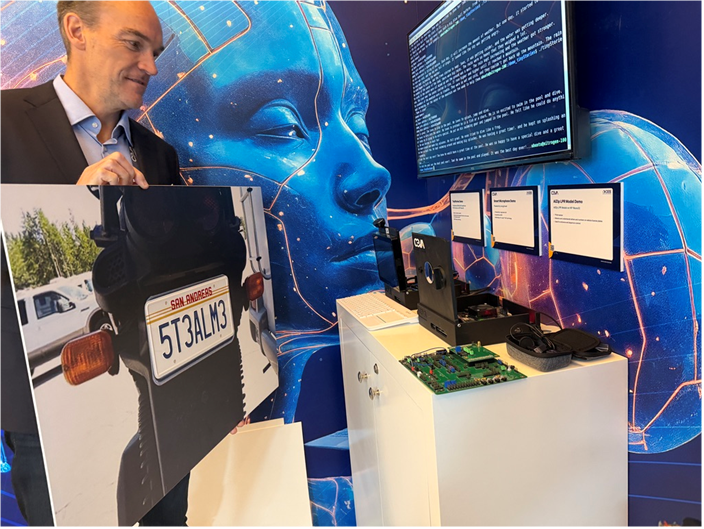
Richard Kingston, vice president, Market Intelligence, Investor & Public Relations at Ceva, Inc., demonstrates its image intelligence technology. (Source: JPR)
Ceva arrived at CES with three related messages, two squarely aimed at the software-defined vehicle transition and one that strengthens its smallest edge-AI NPU platform for consumer and AIoT devices.
First, BOS Semiconductors licensed Ceva’s SensPro AI DSP for its Eagle-A stand-alone ADAS SoC, positioning SensPro as the lidar and radar pre-processing engine that reduces perception latency before higher-level compute (NPU/CPU/GPU) takes over. BOS also leaned into a chiplet strategy, describing Eagle-A scaling alongside its Eagle-N AI accelerator using UCIe and PCIe links, an architectural hint that ADAS platforms are increasingly being built as modular, composable systems rather than monolithic SoCs.
“BOS is a great example of a company leveraging our full portfolio, from SensPro2 DSPs to NeuPro-Nano AI accelerators, to power next-gen ADAS and domain controller chips,” Richard Kingston, vice president, Market Intelligence, Investor & Public Relations at Ceva, told us. “It’s validation of our automotive AI strategy and our ability to scale from edge perception to centralized AI compute.”
Second, NXP integrated Ceva’s SensPro AI DSP into its S32Z2 and S32E2 real-time processors, which target domain and zonal control in software-defined vehicles. The announcement frames SensPro less as AI acceleration in the marketing sense and more as deterministic, safety-aware inference and control, enabling use cases like predictive analytics (battery lifespan, maintenance), driver monitoring, and in-cabin voice interfaces in a multi-application real-time environment. NXP (helpfully) wrapped this in a market narrative, citing software-defined vehicles growing from $213.5 billion (2024) to more than $1.2 trillion by 2030 (34% CAGR).
“We’ve designed these processors from the ground up with the automotive industry in mind. ASIL-B, functional safety, high compute density, and configurability were all central to the design,” Kingston told us. “We enable partners to optimize their SoCs for performance and power with a scalable and software-compatible roadmap from sensors to domain controllers.”
Third, Ceva broadened its non-automotive edge story: Sensory’s TrulyHandsfree wake word now runs on NeuPro-Nano, integrated into the NeuPro-Studio ecosystem so developers can prototype and deploy always-on voice activation without cloud dependency. Ceva’s angle here is pragmatic: Wake word is a feature checkbox that is expensive to do well at ultra-low power. And it’s easier to sell an NPU when the surrounding software content is already validated and productized.
“It’s not enough to just enable wake word or basic perception. Today’s cars need continuous vision processing, voice interaction, and sensor fusion across multiple zones,” Kingston explained. “Ceva’s architecture enables that with a unified DSP and AI platform.”
What do we think?
These three items are worth treating as one story because they expose Ceva’s actual strategy: be the edge-AI IP vendor that wins the unglamorous but unavoidable parts of the pipeline.
Automotive AI is focused on real-time everywhere, not headline TOPS. The BOS and NXP wins both sit in the messy middle ground of raw sensing, fusion, and control loops. That’s a good place to be if your value proposition is performance per watt plus determinism plus safety posture—especially as SDV architectures centralize compute and push more intelligence into zonal and domain controllers.
Meanwhile, Ceva’s expanding wake-word support for NeuPro-Nano signals a tighter integration of software with silicon. Ceva’s bet is that embedded voice, vision, and control are converging into multi-modal pipelines, and it wants to be the IP vendor bridging those use cases.
LIKE WHAT YOU SAW HERE? SHARE THE EXPERIENCE, TELL YOUR FRIENDS.