
China just revealed a homegrown exascale supercomputer—and it runs entirely on domestic CPUs, with no GPU accelerators in sight. LineShine, built at the National Supercomputing Center in Shenzhen claims 2 EFLOPS using Huawei’s LX2 Armv9 processors, custom interconnects, and Chinese storage. It’s a direct response to US export controls, and it demonstrates that China can build world-class HPC infrastructure without American chips. Whether the performance claims hold up at scale is an open question—but the strategic signal is unmistakable. LineShine proves export controls didn’t stop China’s HPC ambitions.
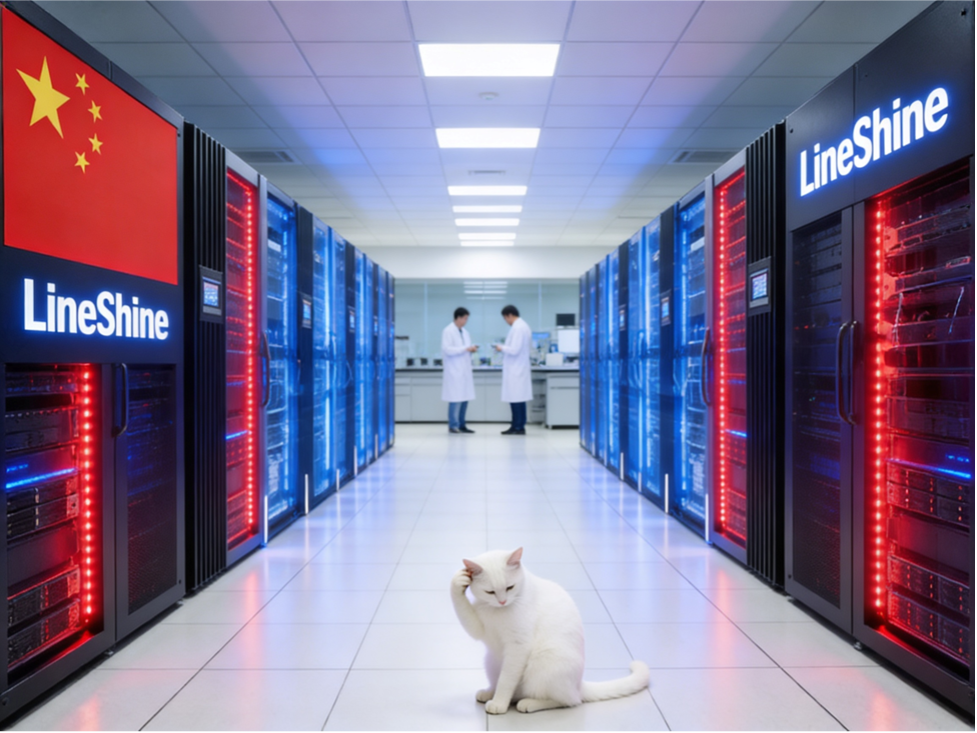
What? No NPUs?
China’s National Supercomputing Center in Shenzhen unveiled LineShine, an all-domestic exascale supercomputer built entirely from Chinese chips, networking, and storage. The system targets 2 EFLOPS of computing performance, which would place it among the fastest systems in the world—and make it by far the fastest all-CPU architecture ever deployed at scale.
LineShine deploys 20,480 computing nodes, each carrying two Armv9-based LX2 processors developed in China. Each LX2 integrates two compute dies totaling 304 cores, alongside eight on-package HBM stacks delivering 32 GB of capacity and 4 TB/s of aggregate memory bandwidth per processor. Each compute die also connects to 128 GB of off-package DDR5 memory across four NUMA domains. A dedicated SDMA engine handles data movement between DDR and HBM, and the LX2 supports FP64, FP32, FP16, and INT8 via SME and SVE vector units—delivering up to 60.3 TFLOPS in FP64 and 120.6 TFLOPS in FP32 per chip.
Node interconnects use LingQi, China’s proprietary high-speed fabric, arranged in a dual-plane multi-rail fat-tree topology providing 1.6 Tb/s of bandwidth per node. The full system includes 47,000 CPUs across 92 compute cabinets, a 1 million-port interconnect, 36 networking cabinets, 67 storage cabinets, 428 storage nodes, 10 TB/s of storage bandwidth, and 650 PB of total storage capacity. The system builds out in two phases, with phase one already using 100 Huawei Kunpeng servers totaling 12,800 cores.
For context: Lawrence Livermore National Laboratory’s El Capitan, currently the fastest machine on the TOP500 list, delivers 1.8 EFLOPS of proven Linpack performance and 2.8 EFLOPS theoretical peak—using AMD Instinct GPU accelerators. LineShine’s 2 EFLOPS claim is all-CPU. That matters architecturally: GPU-accelerated systems achieve peak FLOPS by concentrating massive parallelism in high-throughput accelerators tuned for dense matrix math. An all-CPU exascale system represents a fundamentally different design philosophy, trading raw AI throughput for greater flexibility across workload types—scientific computing, molecular dynamics, fluid simulation, and AI training all run on the same hardware without workload-specific accelerator tuning.
China stopped submitting Linpack results to TOP500 in 2019 following US semiconductor export restrictions. The LineShine announcement represents a deliberate public statement that those restrictions failed to halt China’s HPC development. Li Xiaoli, deputy director of the Shenzhen Science and Technology Innovation Bureau, described the system as demonstrating “complete self-reliance and controllability across the entire stack.” That framing goes well beyond benchmark claims—it positions LineShine as proof of sovereign computing infrastructure.
The center states that LineShine, combined with its domain-oriented intelligent software platform, targets internationally leading performance in molecular dynamics, fluid simulation, life sciences, and large-scale AI model training—a broad set of workloads that historically required heterogeneous compute mixes rather than homogeneous CPU arrays.
What do we think?
The 2 EFLOPS claim needs independent validation—China has not submitted Linpack benchmarks to TOP500 since 2019, and “theoretical peak” figures regularly exceed sustained performance by a wide margin. The LX2’s FP64 figures are impressive for a CPU, but GPU-accelerated systems still dominate AI training throughput at equivalent power. The real story isn’t the benchmark—it’s that China built a credible exascale system entirely from domestic components. That’s the capability the export controls were meant to prevent.
LineShine marks an inflection point in the global HPC and AI sovereignty race. For years, US export controls operated on the assumption that cutting off access to advanced GPUs and interconnects would cap China’s HPC ceiling. LineShine demonstrates that China engineered around that constraint—not by matching GPU architectures but by scaling CPU compute to exascale using entirely domestic silicon, fabric, and storage. The inflection point isn’t that China built a fast computer. It’s that the export control strategy now faces a system it wasn’t designed to stop.
We are tracking AI processors and have logged 230 devices from 141 companies, and not one of them is in this new Chinese supercomputer.
LIKE WHAT YOU’RE READING? TELL YOUR FRIENDS; WE DO THIS EVERY DAY, ALL DAY.