
Suzhou Denglin Technology has joined the Hong Kong Stock Exchange, giving investors a closer look at China’s growing enterprise GPU industry. The company raised HK$1.41 billion on November 10, 2026, and reported nine-month revenue exceeding RMB500 million, along with cumulative shipments of more than 27,990 GPUs. Denglin currently focuses on cost-efficient inference processors for enterprise and edge applications. Its next products will target larger AI data centers, where memory bandwidth, software compatibility, and dependable deliveries will determine commercial success over the coming years.

Suzhou Denglin Technology listed on the Hong Kong Stock Exchange on November 10, 2026, under ticker 9917.HK. The Chinese general-purpose GPU (GPGPU) developer priced its shares at HK$231 (US$29.44), the bottom of its marketed range, and raised HK$1.41 billion (US$179.9 million) in gross proceeds. Net proceeds reached approximately HK$1.31 billion (US$167.16 million).
Shares opened at HK$229 and closed the first session at HK$213, a 7.8% decline from the offering price. Retail investors subscribed for 2.11 times their allocation, while international investors subscribed for 1.34 times theirs.
Denglin plans to direct much of the capital toward upgrading its current processors, developing higher-performance GPUs, expanding its software tools, and entering additional markets.

Table 1. Denglin’s IPO terms and first-day trading performance.
The offering provides capital for an established inference business and a more ambitious data center roadmap. Investors now have a public-market mechanism for evaluating Denglin’s financial performance and product execution.
Revenue and GPU shipments accelerate
Denglin reported unaudited revenue exceeding RMB500 million (US$75 million) for the nine months ending September 30, 2026, approximately 592% above the comparable 2025 period. The growth reflects expanding shipments and a relatively small prior-year revenue base.
The company reported 123 cumulative customers. Its five largest customers contributed 68.8% of nine-month revenue, compared with 90% for the four months ending April 30. The three largest customers accounted for 50.7%.
Denglin also reported cumulative GPGPU shipments exceeding 27,990 units. The company has not disclosed how many of those processors shipped during 2026 alone.
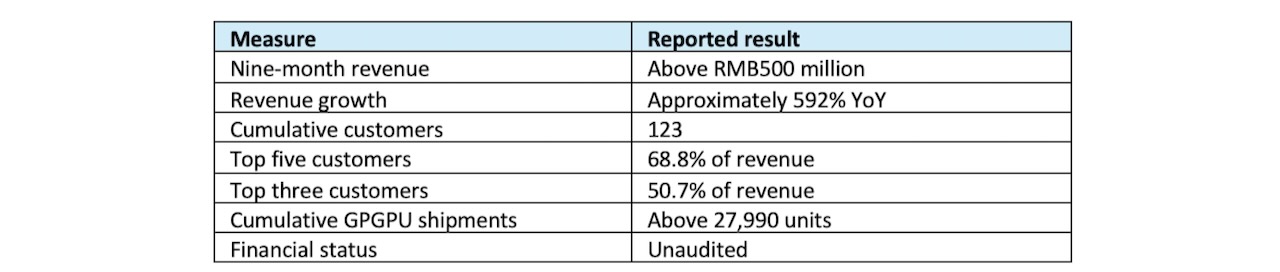
Table 2. Denglin’s financial and operational figures through September 2026.
The figures indicate increasing commercial activity and some improvement in customer diversification. Customer concentration remains substantial, and the company cautions that its unaudited results may change.
From enterprise inference to data centers
Denglin began operations in Shanghai in 2017 and moved its headquarters to Suzhou, China, in 2024. Its current GPU products target inference applications that emphasize power consumption, deployment cost, and compatibility with enterprise software.
The company offers processors with power ratings of 55 W, 95 W, and 130 W. Target applications include industrial AI models, private enterprise clouds, smart cities, industrial inspection, and edge computing.
Denglin’s KS-series GPUs have completed compatibility testing with major AI models. That work matters to ISVs and enterprise customers because software support, framework integration, and application migration influence processor adoption.
Frost & Sullivan ranks Denglin third in China’s enterprise AI GPGPU market, with approximately 1% market share.
The company’s next development phase targets larger AI installations. Denglin schedules Minsky IV for December 2026 and Minsky II for 2027. Its roadmap identifies HBM3e memory for those products, supporting higher-bandwidth workloads in AI data centers.
Denglin will encounter Nvidia and domestic suppliers, including Cambricon, as it expands beyond its current inference markets.
Product availability and pricing
Denglin has not disclosed the date of its first commercial GPU shipment. Its cumulative shipment figure confirms that customers received processors before September 30, 2026, although the company has not identified the initial shipping quarter.
The company also has not published an average selling price (ASP). Its nine-month revenue and cumulative shipment totals cover different periods, preventing a reliable ASP calculation. Revenue may also include products and services beyond individual GPUs.
For market tracking, the available commercial data support the following entries:

Table 3. Denglin processor availability, shipments, pricing, and roadmap.
The missing first-shipment date and ASP limit shipment-based revenue modeling. Future financial disclosures may provide enough information to estimate processor pricing and quarterly unit volumes.
Funding the next GPU generation
Denglin’s capital raise establishes a development path from its current inference processors to HBM3e-equipped data center products. The following diagram illustrates that commercial progression rather than an undisclosed internal chip architecture.

Figure 1. Denglin’s funded progression toward HBM3e data center GPUs.
The roadmap provides two dates for customers and investors to evaluate execution. Actual product availability, software maturity, system integration, and production volumes will determine how effectively Denglin converts its new capital into revenue.
What do we think?
Denglin has established a commercial inference GPU business and secured additional capital for expansion. Its revenue growth and cumulative shipments demonstrate customer activity, although concentration remains high and financial results remain unaudited. The Minsky roadmap introduces substantial development and commercialization requirements. We need verified shipment dates, ASPs, audited results, and evidence of sustained data center deployments before assessing its competitive position.
Inflection point. Denglin’s IPO marks a financing milestone for China’s domestic GPU industry. It gives an enterprise inference supplier access to public capital and introduces regular scrutiny of its operating performance. The listing alone does not establish an inflection point in AI computing. That requires competitive products, mature software, dependable manufacturing, and substantial customer adoption. Minsky IV and Minsky II will test Denglin’s ability to move into higher-performance data centers. Their commercial shipments will provide a clearer measure of progress than the IPO itself.
LIKE WHAT YOU SAW HERE? SHARE THE EXPERIENCE, TELL YOUR FRIENDS.