
FuriosaAI is expanding access to its RNGD inference accelerator in Europe through a deployment at Equinix’s Lisbon LS2 data center. The move gives European enterprises a local environment to evaluate Furiosa’s hardware on advanced models, supported by the company’s recently established Lisbon office. Europe’s AI ambitions are increasingly constrained by power availability, grid capacity, and the practical difficulty of deploying high-density AI systems without major data center upgrades.
(Source: Furiosa)
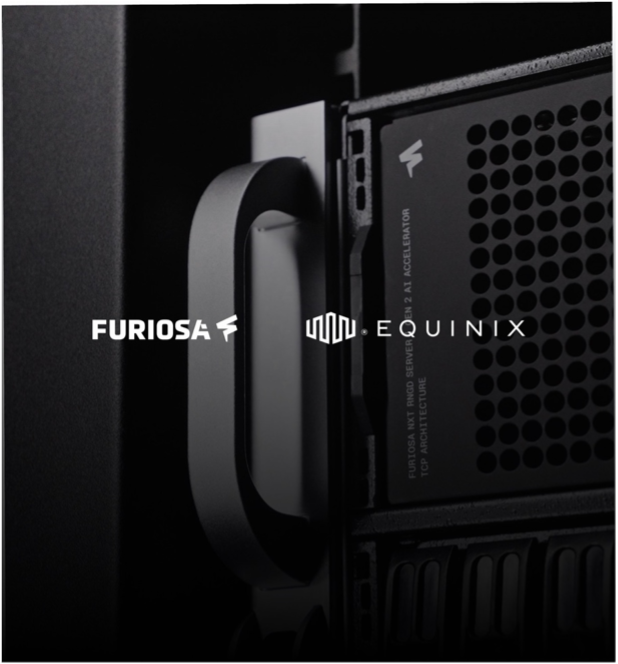
FuriosaAI has announced expanded European availability for its RNGD AI inference accelerator, with NXT RNGD servers being installed at Equinix’s Lisbon LS2 data center. The company says the deployment will allow European enterprises to evaluate RNGD’s performance and ease of use on cutting-edge models firsthand.
The Lisbon installation is being positioned as an initial step in a broader European expansion. Furiosa’s newly established flagship office in Lisbon will support commercial operations, customer and partner technical support, and R&D work focused on compilers, chip design, and PCB design.
RNGD is Furiosa’s inference accelerator for large language models and agentic AI. The chip is based on its proprietary Tensor Contraction Processor architecture, built on a 5 nm process, and delivers a claimed 512 TFLOPS of FP8 performance at a 180 W thermal design profile per accelerator. At the system level, Furiosa integrates up to eight RNGD accelerators in its NXT RNGD Server, a 3 kW-class inference system designed for production AI workloads.
Furiosa says RNGD can be deployed directly into standard, air-cooled data centers without liquid cooling or facility retrofits. The company also claims strong tokens-per-watt efficiency, supported by a software stack designed to reduce the need for large libraries of hand-tuned kernels.
June Paik, FuriosaAI co-founder and CEO, said: “By pairing Equinix’s infrastructure footprint designed for efficiency and sustainability with our high-performance, energy-efficient RNGD architecture, we unlock the ability for enterprises to run inference sustainably and reliably.”
The announcement coincides with the Raise Summit in Paris, a big AI shindig. There, Paik joins leaders from CoreWeave and Supermicro in a discussion on the power and scaling challenges facing global AI infrastructure, while Chief Research Officer Jeehoon Kang is presenting the roadmap for the company’s software stack.
Furiosa has also recently announced a partnership with Broadcom to develop its third-generation inference accelerator, aimed at hyperscale inference for frontier models with a trillion or more parameters.
What do we think?
It’s a modest deployment announcement with larger implications.
Europe wants AI infrastructure, but it does not have infinite power. In many markets, the bottleneck is no longer just accelerator supply or model demand; it is grid capacity, rack power, cooling, etc. Traditional AI infrastructure, especially systems designed around very high-power accelerators and liquid-cooled clusters, can be difficult to scale in environments where power delivery is already constrained.
RNGD is not being sold here as another brute-force AI engine chasing peak performance at any cost. The company is instead emphasizing inference efficiency, tokens per watt, standard data center deployment, and air cooling. In less AI-developed Europe, those are strategic features.
Take a look at our AI library, where, among things, we keep track of the 149 companies offering nearly 300 AI processors. JPR puts the “I” in AI (and because you will ask—Intelligence, market intelligence).
LIKE WHAT YOU SAW HERE? SHARE THE EXPERIENCE, TELL YOUR FRIENDS.