
FuriosaAI just closed a $620 million Series D at a post-money valuation near $2.9 billion, roughly four times its July 2025 figure. The Seoul, Korea, company builds the RNGD inference accelerator, now in mass production, with 20,000 units planned for 2026 and more than 40,000 for 2027. Korean enterprises including LG Group, Upstage, and Samsung SDS already run live services on it. We walk through the funding, the Tensor Contraction Processor architecture, the software stack, and the questions ISVs and CIOs should ask.
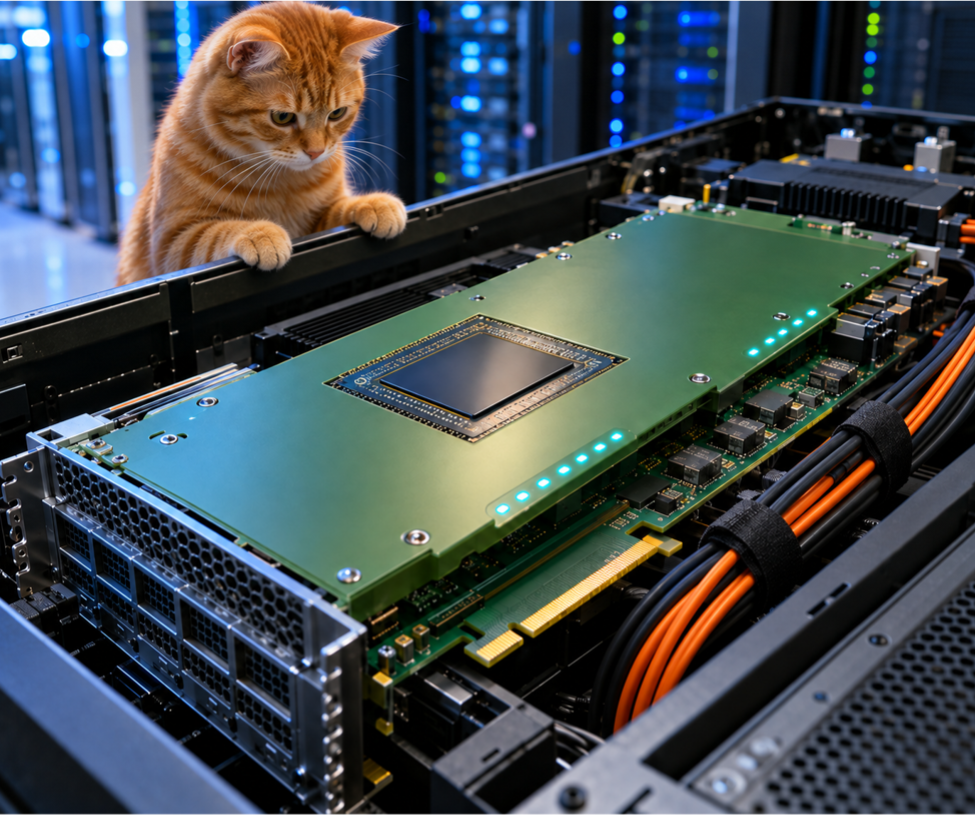
FuriosaAI announced a $620 million Series D financing round on October 29 in Seoul, Korea, reaching a post-money valuation near $2.9 billion. The round values the company at roughly four times its $735 million figure from July 2025. FuriosaAI plans to channel the capital into three programs: expanding RNGD accelerator production, strengthening its software ecosystem, and accelerating a third-generation processor it develops with Broadcom. The financing arrives nine months after RNGD entered mass production in January 2026, and it gives the company resources to convert named deployments into volume shipments.
Investors support the ramp
South Korea’s National Growth Fund committed $280 million and anchors the round. The fund carries a public mandate to expand national AI computing infrastructure and the domestic AI semiconductor ecosystem. International investors committed $110 million combined. Infinitum, a United States investment firm with long experience in AI semiconductors, led that tranche. QUDA Capital Partners of Singapore joined the round; its founder, Charlie Foo, held senior roles at Nvidia and Mellanox and serves as a principal adviser to FuriosaAI. Cisco Investments, NeoFort Holding of Abu Dhabi, Jericho Capital, and Worldline Capital complete the international list.
Existing shareholders committed $125 million in follow-on capital. Naver supplied the seed investment through its D2SF arm and returned through Naver Ventures in Silicon Valley. DSC Investment has backed every round since 2017, and KDB Capital participated as well. Nextrans and Kakao Investment, shareholders since the Series C bridge round, increased their commitments. The Korea Development Bank added $22 million, United Asset Management Company committed $30 million, and the Export-Import Bank of Korea and Hanwha Asset Management joined the round. The three headline categories total $515 million, and the release does not allocate the remaining $105 million by name.

Table 1. Series D commitments.
Tensor Contraction Processor
RNGD, FuriosaAI’s second-generation inference accelerator, runs on the company’s Tensor Contraction Processor (TCP) architecture. GPUs and many AI accelerators split model operations into fixed-size, two-dimensional matrix multiplications. TCP treats tensor contraction, a higher-dimensional operation, as the basic unit of work across hardware and software. Reconfigurable compute slices and deterministic execution complete the design: The compiler fixes the schedule ahead of time, and the hardware follows it without on-the-fly scheduling decisions. FuriosaAI says this organization reduces intermediate data movement and the energy it consumes. The RNGD card pairs the architecture with high-bandwidth memory and draws 180 W with air cooling. The company positions the card for power-constrained data centers: Operators cap power per rack, and an air-cooled 180 W card fits those racks without liquid-cooling retrofits.
Software determines accessibility
The software stack matters to ISVs as much as the silicon. Developers load models from Hugging Face, define them in PyTorch, and use a drop-in replacement for vLLM. Teams needing fine control can drop to the Tensor Contraction Language and a low-level virtual instruction-set architecture. Compiler quality decides how efficiently applications use TCP’s execution resources; model partitioning, tensor scheduling, and operator implementation determine achievable throughput.
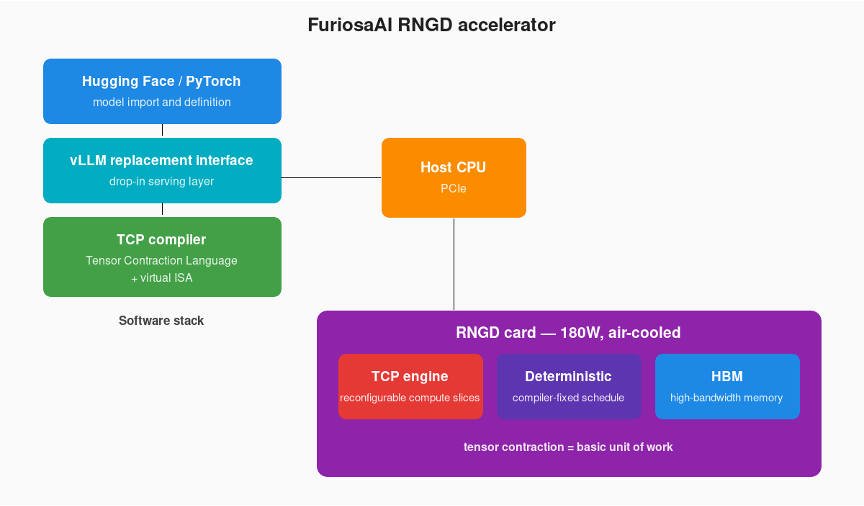
Figure 1. RNGD software stack feeds TCP engine inside 180 W card.
Framework compatibility reduces migration costs for enterprise IT departments and simplifies integration with established inference services. Long-term adoption depends on documentation, debugging tools, model coverage, and predictable behavior across hardware generations.
Reading the performance claims
FuriosaAI states that RNGD matches the throughput of Nvidia’s RTX Pro 6000 at the same card count and serves twice as many users per kilowatt. The release names no model, batch size, numerical precision, or latency target for the comparison, so ISVs and CIOs should treat the figures as vendor claims until independent tests confirm them. The power figure carries weight regardless: Many enterprise data centers cap rack power, and per-kilowatt results change facility capacity math. An accelerator that serves more users per kilowatt lets operators add inference capacity inside existing buildings and defer facility expansion.
Production and the third generation
FuriosaAI expects to build 20,000 RNGD accelerators in 2026 and says it secured supply chain and fab capacity for more than 40,000 units in 2027. Volume matters here; few companies have taken an advanced AI chip from design to volume production. A published schedule gives ISVs a supply they can plan around and gives CIOs a delivery commitment they can hold the vendor to. Actual shipments will depend on yields, component availability, customer orders, and deployment schedules.
The company also collaborates with Broadcom on a third-generation accelerator aimed at hyperscale infrastructure. The release discloses no tape-out date, process node, or specifications for that chip. The timeline will show whether FuriosaAI stays a power-efficiency specialist for enterprise racks or competes for hyperscale orders.
Customers in production
Three deployments show RNGD serving paying workloads. LG Group runs EXAONE language-model deployments on RNGD. Upstage serves live search summarization to millions of users. Samsung SDS launched a commercial NPU as a- Service on RNGD in July 2026. The mix covers a conglomerate, an AI software company, and an IT services provider, and it spreads deployment risk across buyer types. The release gives no unit counts, contract values, or utilization rates for any of them.

Table 2. RNGD deployments.
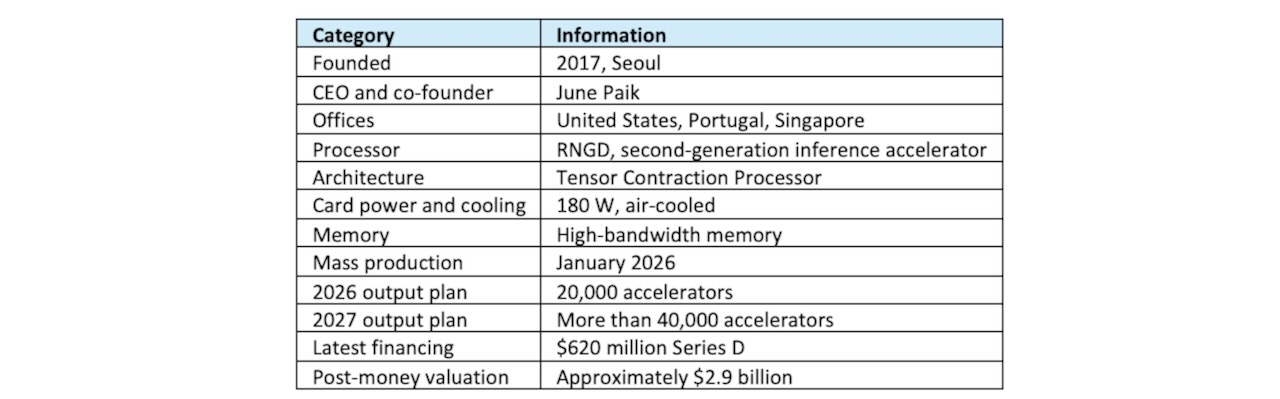
Table 3. Company and processor profile.
For enterprise buyers, the round adds a second qualified inference supplier with volume shipments and live deployments. Silicon teams gain a distinct architecture to evaluate against GPU baselines across tokens per watt, cost per token, and deployment friction. The next evidence comes in shipment counts, customer expansions, and third-generation disclosures. RNGD now ships repeat volume orders after sampling and qualification, and the 2027 plan doubles output for customers already running production services. Those numbers will determine whether the $2.9 billion valuation holds.
What do we think?
FuriosaAI has done what many inference start-ups have not: It reached mass production and named paying customers. The $2.9 billion valuation rewards that execution. The throughput and users-per-kilowatt claims come from FuriosaAI, and the release lists no test conditions. ISVs should test the vLLM path now, and CIOs should request independent per-kilowatt results before committing rack capacity in 2027.
Inflection point. Inference economics now hinge on power. Data centers face fixed power envelopes, and operators measure success in tokens per watt and users per kilowatt. RNGD ships in volume and claims GPU-class throughput at 180 W, so procurement teams can test a power-led architecture against incumbent fleets. That combination marks an inflection point in AI infrastructure: Efficiency now leads purchase criteria for inference capacity. ISVs gain a second compiler target with vLLM compatibility. If shipments double in 2027 as planned, the shift gains evidence.
FuriosaAI’s RNGD increases the number of AI processors to 363 being provided by 158 suppliers, all of which are covered in our AI Processor quarterly update series, and in more detail in our AIP Management Information System tracker. FuriosaAI is now poised for an IPO, and we expect to see that announcement in 2027—most likely at the end of the second quarter. Meta Platforms reportedly offered around $800 million to acquire FuriosaAI in early 2025, and FuriosaAI turned it down, indicating the company doesn’t see an acquisition as its exit strategy.
For more information on the AI processor market, visit our AI Processor library, which offers several free white papers and reports.
LIKE WHAT YOU’RE READING? DON’T KEEP IT A SECRET, TELL YOUR FRIENDS AND FAMILY, AND PEOPLE YOU MEET IN COFFEE SHOPS.