
China’s Denglin Technology has cleared a Hong Kong Stock Exchange listing hearing and plans to raise $300 million to $400 million. The Suzhou-based GPGPU developer sold 10,344 processors during the first four months of 2026, generating approximately $25.1 million in product revenue. Its low-power accelerators target enterprise inference, industrial applications, and private clouds. Denglin’s roadmap includes HBM3E-equipped products for larger computing centers. Meanwhile, Cambricon’s expanding revenue and inventory illustrate the opportunities and financial demands facing China’s domestic AI processor industry.
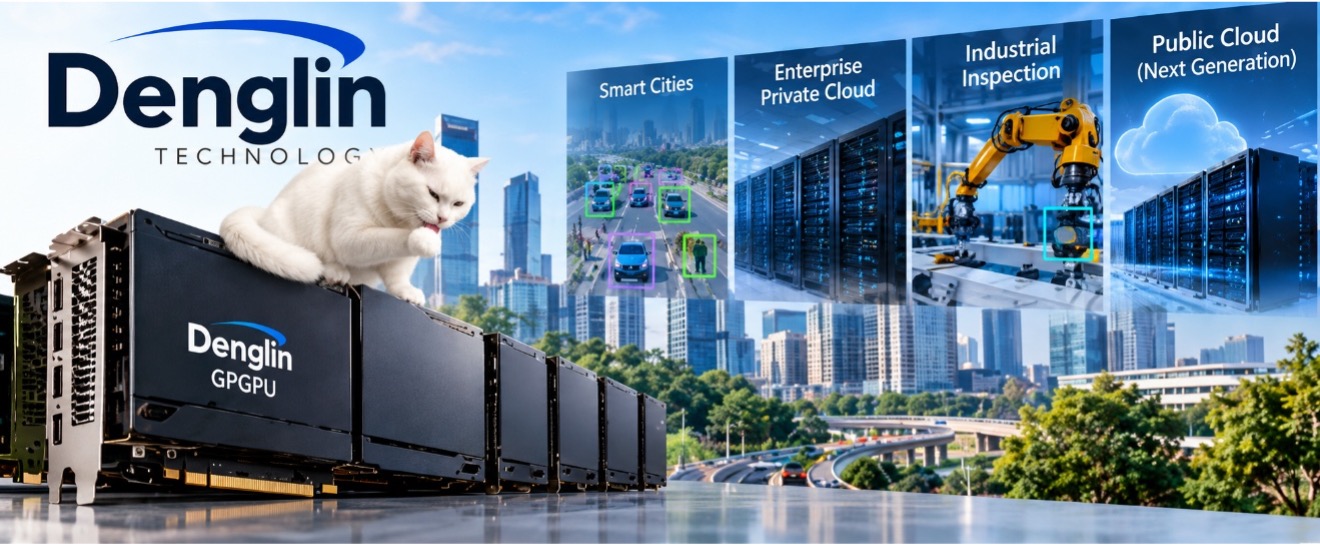
Denglin Technology has passed its Hong Kong Stock Exchange listing hearing, moving the Suzhou, China-based GPGPU developer closer to a public offering under Chapter 18C of the exchange’s specialist technology company rules. The company reportedly plans to raise $300 million to $400 million at a pre-IPO valuation of approximately CNY 7.2 billion ($1.1 billion).
The October 25 hearing marks another step in China’s effort to develop domestic AI computing suppliers. Denglin enters the public market process with established product shipments, growing revenue, and a roadmap extending from enterprise inference to larger cloud installations.
During the first four months of 2026, Denglin sold 10,344 GPGPU units and generated CNY 166.752 million ($25.1 million) in product revenue. Technical services contributed another CNY 33.613 million ($5.1 million), bringing total revenue to CNY 200.365 million ($30.1 million).
Dividing product revenue by unit shipments produces an average selling price of approximately CNY 16,120 ($2,430) per processor. That calculation provides a useful reference for Denglin’s position in the Chinese accelerator market, although the disclosed information does not establish the product mix or individual card prices.
The company’s business focuses on applications that require affordable inference processing, domestic procurement eligibility, and compatibility with existing computing infrastructure.
Enterprise inference defines the current market
Denglin identifies six principal application areas: smart cities, enterprise private clouds, education, industrial-quality inspection, industry-specific large models, and system integration.
Its customers include solution providers, OEMs, and system integrators operating across Beijing, Hangzhou, Shanghai, Suzhou, Shenzhen, and Chengdu. These customers frequently deploy inference workloads in established facilities with limited electrical capacity and conventional server cooling. Their applications include video analytics, defect detection, image recognition, and industry-specific AI models.
Denglin’s three product generations carry maximum power specifications of 55 W, 95 W, and 130 W. The company associates those figures with its Goldwasser I, Goldwasser II, and KS families. Those power envelopes may allow integrators to install accelerator cards in existing servers without extensive electrical or cooling modifications. Actual compatibility depends on PCIe interfaces, mechanical dimensions, airflow, host software, and available power connectors.
For CIOs, the purchasing decision extends beyond processor throughput. Deployment costs include server modifications, software migration, operating expenses, vendor support, and the ability to maintain equipment over several years.
Denglin’s positioning addresses these requirements through relatively low-power hardware and domestic technical support.
Customer concentration creates exposure
Denglin’s early commercial progress also reveals substantial customer concentration. Its five largest customers accounted for 90.4% of revenue during the first four months of 2026. The largest customer alone contributed 38%.
Such concentration makes quarterly revenue sensitive to purchasing decisions by a small group of integrators and enterprise customers. Changes in deployment schedules, project financing, or procurement approvals could materially affect shipments.
Technical services also contribute to the business model. They represented 32.3% of total revenue in 2025.
The company’s prospectus describes these activities as transitional and complementary. They include chip design services and intellectual property architecture licensing, alongside work that supports customer deployments.
Investors will need to distinguish recurring processor sales from individual engineering contracts when evaluating revenue growth and margins.
According to Frost & Sullivan figures, Denglin ranked among China’s 10 largest GPGPU suppliers by 2025 revenue, with less than 1% of the overall market. It held approximately 1% of the enterprise AI segment, ranking third under that classification. Those figures indicate an established commercial presence within a fragmented market.
Funding supports a broader product roadmap
Denglin’s shareholders reportedly include the China Internet Investment Fund, Qualcomm China, Hikvision Fund, Zhongxin Venture Capital, and Orient Semiconductor Electronics. The company held approximately CNY 449 million ($67.5 million) in cash at the end of April 2026. Its 2025 research and development expenditure reached CNY 238 million ($35.8 million). Denglin also reported adjusted net profit of approximately CNY 20.58 million ($3.1 million) for the first four months of 2026.
Its planned offering would provide additional capital for product development, manufacturing commitments, and commercial expansion.
The company expects to introduce next-generation products in two phases, beginning in December 2026 and continuing during the second half of 2027. The later phase targets large intelligent computing centers and public cloud operators, with HBM3E or comparable advanced memory technology. This roadmap introduces additional architectural requirements. Cloud accelerators must address memory bandwidth, interconnect performance, multi-card scaling, model compatibility, and sustained utilization.
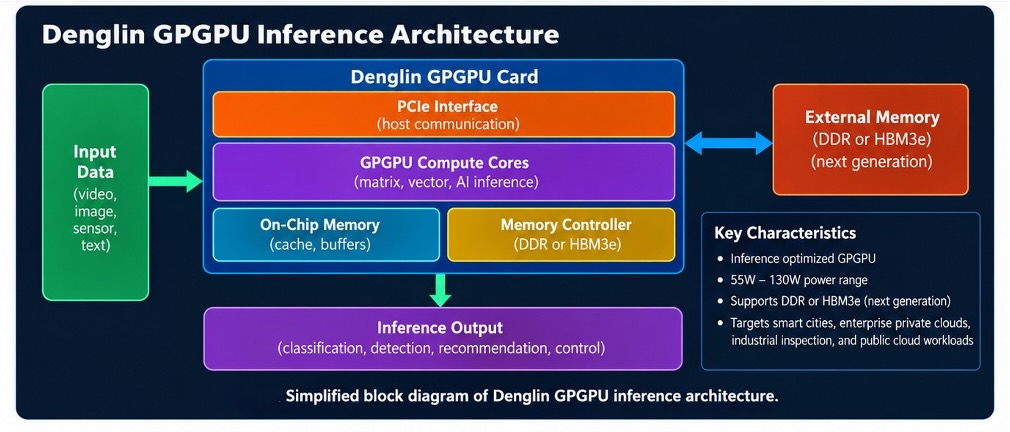
Figure 1. Conceptual block diagram of Denglin GPGPU.
Software development will carry particular importance. ISVs need reliable compiler support, operator libraries, debugging tools, and compatibility with established AI frameworks.
For silicon teams, advanced memory integration also introduces packaging, thermal, signal-integrity, and supply chain considerations.
Cambricon illustrates another growth path
Cambricon provides a useful comparison within China’s domestic AI processor industry. At its October 26 earnings briefing, the company reported revenue of CNY 9.526 billion ($1.4 billion) for the first nine months of 2026, an increase of 106.76% year over year. Net profit attributable to shareholders reached CNY 3.715 billion ($558.2 million), while gross margin stood at 56.53%. Third-quarter revenue reached CNY 3.531 billion ($530.5 million), and the company reported its third consecutive profitable quarter.
Cambricon attributed its revenue primarily to cloud products, including chips, accelerator cards, and supporting hardware and software platforms.
The company has adapted its software to Chinese AI models including DeepSeek, Qwen, GLM, Kimi, and MiniMax. Its Triton-MLU initiative connects the Triton programming model to its MLU hardware backend. That work addresses a commercial requirement for AI processor suppliers: Customers need familiar programming environments and established model support to justify hardware migration.
Cambricon is also investigating multi-machine, multi-card interconnect technology and an associated switch chip.
Inventory raises financial questions
Cambricon’s rapid expansion has increased its working-capital requirements. Inventory reached CNY 11.665 billion ($1.8 billion) at the end of September, compared with CNY 4.944 billion ($742.8 million) at the end of 2025. Prepayments increased from CNY 745 million to CNY 3.044 billion during the same period. Together, inventory and prepayments reached CNY 14.709 billion ($2.2 billion).
Cambricon recorded CNY 501.6 million ($75.4 million) in inventory write-down provisions during the first nine months, citing aging raw materials from earlier strategic purchases.
The company has not disclosed how much inventory corresponds to confirmed customer orders. It also rejected reports attributing a forecast of more than 1 million chip shipments in 2027 to management.
These figures illustrate the financial commitments involved in scaling an AI processor business. Wafer reservations, packaging capacity, component inventories, and customer payment schedules can absorb substantial capital before suppliers recognize revenue.
Denglin and Cambricon illustrate different stages of China’s domestic accelerator market. Denglin has established a commercial base in lower-power enterprise inference and seeks capital to expand its product range. Cambricon has achieved considerably greater revenue scale while committing substantial resources to inventory and future production. Both companies must demonstrate sustained demand, competitive software ecosystems, and predictable manufacturing economics as Chinese AI infrastructure investment continues.
Denglin Technology: Financial and operating indicators
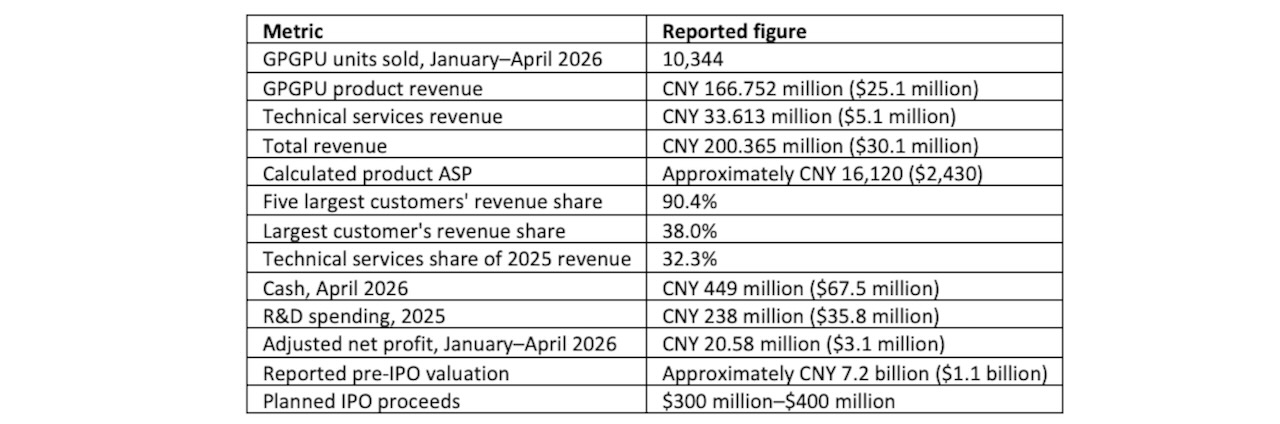
Table 1. Denglin Technology’s financial performance, GPGPU shipments, and operating indicators through April 2026.(Source: Figures attributed in the supplied report to Denglin Technology’s Hong Kong Stock Exchange post-hearing information pack. Dollar equivalents are approximate.)
Cambricon: Growth and working-capital indicators
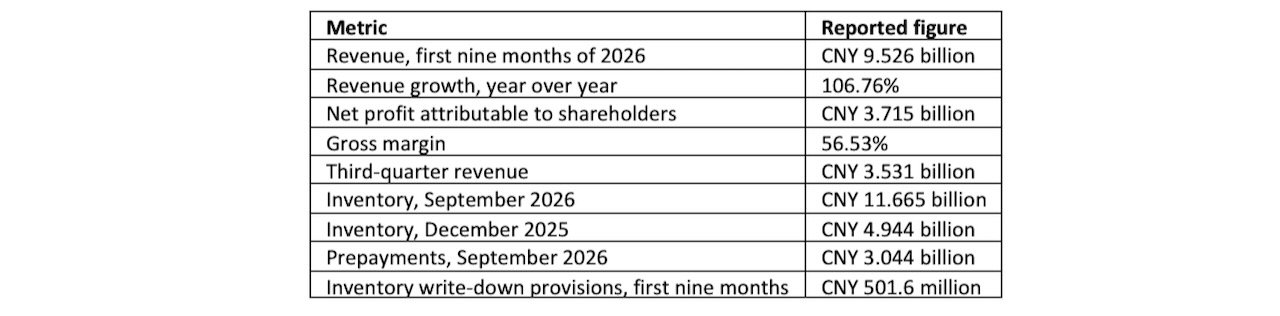
Table 2. Cambricon’s revenue growth, profitability, and working-capital indicators through September 2026. (Source: Figures attributed in the supplied report to Cambricon’s October 26, 2026, earnings briefing.)
What do we think?
Denglin’s shipments establish commercial activity, and its low-power products address practical enterprise deployment requirements. Customer concentration, limited market share, and an ambitious cloud roadmap introduce execution risks. Cambricon demonstrates the revenue potential of domestic accelerators alongside substantial working-capital commitments. We expect software compatibility, manufacturing capacity, customer diversification, and sustained product margins to determine both companies’ long-term competitive positions.
Inflection point. Denglin’s proposed IPO and Cambricon’s revenue expansion suggest China’s domestic AI processor industry is progressing toward broader commercial deployment. An inflection point will emerge when suppliers establish sustained shipments, competitive application performance, and software environments that support customers beyond policy-driven procurement. Denglin’s move toward HBM3E-equipped cloud products will test its ability to scale beyond enterprise inference. Cambricon’s inventory growth highlights the capital requirements accompanying that transition. The industry’s significance lies in converting domestic demand into durable processor businesses with measurable economics.
The source reports that Denglin passed its listing hearing; it does not establish that the IPO has closed. The fundraising, valuation, and future product dates, therefore, remain reported plans. The figures above come from the supplied material and have not undergone independent verification.
LIKE WHAT YOU’RE READING? TELL YOUR FRIENDS; WE DO THIS EVERY DAY, ALL DAY.