
Oxmiq Labs isn’t trying to build another GPU. Raja Koduri’s Campbell, California, start-up wants to become the Arm of AI silicon—licensing GPU IP, chiplet assembly tools, CUDA portability software, and data center orchestration to the companies that want to build their own AI processors without starting from scratch. With $60 million raised across two rounds and a 2 GW AI factory partnership in India already signed, Oxmiq is moving from stealth to production faster than most people expected.

Raja Koduri (Source: Oxmiq)
The AI industry built its first decade on merchant GPUs. That model served hyperscalers well during the initial generative AI build-out, but it left system builders with two options: buy what Nvidia sells, or spend hundreds of millions designing a custom processor from a blank sheet. Raja Koduri founded Oxmiq Labs in 2025 to create a third option—licensable GPU IP, configurable chiplet tools, and software that makes hardware choices transparent to developers.
Koduri’s CV runs through ATI, Apple, AMD, and Intel. He led discrete graphics at AMD during its Radeon R9 era, ran Intel’s Xe GPU program, and managed Apple’s GPU architecture group before that. He understands better than most how long GPU software ecosystems take to mature and how completely developers’ tool dependencies dictate hardware adoption. Oxmiq’s entire architecture reflects that understanding. The company does not need customers to buy a GPU. It needs customers to adopt a platform.
Financial foundation
Oxmiq closed a $35 million Series A round co-led by Fundomo and Samsung Catalyst Fund in July 2026, lifting total capital to $60 million. The full investor list spans the AI infrastructure supply chain: MediaTek, AM Intelligence Labs, Pegatron Venture Capital, CDIB-TEN, Darwin Ventures, Morgan Creek Digital, and Intel Capital joined the round alongside earlier seed investors. The seed round in August 2025 brought in $20 million with MediaTek and Tenstorrent participating.

Table 1. Key investment rounds. (Source: Various)
Jim Keller and Intel veteran Valluri “Bob” Rao joined the board alongside the Series A close. That combination—Koduri founding, Keller advising, Samsung and Intel Capital backing—gives Oxmiq access to semiconductor customers that normally avoid young GPU IP suppliers.
The company runs roughly 45 employees today and intends to grow toward 60–70, with a long-term ceiling below 100. Koduri argues that senior engineers equipped with agentic AI tools now cover more ground than equivalent teams could two years ago. That claim is also a business model—Oxmiq stays small, licenses IP, draws on strategic partners, and avoids the fixed cost structure of a merchant chip company.
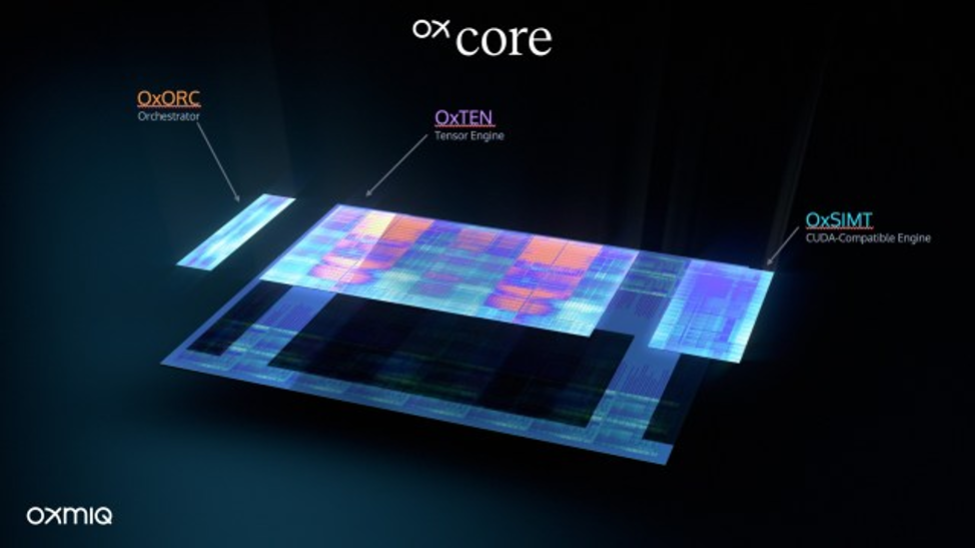
Figure 1. OxCore integrates CUDA-compatible GPU cores, tensor cores, and an orchestration engine into a single licensable IP block. (Source: Oxmiq Labs)
One core, three engines
OxCore is the IP block at the center of the stack. It integrates a CUDA-compatible GPU engine, a Google-like tensor processing engine, and an orchestration engine into a single licensable unit. The orchestration engine is the part worth paying attention to—it acts as CPU-like control logic inside the compute block, coordinating model execution, tool calls, memory movement, scheduling, and workload distribution. That design targets agentic AI workloads, where inference isn’t a single model call but a sequence of decisions, retrievals, and executions that need tight coordination.
OxCore runs on FPGA today as a demo unit. FPGA demonstrations don’t prove production silicon performance, but they do prove that the architecture and software stack have moved beyond concept. For silicon teams evaluating IP licenses, that matters. Hardware adoption depends on software confidence that must exist long before tape-out.
OxQuilt: Chiplets as configuration
OxQuilt may be the most underappreciated part of the announcement. Everyone in the semiconductor industry talks about chiplets. Oxmiq is building the software tooling that lets customers assemble them—mixing compute, memory, I/O, and packaging choices the way a system integrator mixes components, across logic nodes, DRAM types, interconnect standards, and advanced packaging options.
That configurability changes the procurement model. A high-throughput token service needs one type of a ratio of compute, memory, and I/O. A low-latency inference system needs another. A customer operating under a strict megawatt or CapEx ceiling may choose an older process node, more SRAM, less DRAM, or a different chiplet mix. OxQuilt gives Oxmiq a way to serve all of those customers from the same underlying IP without re-spin costs. Semiconductor companies, neocloud providers, and AI infrastructure builders can prepay for tape-outs and production capacity when the custom cluster economics justify it, rather than betting on merchant silicon allocation.
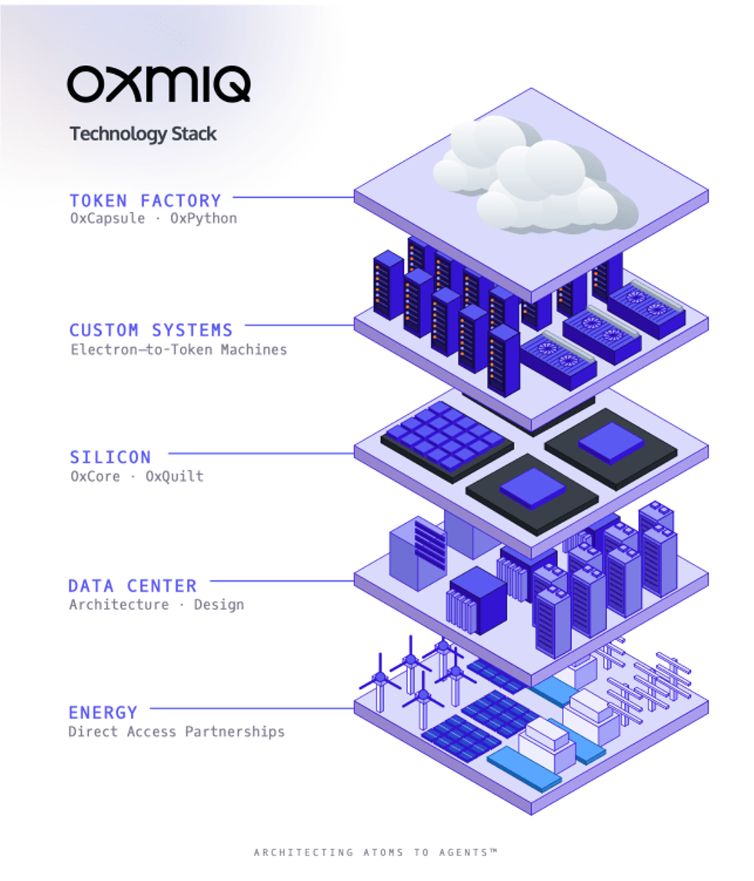
Figure 2. Oxmiq’s new technology stack includes data center design. (Source: Oxmiq Labs)
OxPython: Software is the real product
Developers don’t buy hardware. They buy software ecosystems.
OxPython lets developers run existing CUDA and PyTorch applications on OxCore-powered or third-party hardware without modifying source code. Oxmiq has already demonstrated OxPython on Tenstorrent platforms, the first external validation that the portability layer works on production third-party hardware.
That matters because CUDA doesn’t stand alone in a data center. Drivers, runtimes, orchestration tools, monitoring, model-serving stacks, and operations workflows all assume Nvidia hardware. A non-Nvidia rack can fail to earn revenue from Day One if software bottlenecks prevent utilization. OxPython addresses exactly that failure mode. If it performs as described, it gives infrastructure buyers a credible migration path rather than a forced rewrite.
From Electrons to tokens
Koduri uses the phrase “electron-to-token” to describe Oxmiq’s optimization target. Most AI silicon companies optimize for FLOPS. Hyperscalers optimize for dollars per token—the cost of generating one unit of AI output from 1 MW of electricity. Those are different problems.
A 100 MW AI data center pushes accelerator spending into billions of dollars. A customer that controls silicon design, chiplet configuration, memory placement, packaging, and software orchestration can remove multiple margin layers from that cost structure and shape the design around its own token economics rather than a vendor’s product roadmap.
OxCapsule handles heterogeneous execution at the device level—abstracting hardware differences and routing workloads based on cost and execution speed. OxFactory extends that logic to full data center scale, managing hardware and network failures, scheduling constraints, and mixed hardware environments across thousands of GPUs while keeping the infrastructure earning revenue.
The AM Intelligence Labs engagement
AM Intelligence Labs, part of the AM Green Group, a global leader in clean energy generation and scaled energy storage systems, the global green hydrogen molecule market, and building AI infrastructure and token delivery factories, joins this Series A round as an investor. The move extends the collaboration behind the 5 GW AI factory initiative, including a 3 GW renewable-powered AI compute platform, that AMI is building in India.
That project requires co-designing everything from renewable energy sourcing through to compute architecture. It also gives Oxmiq a live path to connect the electron-to-token chain at real scale before Oxmiq-designed silicon exists. The engagement moves the company closer to the role of a Synopsys, Cadence, or Arm—an architecture partner—than a merchant accelerator vendor.
The business model question
The right question for Oxmiq is not whether it can build a GPU. It’s whether it needs to.
If hyperscalers finance tape-outs, if semiconductor companies license OxCore and OxQuilt rather than designing their own GPU from scratch, and if OxPython achieves the software adoption that makes OxCore hardware attractive—then Oxmiq avoids the billions of dollars normally required to enter the merchant GPU market. That is a materially different semiconductor economics model than the one Nvidia, AMD, or Intel operate under.
The competitive field is not empty, our 151-company AI Processor Tracking Service is proof of that. Arm, Imagination Technologies, Synopsys, Cadence, and custom silicon groups at every major hyperscaler all want a role in AI infrastructure. Nvidia retains a software and systems depth that customers understand and trust. Oxmiq’s opening comes from a different direction: Customers want control over silicon, packaging, memory, power, orchestration, and margin in ways that finished merchant products don’t provide. A licensable GPU and AI IP stack addresses that demand if the software matures and the silicon scales.
Execution risk remains real. GPU software takes years to stabilize. Data center buyers demand driver stability, observability, security, and predictable performance under production workloads, and a supplier that will be in business five years from now. Silicon customers need validated physical design paths, memory interfaces, chiplet packaging flows, firmware, and model-serving integrations. Oxmiq has the vocabulary and the founder. It still needs production silicon and repeatable customer wins.
Whether Oxmiq succeeds depends less on its GPU architecture than on its ability to persuade semiconductor companies to adopt a new licensing model. If that model gains traction, it demonstrates that the next generation of AI infrastructure consists of configurable IP, chiplets, and portable software rather than monolithic processors sold by a handful of vendors.
What do we think?
Oxmiq has a credible architecture thesis because it connects IP licensing, chiplet configuration, CUDA portability, and data center orchestration into a single platform. Koduri’s reputation opens doors that most GPU IP start-ups cannot reach. Execution risk remains high—software trust, silicon proof, and supply-chain alignment decide AI infrastructure wins. The IP-first model gives Oxmiq room to establish customer relationships before full silicon commitments, which is the right sequencing for a 45-person company in this market.
Inflection signal
The semiconductor industry has concentrated AI compute in the hands of a small number of merchant GPU vendors. That concentration served the first wave of generative AI well. The inflection point arrives when hyperscalers, sovereign AI projects, and infrastructure builders start treating silicon configurability as a procurement lever rather than an engineering exercise—optimizing for token economics, energy cost, and supply-chain margin rather than raw benchmark performance. Oxmiq’s strategy addresses that shift directly. If licensable GPU IP gains traction this decade, the AI infrastructure stack fragments in ways that benefit architecture platforms over finished processors.
Take a look at our AI library, where, among things, we keep track of the 151 companies offering 292 AI processors. JPR puts the “I” in AI (and because you will ask—Intelligence, market intelligence).