
Graphcore built one of the most architecturally original AI processors ever designed—the IPU, conceived in a Bath, England, pub in 2012 and commercialized into a 1,472-tile, 7.5 TB/s on-chip bandwidth accelerator. The company raised $684M, peaked at a $2.77B valuation, and then ran out of commercial momentum. SoftBank acquired it in July 2024 for ~$500M, injected $457M, and set the team to work on Izanagi—a next-generation chip targeting SoftBank’s Stargate hyperscale infrastructure in 2026.
Nigel Toon and Simon Knowles designed their first semiconductor company together before selling it, then met at the Marlborough Tavern in Bath, England, in January 2012 to plan their next one. The idea they arrived at—a processor built from scratch for machine learning, owing nothing to GPU or CPU architecture—became Graphcore. They incorporated the company in Bristol, England, in June 2016, with headquarters on Wine Street.
The first IPU hardware shipped to early access customers in 2018, with the C2 IPU Accelerator PCIe card appearing publicly at ICML in Stockholm, Sweden, that July. Products launched commercially in November 2019. Microsoft joined as an early customer, with IPUs available on Azure and through Dell.
The IPU architecture
The IPU (Intelligence Processing Unit) organizes computation around bulk synchronous parallel (BSP) execution. Each chip contains thousands of independent processor tiles, each carrying its own local SRAM, all running simultaneously. No shared memory bottleneck exists between tiles—each executes independently and synchronizes at defined intervals. This model targets the sparse, irregular compute patterns that characterize real machine learning workloads, where a GPU’s dense matrix approach wastes cycles on zeroes and irregular access patterns.
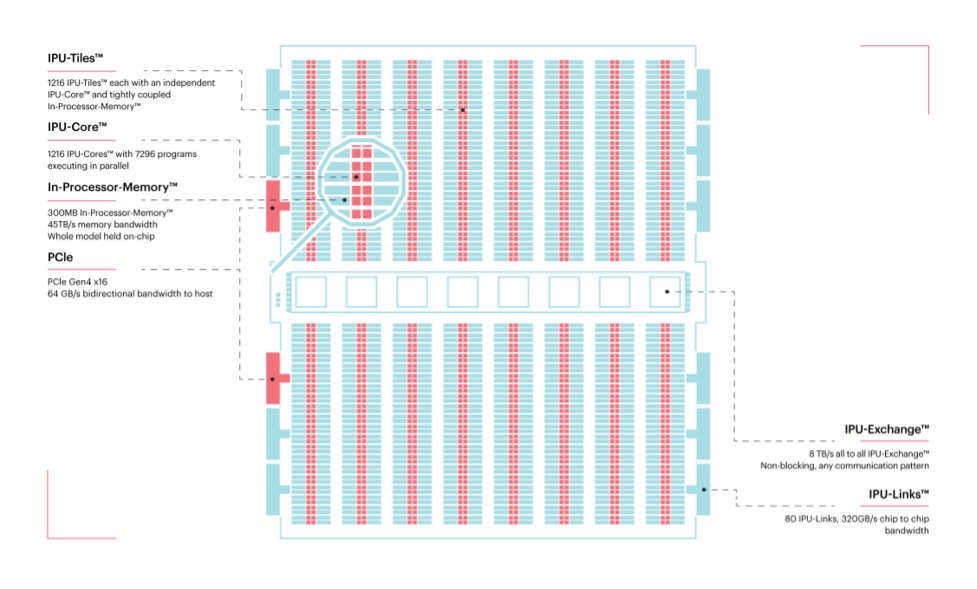
Figure 1. Colossus MK2 IPU (Source: Graphcore)
The Colossus MK2 Bow IPU, Graphcore’s most recent commercial chip, contains 1,472 IPU tiles, delivers 250 TFLOPS at FP16, carries 47.5 MB of on-chip SRAM, and achieves 7.5 TB/s on-chip memory bandwidth. TSMC fabricates it on a 7 nm process. The Bow also holds the distinction of being the first chip to enter commercial production using wafer-on-wafer 3D stacking—a process integration technique that bonded two wafers to increase SRAM density without expanding die area. TDP runs to 350 W. The IPU-POD system family scales from single chips to multi-rack configurations, with software support for PyTorch, TensorFlow, and Graphcore’s own Poplar SDK.
The commercial gap
Graphcore’s architecture performed. Its commercial numbers did not. The company reported $2.7 million in revenue against $205 million in losses in 2022. The gap reflected a market where Nvidia’s CUDA ecosystem, established customer workflows, and dominant data center presence made switching costs prohibitive regardless of architectural merit. Research labs and pharmaceutical companies ran IPUs productively, but hyperscale and enterprise buyers stayed with GPUs.
SoftBank acquired Graphcore in July 2024 for an estimated $500 million to $600 million—roughly one-fifth of its $2.77 billion peak valuation. Graphcore continues to operate under its own name as a wholly owned SoftBank subsidiary. SoftBank subsequently injected $457 million and committed to a £1 billion engineering campus in Bengaluru, India, adding 500 semiconductor engineering roles.
CEO Toon framed the acquisition as a platform for scale: “Demand for AI compute is vast and continues to grow. There remains much to do to improve efficiency, resilience, and computational power to unlock the full potential of AI. In SoftBank, we have a partner that can enable the Graphcore team to redefine the landscape for AI technology.”
Next generation: Izanagi
Graphcore and Ampere Computing—also a SoftBank portfolio company—are co-developing the Izanagi chip, which combines IPU parallel processing with Ampere’s Arm-based server CPU architecture. SoftBank targets Izanagi for deployment in Stargate hyperscale data centers in 2026. Whether Izanagi ships as a Graphcore-branded product or as a SoftBank platform component remains unresolved; the distinction carries real database and procurement implications. Either way, the Poplar SDK merges with Ampere’s open-source cloud-native toolchain, giving developers a unified development environment across both architectures.
Why IPUs didn’t displace GPUs
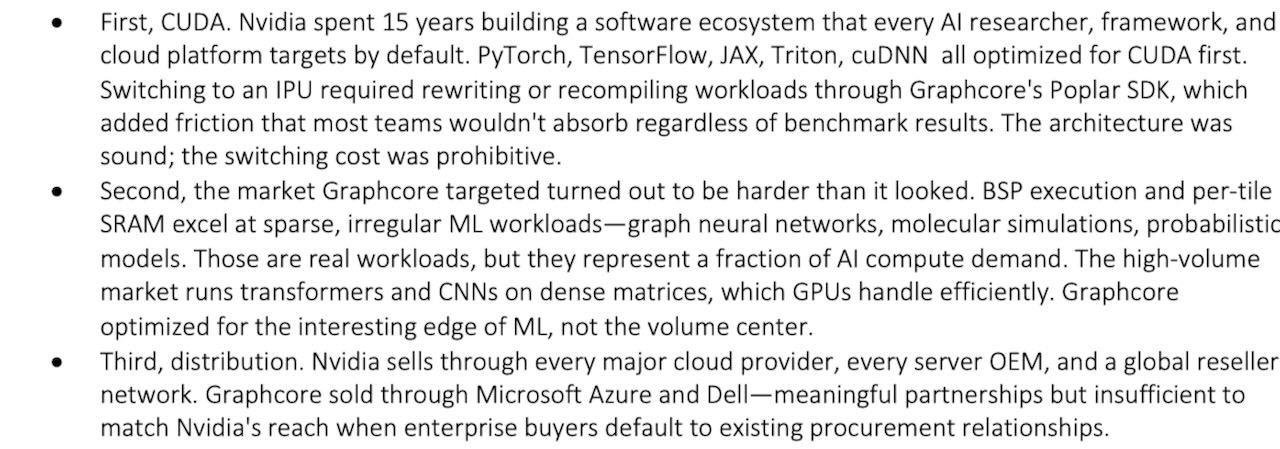
Graphcore’s trajectory illustrates a recurring pattern in AI silicon: architectural correctness and commercial success require different things, and the gap between them can exceed $200 million per year. The IPU’s BSP model addresses real limitations in GPU compute for sparse ML workloads. SoftBank’s backing eliminates the runway constraint that prevented Graphcore from scaling distribution and ecosystem—the two factors that actually determine enterprise adoption. Izanagi will test whether the architecture can convert that backing into volume deployments.

Figure 2. Nigel Toons and Simon Knowles, founders of Graphcore. (Source: Graphcore)
The Series B drew a notable cohort of AI researchers as individual investors—Hassabis (DeepMind), Sutskever (then OpenAI), and Brockman (OpenAI)—reflecting the architecture’s credibility among practitioners that understood what BSP execution offered over GPU compute.
Graphcore burned $205 million in a year on $2.7 million of revenue. SoftBank’s $457 million injection and ongoing ownership eliminates the existential funding question that constrained every business decision—hiring pace, R&D investment, pricing strategy, and the ability to sustain long enterprise sales cycles.
Captive demand. SoftBank owns or co-owns Arm, Ampere, and a significant stake in the Stargate consortium. That gives Graphcore guaranteed deployment targets that don’t require winning competitive procurement battles. Izanagi will go into Stargate infrastructure because SoftBank controls both sides of that transaction—a structural advantage no amount of benchmark performance could have created independently.
Strategic coherence. SoftBank’s “Silicon Trinity”—Arm architecture, Ampere CPUs, Graphcore IPUs—creates a vertically integrated AI compute stack that SoftBank controls end to end. Each component becomes more valuable as the others scale. Graphcore’s IPU gains a distribution platform; Ampere gains an AI acceleration partner; Arm gains silicon implementations that demonstrate its ISA at the frontier. None of that was available to Graphcore as an independent company.
What do we think?
The IPU architecture is sound. BSP execution with per-tile SRAM addresses real GPU bottlenecks in sparse ML workloads, and the Bow’s wafer-on-wafer 3D integration was a genuine process first. The acquisition validates the technology while confirming the distribution problem. SoftBank removes the funding constraint; Stargate provides a captive deployment target. Whether Izanagi captures broader market share depends on SDK adoption, not silicon performance.
Izanagi marks a structural shift in AI accelerator procurement— rom chip-centric evaluation to platform-centric access. Enterprises won’t buy Izanagi hardware; they’ll consume it as a Stargate cloud tier, shifting the question from “which chip” to “which infrastructure platform.” Three implications follow: Workload lock-in accelerates once teams depend on the Poplar-Ampere SDK; a genuine second hyperscale AI compute pole emerges alongside Nvidia-backed infrastructure; and acquisition-then-captive-deployment becomes the primary route that differentiated AI silicon takes to market. Enterprise IT procurement strategy built around hardware SKUs needs to adapt before platform agreements make the choice for them.
Graphcore’s acquisition marks an inflection point in AI hardware consolidation: the moment architecturally differentiated AI processors stopped competing independently and began folding into hyperscaler infrastructure platforms. That inflection point shifts the competitive axis from chip-versus-chip benchmarks to ecosystem lock-in and deployment scale. Izanagi’s Stargate target confirms the pattern—next-generation AI processors will launch inside hyperscale infrastructure, not through open market chip sales. For ISVs and enterprise IT, the implication is clear: The AI silicon market is consolidating around a small number of platform owners.
Graphcore’s IPU is one of the 152 AI processors in our AI Processor Tracking Service, which also lists performance and other specifications for 291 products.
LIKE WHAT YOU’RE READING? INTRODUCE US TO YOUR FRIENDS AND COLLEAGUES.