
I keep hearing people say AI showed up out of nowhere with ChatGPT. It didn’t. I’ve been watching pieces of this story assemble for close to 50 years, through graphics chips, game AI, machine vision, speech, and parallel computing. Nobody planned the sequence. Each generation just solved its own problem and moved on, with no idea what it was building toward. Looking back now, the path reads almost too clean: Lookup tables became digital humans, digital humans became machine learning, and machine learning became the GPU-powered AI infrastructure running everything today.

(Source: JPR)
I remember arguing about AI in games back in the mid-1980s, years before GPUs existed. Back then, “AI” meant a stack of lookup tables telling an enemy in a first-person shooter when to duck or charge. The tables kept growing, the behavior kept looking sharper, and pretty soon everybody just assumed games came with smart characters built in.
Next came the intelligent avatars
Back in the late 1990s, before GPUs existed, Animatek introduced Jennifer, an interactive 3D avatar built for e-commerce. Her creator, Barbara Hayes-Roth, had worked with Stanford’s AI research team since 1982, testing models of agents operating in real-world situations. Jennifer’s job was to act as a virtual spokesperson, greeting and assisting shoppers at virtual auto shows.
I’d argue Jennifer beat today’s AI presenters to the idea by a solid 25 years. She had no large language model, no modern speech synthesis, and she still proved software could gather information, decide what mattered, and deliver it through a believable digital personality. That earns her a real place in the line from computer graphics to AI-driven digital humans.

Figure 1. Ananova, the world’s first virtual newscaster.
Then in 2001 came Ananova, built by training on thousands of faces to produce one friendly, composite creature of the future. This time, GPUs actually mattered. Ana, as everyone called her, read you the news on demand, a kind of pre-streaming service before streaming existed.
She launched in 2000, with real public visibility arriving through 2001, as a fully automated virtual news presenter. UK start-up Ananova Ltd. built her, with backing from the Press Association, and ran her on SGI workstations and graphics systems.
And then the cats came
Fei-Fei Li’s ImageNet project handed modern AI one of its most important ingredients: scale. She launched the project in 2007 at Princeton with an idea that sounds obvious now but fought against how most of the field worked at the time, tuning algorithms in tiny increments. Li’s argument was simple: computer vision needed a much bigger training foundation. Better models mattered. Better data mattered just as much.
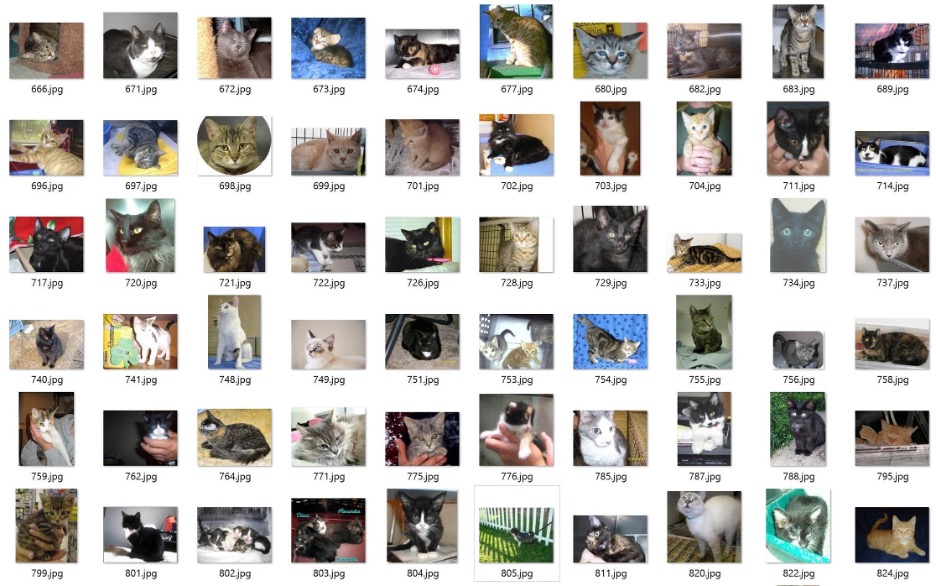
Figure 2. The first AI cat library.
To pull that off, she teamed up with Christiane Fellbaum, one of WordNet’s creators, and organized images into a hierarchy machines could actually use. By 2009, the ImageNet team presented the work at CVPR. The database held millions of labeled images, including thousands of cats across dozens of breeds. Those cats ended up in the visual vocabulary that pushed machine learning out of the lab and into practical recognition.
Most people connect AI training with “cat pictures” because of Google Brain’s 2012 experiment, run by Andrew Ng, Jeff Dean, and their team. They trained a massive neural network on 10 million random YouTube images. Cats showed up so often that the system taught itself to recognize cat faces without anyone labeling a single one.
That result grabbed the industry’s imagination. ImageNet proved curated data at scale could discipline computer vision. Google Brain proved huge neural networks could pull useful features out of messy, Web-scale data. Between them, they pushed AI away from clever handcrafted methods and toward data-hungry deep learning systems that learn straight from the Internet’s visual exhaust.
Machines can learn?
By this point, I was throwing around the term “machine learning,” or ML, freely, and, I assumed, knowledgeably.
The term “machine learning” was coined by Arthur Samuel at IBM in 1959, describing his checkers-playing program that improved through self-play. Natural Learning Processing (NLP) as a field traces to even earlier—Alan Turing’s 1950 paper “Computing Machinery and Intelligence” posed the question, Can ines think? and gave us the Turing Test. Then came the 1954 Georgetown-IBM experiment, translating 60 Russian sentences into English, the first real NLP demonstration anyone had seen.
Joseph Weizenbaum’s ELIZA, built at MIT in 1966, was the moment NLP reached a wider audience. It mimicked a psychotherapist well enough that some users genuinely believed they were talking to one.
In 2012, AlexNet blew past the existing ImageNet accuracy numbers and marked a real turning point for deep learning. Geoffrey Hinton’s team at the University of Toronto won the ImageNet competition by a margin that shocked everyone watching, and that’s the moment the ML research community knew neural networks had won the argument. The popular press caught up about two years later.
And it all ran on GPUs
GPUs didn’t start out as AI accelerators. They earned that role through a string of architectural advances that turned them from fixed-function graphics chips into programmable parallel processors. Programmable shaders, introduced around 2001, gave researchers their first real shot at using GPUs for non-graphics work. Early GPGPU pioneers ran scientific simulations, image processing, and signal analysis on them, proving GPUs could crunch thousands of operations at once.
The real breakthrough landed in 2006, when Nvidia introduced CUDA. For the first time, developers could program GPUs directly in C without disguising computations as graphics operations. CUDA lowered the barrier to parallel computing and attracted researchers working on machine learning, neural networks, and scientific computing. The GPU had become a programmable parallel processor.
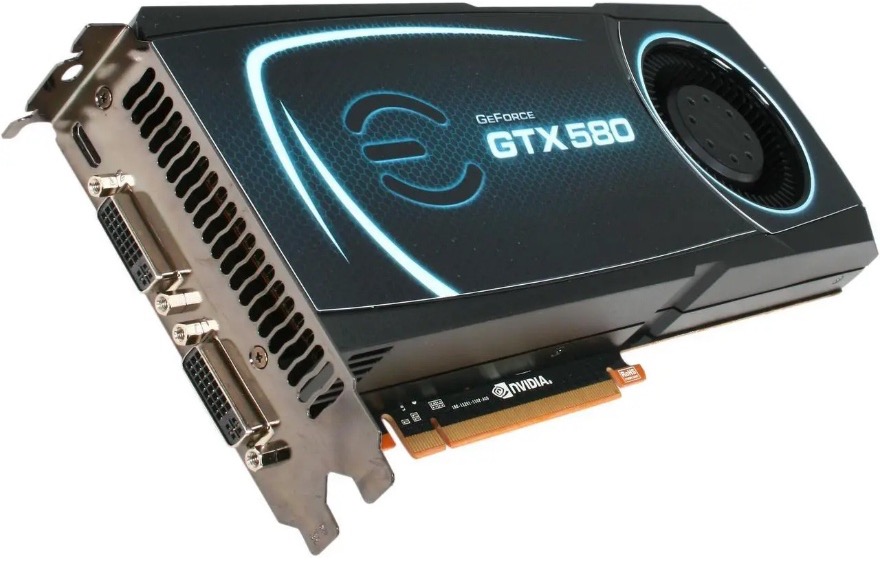
Figure 3. Nvidia GTX 580 started as a game board and became an AI processing pioneer. (Source: EVGA)
Another milestone followed in 2012. Alex Krizhevsky, Ilya Sutskever, and Geoffrey Hinton trained AlexNet on two Nvidia GTX 580 GPUs. Their convolutional neural network dramatically improved ImageNet classification accuracy and convinced the research community that GPU-accelerated deep learning represented the future of AI. From that point forward, GPUs became the preferred platform for training neural networks.
JPR followed each stage of that evolution. During the early years, our coverage focused on graphics processors, workstations, visualization, and CAD. As GPUs became programmable, we expanded into GPU computing, CUDA, and heterogeneous processing. Machine learning, computer vision, autonomous vehicles, and edge inference naturally followed. In 2014, we published our first article devoted specifically to AI, asking whether machine learning would become a job creator, a job killer, or humanity’s next indispensable tool. That same year, IBM introduced TrueNorth, its neuromorphic processor inspired by biological neural networks.
Our first dedicated AI market research arrived in 2017 with the Video Processor Unit Quarterly report. VPUs accelerated computer vision, computational photography, and real-time inference before those capabilities migrated into the image signal processors now found in smartphones and autonomous vehicles. In many respects, VPUs represented the first dedicated AI processors.
Today JPR’s AI research spans AI processors, AI PCs, NPUs, physical AI, photonic processors, and quarterly market tracking covering more than 150 companies and hundreds of products. The subject matter has changed, yet the underlying story remains remarkably consistent. Graphics processors evolved into programmable processors. Programmable processors evolved into AI accelerators. AI accelerators now power the infrastructure behind generative AI, robotics, autonomous systems, and scientific discovery.
Graphics did not disappear. It became the computational foundation of artificial intelligence.
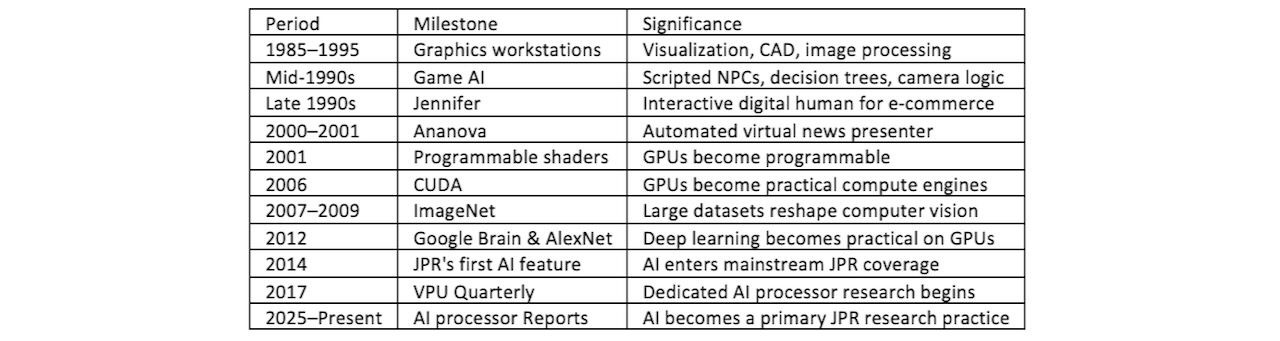
Table 1. Timeline of the evolution.
Looking back over four decades, AI did not replace graphics; it grew from graphics. Every stage of the journey built on advances in programmable hardware, software, algorithms, and data. The same GPUs that once rendered polygons now train foundation models and power large language models. JPR’s research followed that progression because accelerated computing remained the common thread connecting graphics, high-performance computing, machine learning, and artificial intelligence.
What do we think?
JPR’s AI coverage reflects continuity rather than reinvention. Graphics, GPU computing, machine learning, and AI represent successive stages of the same technological evolution. That perspective helps explain why graphics companies now lead AI infrastructure and why many of today’s AI breakthroughs originated in technologies first developed for visualization, simulation, and interactive computing.
Inflection signal
The evolution from graphics to AI marks more than a technology transition; it represents an inflection point in computing. Programmable graphics processors created the hardware foundation for deep learning, while large datasets and neural networks unlocked new applications. Today’s AI infrastructure extends that trajectory into every sector of computing. Understanding this history clarifies why GPUs, NPUs, and specialized AI processors now define the industry’s direction and why future innovations will continue to emerge from advances in accelerated computing.
Take a look at our AI library, where, among things, we keep track of the 151 companies offering 292 AI processors. JPR puts the “I” in AI (and because you will ask—Intelligence, market intelligence).
LIKE IT? THINK YOUR FRIENDS AND ASSOCIATES MIGHT? PLEASE SEND IT TO THEM WITH OUR BEST WISHES.