
SiPearl’s role in the Æther consortium gives the European CPU designer a potential path from flagship supercomputing programs into broader AI infrastructure. The consortium plans two Strasbourg-region AI gigafactory campuses, with SiPearl CPUs paired with Axelera AI accelerators and 2CRSi servers as part of a European hardware stack. Caveats: Rhea1 is still pre-release, the accelerator ecosystem remains challenging, and sovereignty through integration is not the same as full architectural independence.
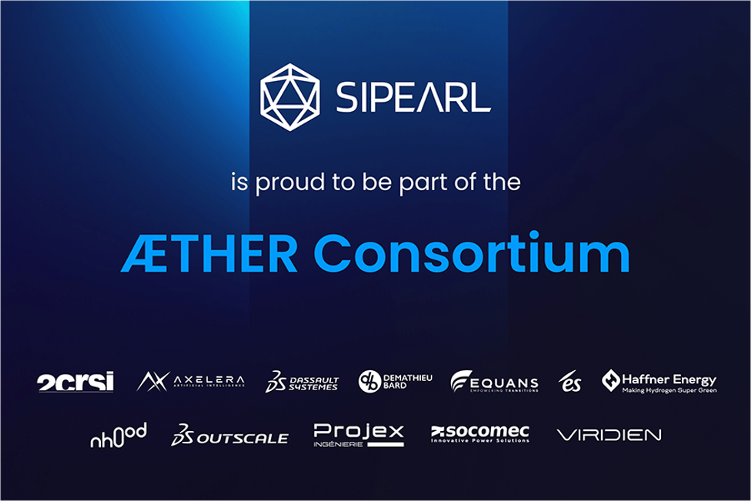
(Source: SiPearl)
SiPearl has joined the newly announced Æther consortium, a European effort to build AI gigafactory campuses in the Strasbourg, France, region. The announcement gives SiPearl something it needs: not just another sovereignty talking point, but a possible deployment path for European high-performance CPUs beyond the supercomputing programs that created the company.
Æther has applied for the European Commission’s forthcoming AI gigafactory call for proposals and is in advanced negotiations to acquire two industrial sites in the Strasbourg region. The first site, FR-SXB1, is expected to begin operations during 2027 if acquisition closes by the end of October 2026, with FR-SXB2 following a few months later if its own acquisition closes by the end of December 2026. The two sites would initially provide 42 MW of electrical capacity, with the objective of adding another 40 MW within 12 months. Longer term, the consortium is targeting more than 400 MW, subject to grid availability.
SiPearl is positioning itself as the European CPU supplier for sovereign HPC, AI, and data center infrastructure. Its first-generation processor, Rhea1, features 80 Arm Neoverse V1 cores and 61 billion transistors, with release planned for the end of 2026. The company says its CPUs will equip Europe’s first two exascale supercomputers: Rhea1 in Germany’s JUPITER system and Rhea2 in France’s Alice Recoque machine.
It was clear to us from the ISC HP 2026 last month in Hamburg, Germany, that while supercomputers are prestigious, they are not a broad commercial market, and much of the interest now is shifting towards AI factories. If Europe can actually build them, it is closer to the direction of demand: large-scale compute infrastructure for research, industry, public services, and regulated AI workloads. For SiPearl, participation in Æther is a step toward moving from national and European HPC procurement into the wider AI infrastructure stack.
SiPearl CEO Philippe Notton said the consortium aims to combine SiPearl’s high-performance processors with Axelera AI’s accelerators in 2CRSi’s high-density servers to deliver “a complete hardware solution” for demanding AI workloads, with European sovereignty as an added benefit.
Europe already has pieces of an AI compute stack. SiPearl brings the CPU, Axelera brings European inference acceleration, 2CRSi brings server integration, Viridien brings HPC operations, and Dassault Systèmes’ Outscale brings sovereign cloud capability. SiPearl also recently announced a partnership with GPU/TPU company Semidynamics. So, can those elements be integrated into competitive systems at a useful scale?
What do we think?
Europe has no shortage of consortia, declarations, frameworks, and grandly named initiatives. What it lacks is deployed compute capacity built around European-controlled technology.
For SiPearl, the timing is delicate. Rhea1 is still pre-release. The company has around 200 employees across France, Spain, and Italy, has completed a €130 million (~US $148.7 million) Series A, and has launched its Series B round. That is solid progress, but the company is still moving from a strategic project to a commercial supplier. Æther gives it a larger story to tell investors, customers, and policymakers: SiPearl is not only building CPUs for European supercomputers, but it also has the potential to become part of Europe’s sovereign AI infrastructure layer. SiPearl’s origins in European HPC give it political legitimacy, but the commercial question is whether it can extend beyond flagship supercomputers into AI infrastructure.
Rhea1 uses Arm Neoverse V1 cores, so this is not sovereignty in the sense of a wholly European instruction set or CPU architecture. It is sovereignty through integration into the European infrastructure. That may be enough for many public-sector and regulated customers, but it is not the same as full architectural independence.
There is also the accelerator problem. Training-scale AI infrastructure is still dominated by Nvidia. Axelera’s role is important, but the gap between promising European AI silicon and hyperscale training infrastructure remains large.
CPUs are not glamorous in the AI boom, but they are essential. AI factories are heterogeneous machines, not just rooms full of GPUs. They need host CPUs, memory bandwidth, interconnects, orchestration, storage, security, energy management, and operations. SiPearl’s opportunity is to become part of the strategically important control plane. If Æther reaches operation in 2027, it could become a useful proving ground for SiPearl’s move from European HPC champion to AI infrastructure supplier.
Inflection signal
SiPearl’s role in Æther could mark an inflection point for European AI infrastructure if it turns sovereignty from policy language into deployed compute. Europe already has pieces of the stack: CPUs, accelerators, servers, HPC operations, and sovereign cloud. The hard part is integrating them into systems that customers can use at scale. If Æther reaches operation in 2027, SiPearl gains a proving ground beyond supercomputers and into AI factories.
Take a look at our AI library, where, among things, we keep track of the 150 companies offering nearly 300 AI processors. JPR puts the “I” in AI (and because you will ask—Intelligence, market intelligence).
LIKE WHAT YOU’RE READING? INTRODUCE US TO YOUR FRIENDS AND COLLEAGUES.