
Building on the success of the ZBook Ultra G1a 14-inch, powered by AMD Ryzen AI Max Pro 300-series, HP announced a new mobile workstation, the ZBook Ultra G3a with AMD’s new Ryzen AI Max Pro 400 series, which for the first time, offers the machine in a 16-inch configuration. The update pairs up to 192 GB of unified memory, of which 160 GB can be allocated to the iGPU, giving this mobile workstation not only room to fit bigger and more models, but also to accommodate sufficient context window sizes.
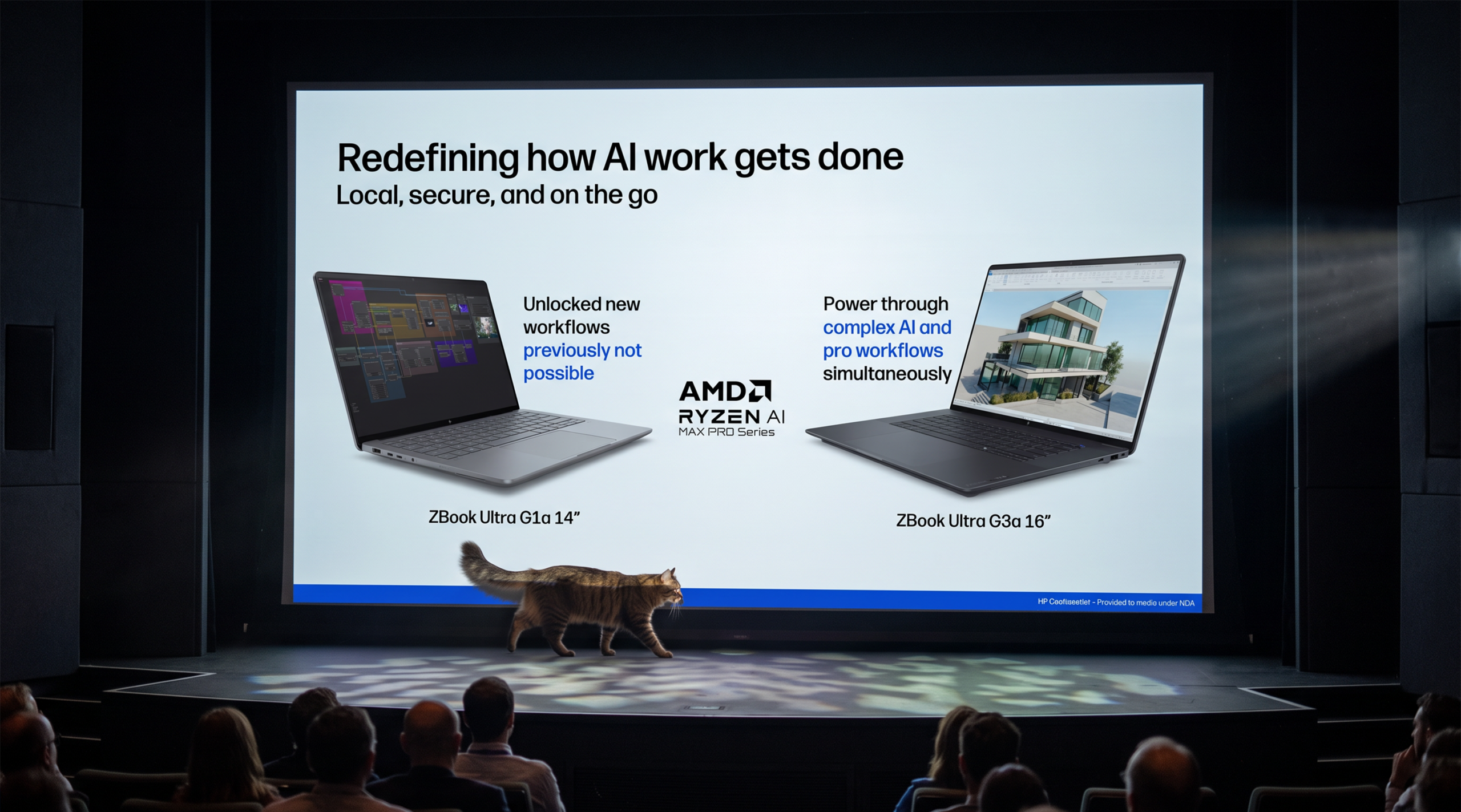
HP AMD Ryzen Pro Max-series workstations, including the ZBook Ultra G3a 16″, powered by Ryzen AI Max Pro 400-series processors. (Source: JPR; HP slide)
HP has refreshed its ZBook Ultra G3a mobile workstation line, moving to AMD’s new Ryzen AI Max Pro 400-series processors and, for the first time, offering the machine in a 16-inch configuration alongside the original 14-inch model. HP unveiled the update during a media briefing tied to the company’s broader push into what it calls “hybrid AI,” pairing local, on-device inference with cloud services, depending on the task at hand.
The refreshed ZBook Ultra G3a is powered by the AMD Ryzen AI Max Pro 400-series CPU line. The preproduction unit HP demonstrated used the AMD Ryzen AI Max+ Pro 495, a 16-core, 32-thread processor paired with AMD Radeon 8060S integrated graphics. Memory tops out at 192 GB of unified system memory, with up to 160 GB available as dedicated graphics memory for AI workloads and creative applications. The AMD Ryzen AI Max+ Pro 495 has an integrated XDNA 2 NPU that AMD specifies up to 55 NPU TOPS, for a total AI performance up to 131 TOPS, making this a certified AI PC under the Microsoft Copilot+ definition. HP said the 16-inch model starts at 17.9mm thick, making it the thinnest laptop in its class, and rated battery life at up to 16.6 hours. Built-in 5G connectivity through HP Go is optional and configured at purchase.
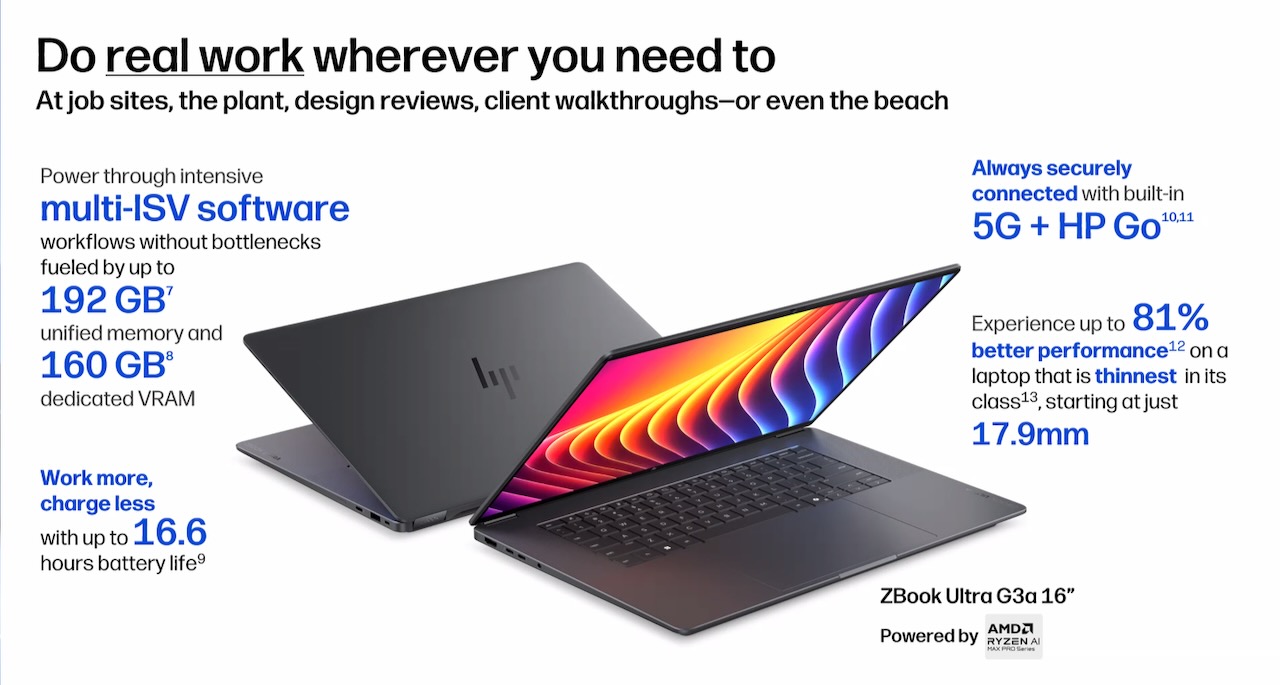
Figure 1. Platform features of the new ZBook Ultra G3a 16″. (Source: HP)
HP is positioning the 16-inch ZBook Ultra G3a as the first and only thin performance mobile workstation able to run a 300 billion-parameter model locally, according to the company. It also credited a new dynamic thermal design with delivering up to 81% better performance than the prior generation.
Jim Nottingham, SVP and division president of HP Advanced Compute Solutions, presented HP’s hybrid AI vision during the briefing, framing the hardware update around a widening gap between AI token pricing and consumption: Even as token prices fell threefold over three years, token usage is expected to climb 24 times by 2030, according to HP’s sources, pushing IT departments to look for ways to blunt runaway cloud AI costs.
Christina Gill, senior manager for HP Z Workstations new product introduction, led the hands-on portion of the briefing. HP cited an insight from surveying industry professionals.
“I’d love to have multiple AI agents helping me with coding, summarizing, and planning. But I can’t send all that sensitive work to the cloud, and IT won’t pay for everyone to hammer the APIs.” —HP’s insights from tech-savvy professionals
Beyond the hardware refresh, Gill demonstrated an agentic AI workflow built entirely on the ZBook Ultra G3a, orchestrating an end-to-end architecture, engineering, and construction (AEC) interoperability pipeline from a single prompt. The demo linked Autodesk’s Revit 2027, Autodesk’s 3ds Max 2027, Chaos’ V-Ray, and OpenAI’s Codex, using natural language prompts to let non-programmers create automation scripts without traditional coding.
In one script, a single prompt instructed Codex, running model GPT-5.6 Sol on the cloud, to loop through every camera in a linked 3ds Max scene, render each view using the current V-Ray settings, and save each as a JPG named for its camera, repeating the process automatically across every camera in the scene rather than requiring someone to trigger each render by hand. HP said the demo unit rendered a 56-camera scene at 4K resolution while monitoring CPU and NPU utilization in real time.
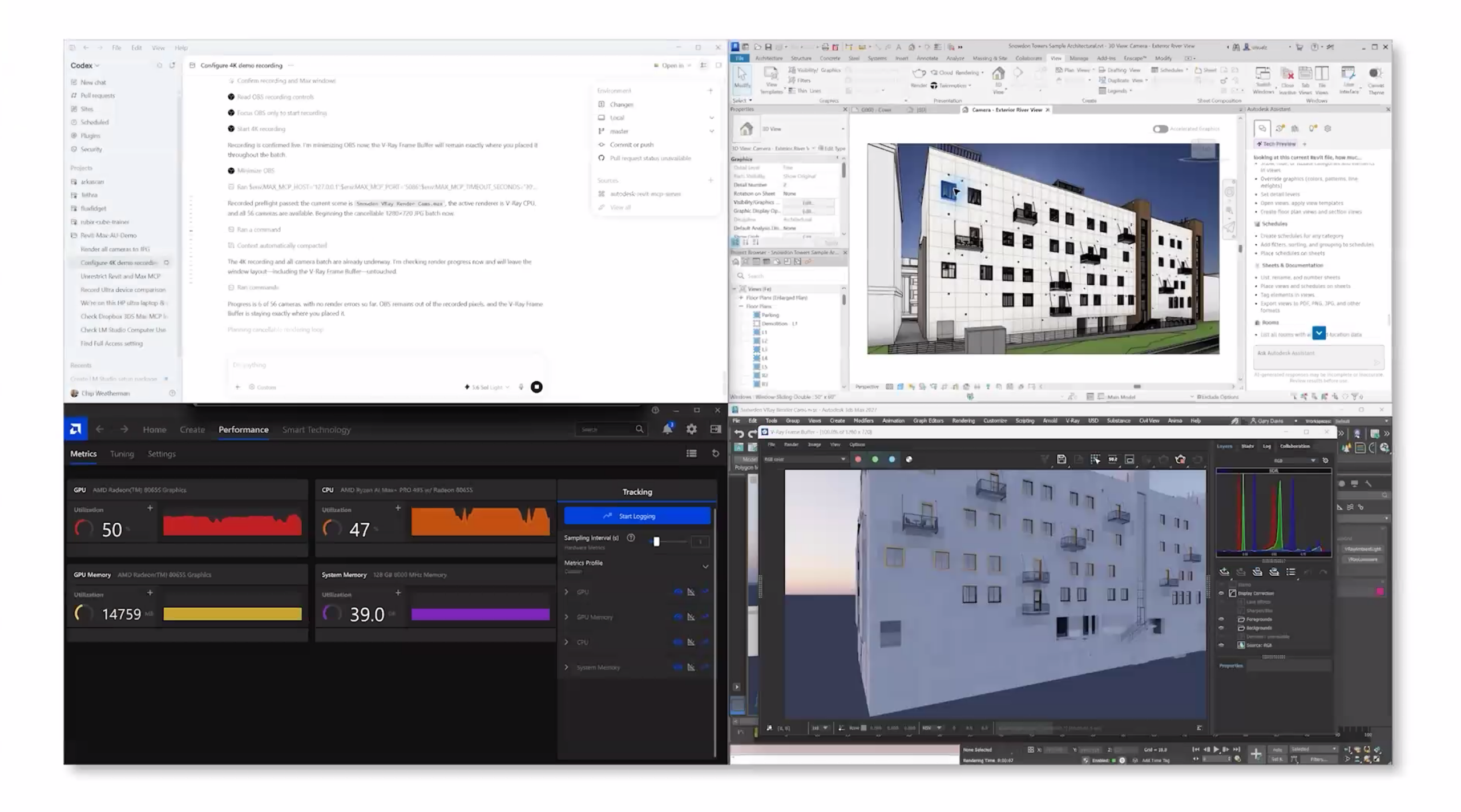
Figure 2. AI on AEC demonstration, celebrating Autodesk University 2026. (Source: HP)
HP benchmarked the result against a ZBook Studio G11 built on Intel’s Meteor Lake architecture from 2024, the generation preceding Intel’s Arrow Lake 200-series and this year’s flagship Panther Lake 300-series chips. Against that Meteor Lake-era machine, which paired 64 GB of memory with Nvidia RTX 3000 Ada graphics, the ZBook Ultra G3a completed the same 56-camera scene in 15 minutes and 36 seconds, versus 68 minutes and 27 seconds on the older system, or about 16.7 seconds per camera versus one minute 13.3 seconds. HP called that a 77% improvement in processing time, though the comparison spans multiple Intel CPU generations rather than a direct predecessor-to-successor test. JPR’s take on this performance delta later in the What do we think? section.
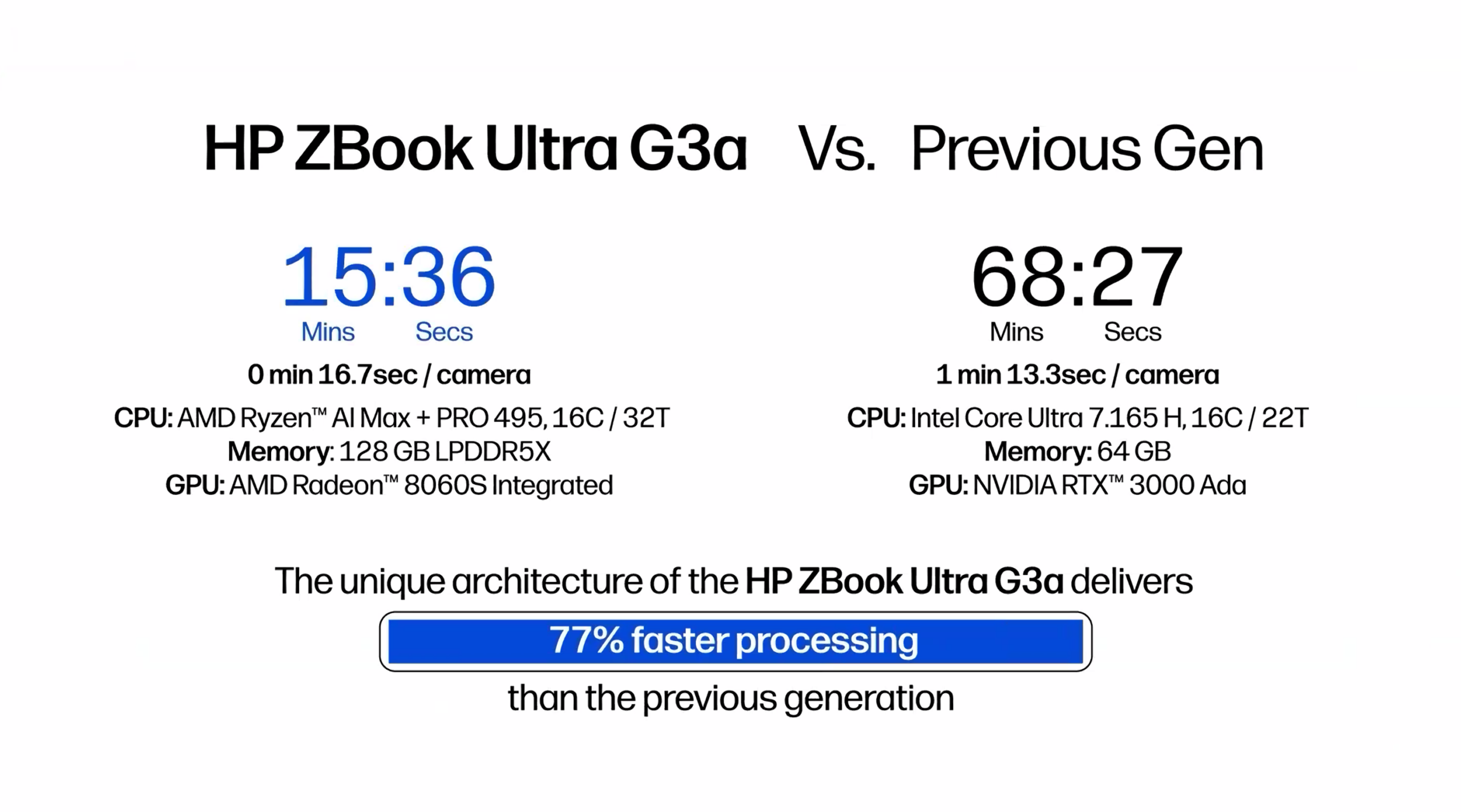
Figure 3. HP performance comparison vs. a 2024 ZBook. (Source: HP)
HP also cited broader productivity figures tied to the same workflow. Learning to use Autodesk Revit dropped from years to hours for new professionals. This claim is founded on the new AI capabilities to view, interact, and collaborate with the user’s OS interface. In a separate demonstration, four AI agents drawing on three distinct models, totaling 181 billion combined parameters, produced a complete research presentation in just over three minutes, all running locally on the device.
The briefing also confirmed that the ZBook Ultra G3a will support Perplexity’s Portable Computer software on Windows, marking the software’s first Windows deployment. Perplexity’s initial Portable Computer announcement two weeks earlier had focused on Nvidia’s DGX Spark running Linux, and Nvidia has said Windows support is coming this month, so a broader rollout appears imminent. Analysts pressed HP on whether the on-device experience would be fully local or a hybrid setup with cloud connectors for certain operations, and whether chats and workflows could carry across platforms and devices. (Don’t miss JPR’s articles on Perplexity Portable Computer for more details.)
Information regarding pricing and availability can be found on the HP website.
What do we think?
The partnership between HP and AMD is old and strong, and the ZBook Ultra G3a 16” is another AMD win, penetrating the mobile workstation market, responsible for six out of every 10 workstations. When it comes to HP, they were the only PC OEM with a mobile workstation based on AMD Ryzen Pro Max processors, and now with the 16” model, they are extending their leadership.
These machines are quite capable, and AI workflows are giving a lot of relevance to Unified Memory spaces, as long as they are balanced with AI software enabling and powerful integrated GPUs (iGPUs). So if local AI is on the table, there is a need for mobility, and the user applications run on Windows, then there are currently no better alternatives than the HP ZBook Ultra G3a.
The massive performance delta is expected since Chaos V-Ray supports hybrid CPU+GPU rendering on AMD, while on the Intel system, the 56 cameras are rendered only on the CPU; the Intel Meteor Lake family used as a baseline is optimized to save power, though it’s not necessarily the fastest processor. even when it was launched in 2024. AMD has all the right to highlight this gap since technological advantages like this are the fruit of their hard work enabling Chaos on their platform.
—The Workstation Cavalry
AND IF YOU LIKED WHAT YOU READ HERE, DON’T BE STINGY, SHARE IT WITH YOUR FRIENDS.
Disclaimer: This article is not financial advice. The content is for informational purposes only. The author may own shares in companies mentioned, and readers should not consider this article a recommendation to buy, sell, or hold any assets.