
MediaTek’s Dimensity 9600 Pro brings agentic AI deeper into premium smartphones through tighter integration of CPU, NPU, GPU, ISP, memory, and connectivity. Built on TSMC’s 2nm process, the platform targets higher performance, lower power and persistent on-device intelligence. Dual NPUs, AI Compute Fusion, LPDDR6, neural graphics, and enhanced imaging show how MediaTek increasingly treats AI as a system-wide architectural function.
MediaTek is positioning its Dimensity 9600 Pro as more than another performance upgrade for premium smartphones. The 2nm processor combines a new all-big-core CPU, dual-NPU architecture, neural graphics, a more capable ISP, LPDDR6 memory support, and upgraded connectivity. The architectural theme centers on tighter cooperation among compute engines. MediaTek calls this AI Compute Fusion, with CPU, NPU, imaging, and graphics resources increasingly working together to support agentic AI, local models, imaging, and gaming while reducing power consumption.
The Dimensity 9600 Pro moves to a 2+3+3 all-big-core CPU architecture and increases L2 cache capacity by 21%. MediaTek claims 17% higher single-core performance and 15% higher multi-core performance than its previous flagship, while reducing power consumption by 37% for single-core workloads and 61% for multi-core workloads.
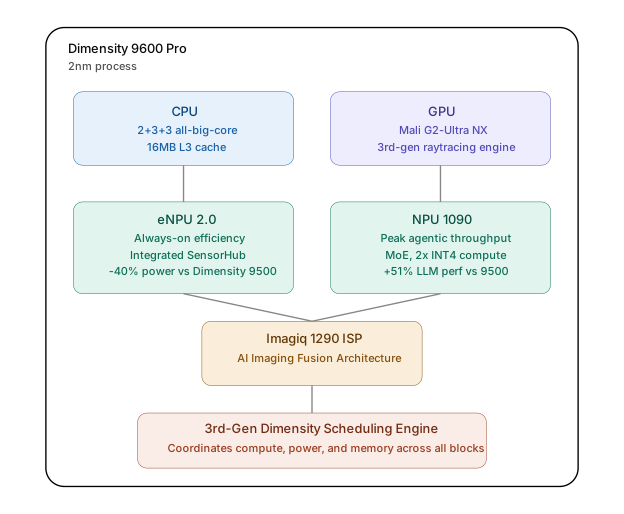
MediaTek couples its Dimensity Scheduling Engine 3.0 with an AI Compute Fusion architecture. The company says the combination increases LLM token-generation performance by 40% while reducing power consumption by 27% at equivalent performance. LPDDR6 support raises effective memory bandwidth by 33%, while UFS 5.0 doubles read-and-write performance compared with two-channel UFS 4.
Agentic AI moves onto the device
MediaTek gives AI a larger architectural role through a dual-NPU design and its Dimensity Agentic Engine. The NPU 1090 doubles INT4 compute capability and improves LLM performance by 51%, according to MediaTek. A separate eNPU 2.0 targets persistent workloads with 40% better power efficiency.
The architecture supports on-device Mixture-of-Experts model inference and LLM compression. MediaTek also identifies proactive suggestions, scene detection, and live-photo object removal as examples of local AI workloads. The approach indicates that the company expects smartphones to run increasingly persistent AI agents rather than depend entirely on cloud inference.
MediaTek also adds hardware protections for that model. A hardware root of trust provides tamper-resistant protection, post-quantum cryptography addresses future quantum threats, and pKVM hypervisor isolation separates proactive AI workloads and private information.
Imaging and graphics converge with AI
The Dimensity 9600 Pro expands AI into imaging through a direct ISP-NPU relationship. MediaTek supports 60 fps continuous subject tracking, 4K live photos, 4K 100 dB HDR capture, 4K60 HDR semantic processing, and 4K120 Cinematic Log recording. Slow-motion capture reaches 4K240.
Graphics follows the same heterogeneous-compute strategy. MediaTek links the GPU and NPU for neural rendering and higher-quality super resolution. The company claims 27% higher peak graphics performance, 24% better power efficiency at peak performance, and up to 18% higher ray-tracing performance. The processor supports native gaming above 185 fps, hardware-accelerated OMM ray tracing, and multi-material reflections.
MediaTek also introduces H.266 hardware decoding, improves video-encoding efficiency, and supports a BT.2020 display color pipeline.
Connectivity receives another AI layer. The integrated 5G-Advanced modem incorporates in-modem AI, supports five-component-carrier aggregation, and reaches more than 7.4 Gb/s downlink performance. MediaTek also adds Bluetooth 6.2 and says its new GNSS RF implementation improves power efficiency by as much as 65%.
The Dimensity 9600 Pro, therefore, illustrates where MediaTek sees premium mobile silicon heading. CPU, GPU, NPU, ISP, memory, and connectivity no longer operate as largely independent specifications. MediaTek increasingly treats them as cooperating engines, with AI serving as a mechanism for moving workloads among them and extracting more performance within a smartphone’s tight power envelope.
What do we think?
MediaTek has moved beyond treating the NPU as an accelerator attached to a mobile SoC. The Dimensity 9600 Pro connects CPU, NPU, GPU, ISP, memory, and software around AI workloads. For silicon teams and ISVs, that integration matters more than individual TOPS claims. CIOs should watch how effectively this architecture moves inference from cloud services onto managed endpoint devices.
Inflection point. The Dimensity 9600 Pro could mark an inflection point for mobile AI as smartphones move from occasional inference toward persistent, agentic workloads. MediaTek’s dual-NPU architecture, AI Compute Fusion, local MoE support, and hardware security indicate that on-device AI now influences the complete SoC rather than one accelerator block. For ISVs and enterprise IT, this shift could reduce cloud inference requirements, improve response time and privacy, and create a new application platform built around continuously available local intelligence.
AND IF YOU LIKED WHAT YOU READ HERE, DON’T BE STINGY, SHARE IT WITH YOUR FRIENDS.