
Intel is developing a 4+0+4+4 Panther Lake SoC variant specifically for entry-level gaming handhelds, featuring four performance cores, zero efficient cores, four low-power efficiency cores, and four Xe3 GPU cores. This design strategy targets budget-conscious devices rather than high-end portable gaming, expanding Intel’s market reach.
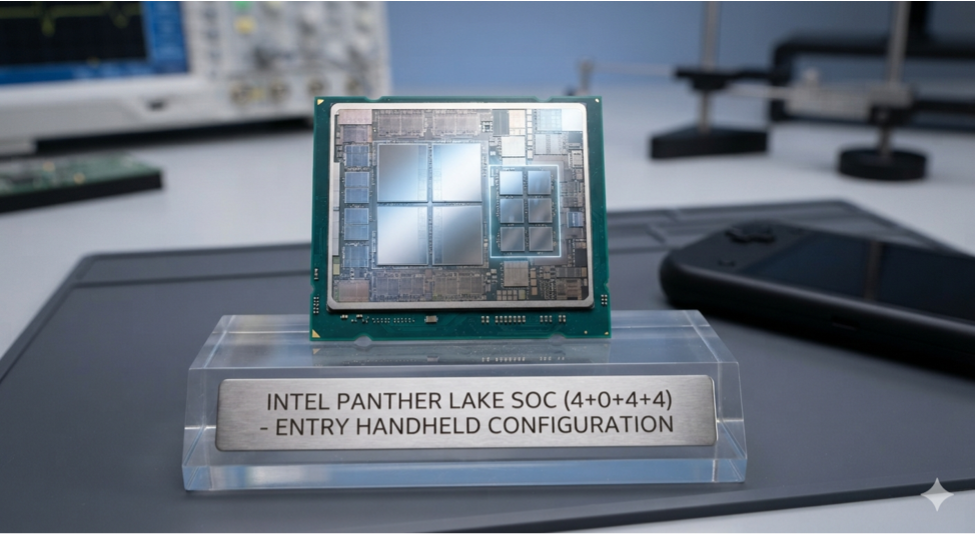
The specific layout of Intel’s planned Panther Lake balances performance requirements with the power and cost constraints of more affordable portable systems. By omitting standard efficient cores and utilizing a specialized core count, Intel provides hardware partners with a tailored solution, allowing manufacturers to design competitive entry-level handhelds without utilizing expensive, higher-tier silicon. The engineering choice removes execution pipeline overhead, optimizing physical die size to fit smaller hardware enclosures.

Panther Lake will leverage Intel’s advanced semiconductor manufacturing nodes to deliver high-volume components to portable console integrators. This targeted chip layout optimizes power delivery metrics for standard mobile application environments. Hardware partners gain an option to reduce retail costs while retaining architectural advantages like localized memory control and standard display pipelines.
Manufacturers likely adopt this silicon to produce functional, lower-cost mobile units. This strategy expands the market for portable gaming, making it more accessible to casual players. System designers use specialized building blocks to build diverse ecosystems of affordable devices.
Top-tier Intel Panther Lake (Core Ultra Series 3) laptops cost roughly $1,400 to $2,400, with flagship configurations averaging around $2,100. The maximum configuration delivers up to 180 total platform TOPS (with the dedicated NPU5 delivering 50 TOPS) and features top-end Arc B390 graphics with 12 Xe3 cores.
What do we think?
Intel is targeting budget segments with specialized silicon designs, simplifying the die layout to reduce manufacturing costs. This allows hardware partners to launch affordable portable gaming gear. This strategy increases market competition across the entry-level handheld sector and secures steady volume for Intel.
Inflection point: This move marks a shift toward specialized low-cost silicon, where companies stop forcing flagship designs into budget form factors. Tailored core counts directly match specific device requirements, shaping an industry inflection point for mobile computing. Makers optimize power delivery for specific gaming use cases, using customized configurations rather than scaled-down parts. Chip designers embrace modular efficiency across every product tier.
LIKE WHAT YOU SAW HERE? SHARE THE EXPERIENCE, TELL YOUR FRIENDS.