
Nvidia just spent $12.93 billion on a company that doesn’t make chips or models, it makes the place where 18 million developers go to find them. Hugging Face functions as something like GitHub for AI, and Nvidia isn’t buying the models sitting on it, it’s buying the distribution layer connecting those models to the hardware running them. We walk through why Nvidia explicitly promised not to require its own hardware, what that promise actually protects, and what this means for AMD and Intel.
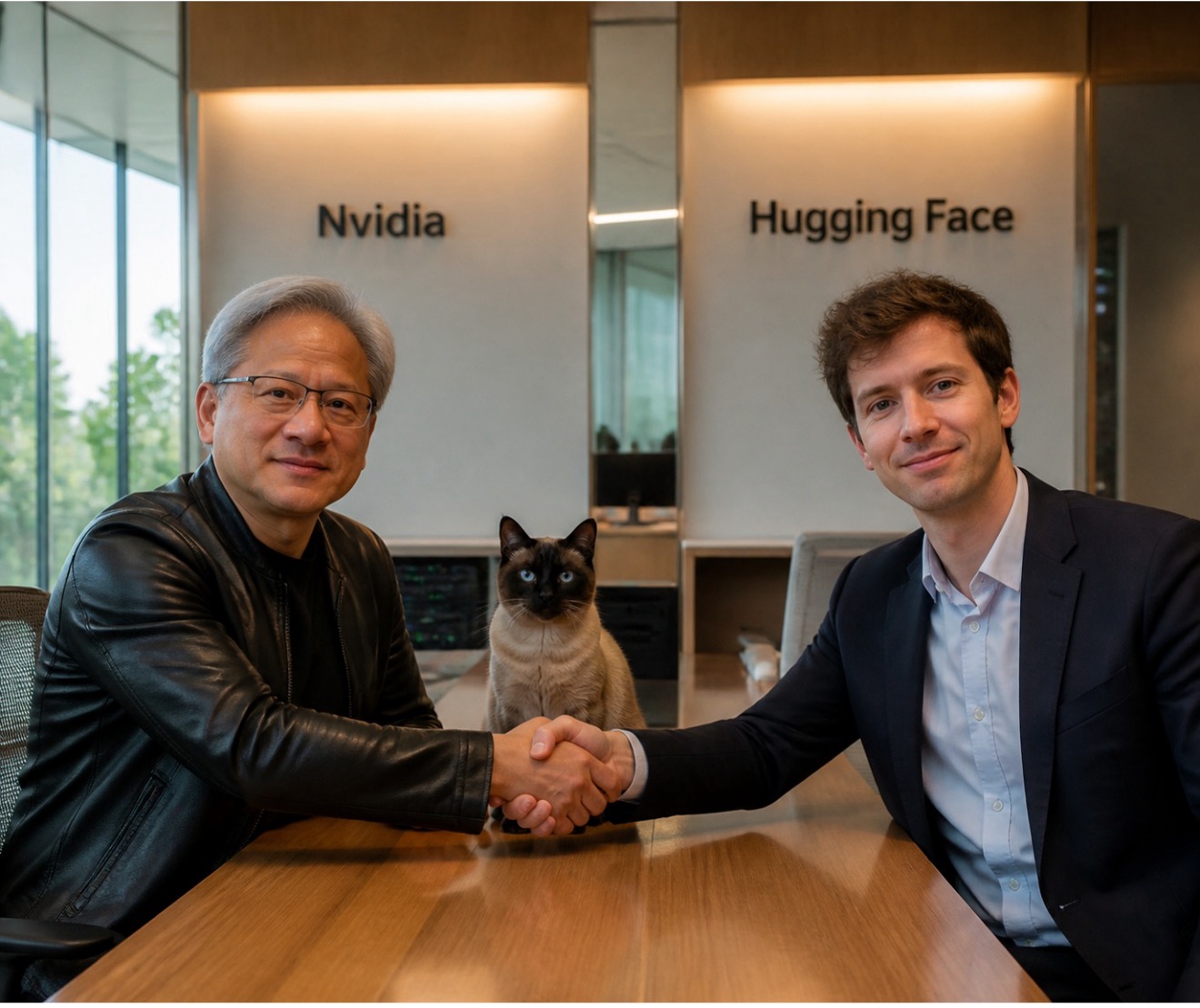
Nvidia confirmed a $12.93 billion acquisition of Hugging Face on Thursday, sending Nvidia shares up roughly 2%. Hugging Face hosts more than 3 million models, 500,000 datasets, and 1 million applications, drawing more than 18 million developers, researchers, and creators, with more than 200,000 companies using the platform to discover, evaluate, customize, and deploy AI. The deal will close in the first half of 2027, pending regulatory approval.
Nvidia isn’t buying a model company here. It’s buying the distribution layer for open AI. Hugging Face has become something close to GitHub for AI models, the place developers discover them, compare them, customize them, and decide how to deploy them. Nvidia built its dominant position from the bottom up: GPUs provided the compute, CUDA created the programming environment around that compute, and networking plus DGX systems expanded that into complete AI infrastructure. Hugging Face moves Nvidia one step closer to the developer, sitting at the exact decision point of which model to use and where to run it.
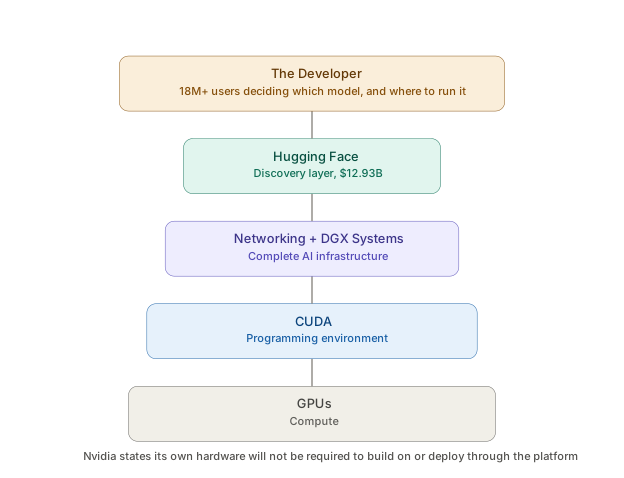
Figure 1. Distribution layer.
A real economic logic sits underneath the deal. The largest frontier AI companies count among Nvidia’s biggest customers, and those same companies carry the strongest incentive to build alternative accelerators and custom silicon. Open AI creates a fundamentally different market structure instead: millions of developers, thousands of organizations, millions of models, and an enormous variety of workloads. That fragmentation suits a broadly programmable accelerated-computing platform well. Nvidia doesn’t need to win the model war outright. It benefits simply if nobody else does.
Nvidia CEO Jensen Huang went unusually far in promising Hugging Face stays open. Developers keep the freedom to choose their own models, frameworks, clouds, inference providers, and computing platforms, and Nvidia explicitly stated its own compute will not become a requirement for building on or deploying through the platform. Justin Boitano, Nvidia’s enterprise computing general manager, framed the strategy directly: Growing Hugging Face’s user base depends on keeping developers free to choose their own hardware, clouds, and stack, even as Nvidia benefits from the training and inference that happens to run on Nvidia hardware anyway.
“Open models strengthen safety and cybersecurity, accelerate innovation and diffusion, and enable sovereignty,” Huang posted on X. “They allow every developer, startup, university, industry and country to build with, customize and benefit from AI.”
That commitment isn’t simple goodwill. It’s fundamental to the acquisition’s actual value. Hugging Face became important precisely because it functions as a broadly accessible meeting place for the entire AI community, and turning it into an Nvidia-only channel would undermine the exact ecosystem Nvidia just paid nearly $13 billion to acquire. Nvidia doesn’t need that kind of exclusivity. It only needs its own path through the platform to run exceptionally well, letting a developer discover a model on Hugging Face, evaluate it, optimize it for Nvidia hardware, and deploy it through Nvidia’s own growing software stack, all without technically closing off any other path. The real competitive question isn’t whether Hugging Face keeps supporting AMD, Intel, and other accelerators; it’s whether Nvidia’s own path becomes so frictionless that neutrality stops mattering in practice.
The acquisition extends well past hyperscale cloud, too. Huang specifically described open models reaching factories, hospitals, farms, classrooms, and Main Street businesses, running across cloud GPUs, enterprise servers, AI workstations, local AI appliances, PCs, edge systems, and robots. Deploying a model increasingly means an RTX workstation, a DGX-class appliance, an edge server, or an autonomous machine, connecting Hugging Face directly to Nvidia’s push into local AI, robotics, and physical AI.
Hugging Face itself carries a genuinely French origin story. Three Frenchmen—Clement Delangue, Julien Chaumond, and Thomas Wolf—founded the company in New York back in 2011, originally building a conversational AI interface aimed at teenagers, a rough forerunner of ChatGPT. The platform pivoted toward businesses and professionals, then took off sharply once ChatGPT itself launched and generative-AI use exploded. Hugging Face turned down multiple stake purchases and takeover offers before choosing Nvidia, citing its stated commitment to the open ecosystem. French Economy Minister Roland Lescure called the deal a “wake-up call” for Europe’s own capital markets, warning that start-ups without enough local capital will keep finding it elsewhere.
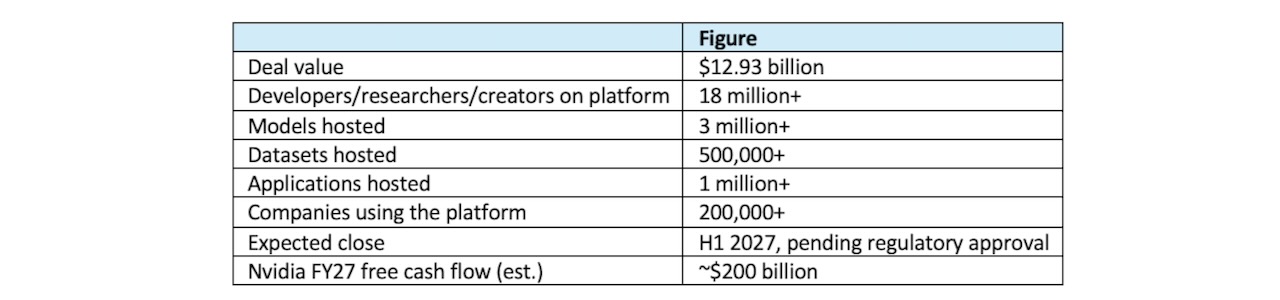
Table 1. Statistics of the deal.
Nvidia’s own free cash flow, expected to be near $200 billion for fiscal year 2027, makes the $13 billion price tag look small by comparison. The harder question isn’t affordability. It’s whether Nvidia can keep Hugging Face genuinely neutral, making its own path through the platform good enough at the same time that neutrality stops being the thing developers actually choose.
What do we think?
The neutrality pledge is the deal’s real load-bearing wall, not a talking point. Nvidia doesn’t need every model built on its hardware; it needs the best path through Hugging Face to run on Nvidia silicon specifically. Watch whether that “exceptionally good” Nvidia path stays a genuine choice among equals or quietly becomes the default nobody bothers avoiding.
Inflection point. Nvidia already owns the compute layer through GPUs and the programming layer through CUDA. Hugging Face adds the discovery layer, the actual point where a developer picks which model to use. Owning that decision point, keeping it technically open at the same time, marks a genuine inflection point in how AI infrastructure competition works: The fight stops being purely about who ships the fastest chip and becomes about who sits closest to the moment a developer decides where their workload runs.
LIKE WHAT YOU’RE READING? DON’T KEEP IT A SECRET, TELL YOUR FRIENDS AND FAMILY, AND PEOPLE YOU MEET IN COFFEE SHOPS.