
Tripo AI is a start-up whose AI 3D foundation model and full-stack 3D-generation ecosystem is turning heads and turning 3D content creation on its head. Its goal is to make creation of interactive 3D content easy, starting with 3D asset generation that led to development of the company’s own 3D foundation models. Now, it is building a connected workflow for structured topology, segmentation, texturing, rigging, animation, and export.
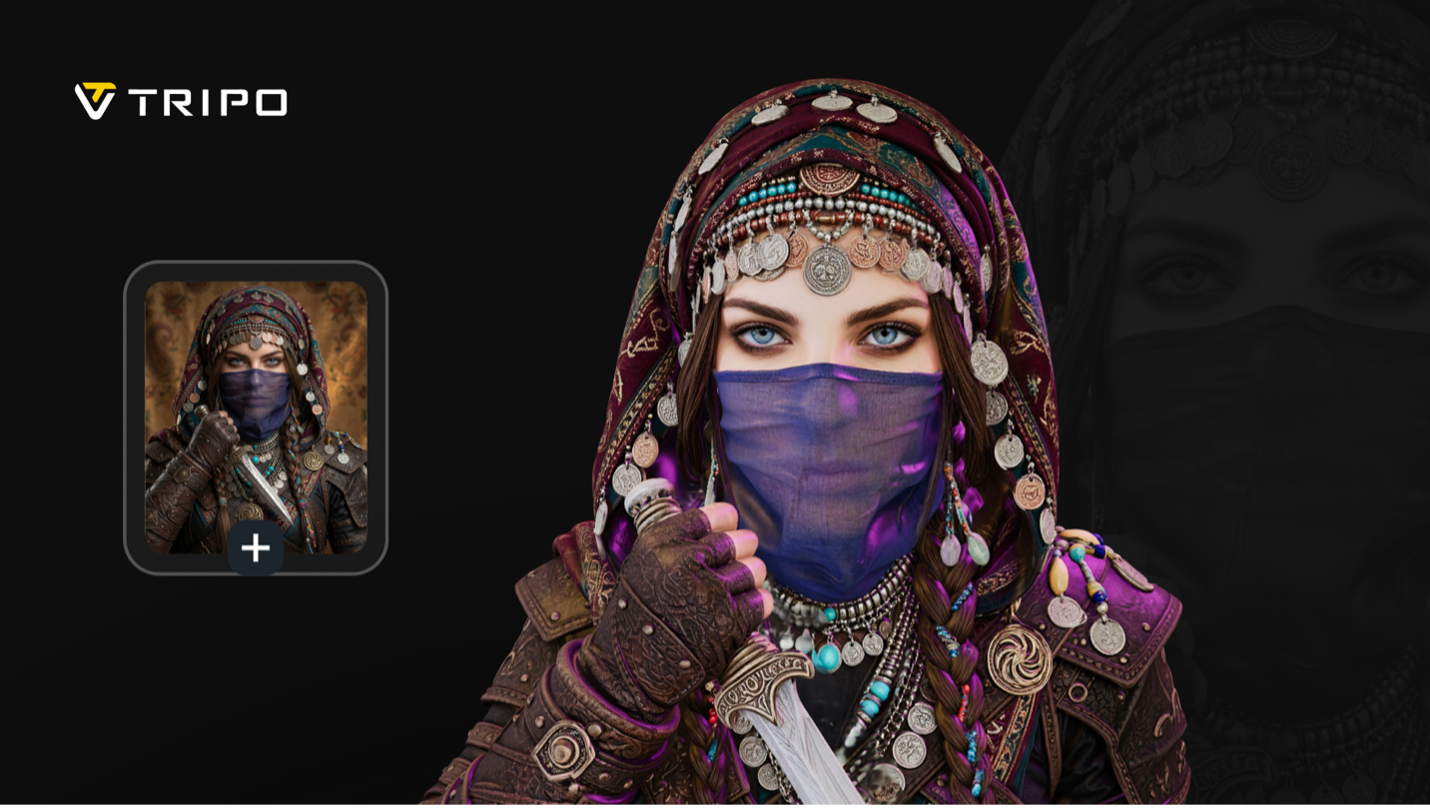
Tripo Studio is more than a prompt box; it brings generation and the next stages of asset preparation into the same workspace. Tripo P1.0 (Smart Mesh) can generate a structured mesh in about two seconds and is aimed at lightweight, structured geometry for real-time applications. Tripo H3.1 supports high-detail generation up to 2 million polygons for uses such as hero assets, close-up visuals, and 3D printing.
(Source: Tripo AI)
It was difficult to miss Tripo AI at Siggraph 2026, and not just because of the very large bright yellow bags emblazoned with the company’s logo being toted around by many on the show floor. Or, the spacious, eye-catching booth and constant crowds. Tripo’s leaders presented a keynote focused on the company’s 3D generative AI and world models. It also participated in Siggraph’s GenAI hackathon, stage sessions, and more, presented five technical papers, and hosted a happy hour too. But what really made people take notice was what the company was serving up: its full-stack 3D-generation ecosystem. So impressive was the live system that generates fully textured, rigged, and animated 3D assets from images in seconds that it won the Siggraph 2025 Real-Time Live Best in Show award.
This year wasn’t Tripo AI’s first Siggraph rodeo. That was in 2023, when founder and CEO Simon Song was a Sponsored Keynote speaker; last year in Vancouver, the company exhibited its product suite comprising a web app, API platform, plug-ins, and community resources. Since then, it has been building momentum, with the goal of revolutionizing the 3D content-creation landscape with its AI 3D foundation model, which it launched in 2024.
China-based Tripo AI (with offices in Beijing, Hangzhou, and other locations throughout China) was founded in 2023 by Beijing start-up Vast, with the long-term goal of making interactive 3D content easier to create. It began with 3D asset generation, the company says, since an interactive world needs usable objects before it can support motion, behavior, or shared experience. This led to development of the company’s own 3D foundation models, followed by Tripo Studio and the Tripo API.
The Tripo AI 3D generation platform turns a text prompt, single photo, a few multi-view images, or even a rough sketch into a usable 3D model in seconds. Instead of blocking out geometry by hand, the user describes or illustrates what they’d like, and the model reconstructs the mesh, textures, and materials for them. It runs entirely in the browser through Tripo Studio, with a separate Tripo AI for developers that want to generate assets programmatically.
According to the company, the output is meant as a fast starting point for games, 3D printing, product design, animation, AR/VR, and concept work assets that can be refined further in other DCC tools. Tripo 3D points out that the time from prompt to a previewable 3D model takes second. Approximately 500K polygons are supported on the latest models.
As for pricing, Tripo Studio runs on monthly credits—generating a model costs about 25 credits. The Basic plan, which has a limit of 200 credits, or about eight models, is free. There is also a Professional and Advanced plan, priced at $19.99 and $49.99 per month, whose models carry full commercial rights.
And now, Tripo AI is building a connected workflow for structured topology, segmentation, texturing, rigging, animation, and export. Project Eden, the latest development, takes the same research into a new area, studying how a world can maintain an evolving state separately from the images shown to each viewer. All along, the company’s direction has been consistent: First make the assets usable, then study how those assets can persist, change, and interact inside a world.
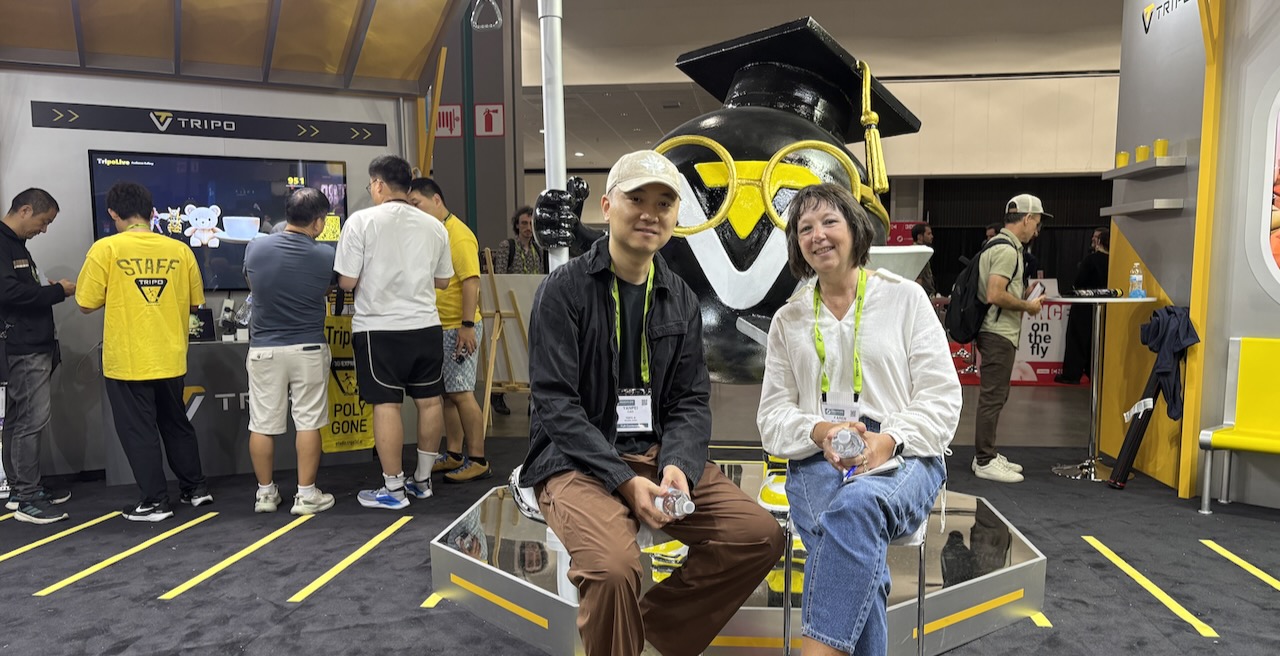
Tripo AI’s chief scientist, Yan-Pei Cao, discusses the company’s technology with JPR’s Karen Moltenbrey. (Source: JPR)
JPR talked with Yan-Pei Cao, chief scientist at Tripo AI, as the company if often referred to, during Siggraph 2026, about Tripo AI’s technology and what is next for them.
Tell me about Tripo’s current product line. Is Tripo Studio your main offering for creating 3D models?
Yanpei Cao: Yes. Tripo Studio is our AI-native, web-based 3D content creation workspace for people who want a visual creation process. A creator can start from text, a single image, or multiple views, generate a model, inspect it, refine the geometry or texture, and export it to the next tool. The important part is that Tripo Studio is not only a prompt box; it brings generation and the next stages of asset preparation into the same workspace.
Tripo API is for developers and companies that want to put these capabilities inside their own products or production systems. Its endpoints cover text, image, and multi-view generation, along with texturing, segmentation, retopology, rigging, and animation. Plug-ins are also available for major DCC tools and game engines including Blender, Maya, Unity, and Unreal Engine.
Tripo Game Hub is our global community platform for creators building AI-powered 3D interactive experiences. By integrating Tripo AI directly into gameplay, it turns creation into part of the gaming experience, enabling users to build interactive worlds, prototype ideas, and collaborate with other creators. The platform hosts regular Game Jams, monthly challenges, and community events with industry partners around major industry events. Earlier this year, we hosted a game-jam-themed Portal Pass. Participants were invited to create a single level inspired by this theme, and all the levels were then seamlessly connected to form a complete, multi-level 3D game. We later showcased the short-listed projects at GDC 2026, giving creators the opportunity to present their work to the global game development community.
Everyone has been impressed by the speed at which Tripo Studio generates these high-quality images. What steps does the user have to take?
Cao: In Tripo Studio, the user starts with text, one image, or a set of views. They choose a geometry path based on the job, generate the asset, and inspect it in the browser. From there, they can work on texture, parts, topology, polygon count, rigging, or animation before export.
How much refinement is needed depends on the destination. A prototype prop and a close-up character do not have the same standard. We want the workflow to be fast, but we also want creators to see where judgment is still required.
How fast does it work?
Cao: The fastest option is Tripo P1.0 (Smart Mesh), which can generate a structured mesh in about two seconds. That is the mesh itself, not a fully textured and rigged asset ready for export. High-detail geometry and 8K textures take longer.
What limits are there for fidelity, resolution?
Cao: We currently offer two complementary geometry paths. Tripo H3.1 supports high-detail generation up to 2 million polygons for uses such as hero assets, close-up visuals, and 3D printing. Tripo P1.0 (Smart Mesh) is aimed at lightweight, structured geometry for real-time applications.
Textures are separate from polygon count. The highest setting is an 8K base color texture, with 4K normal and ORM maps.
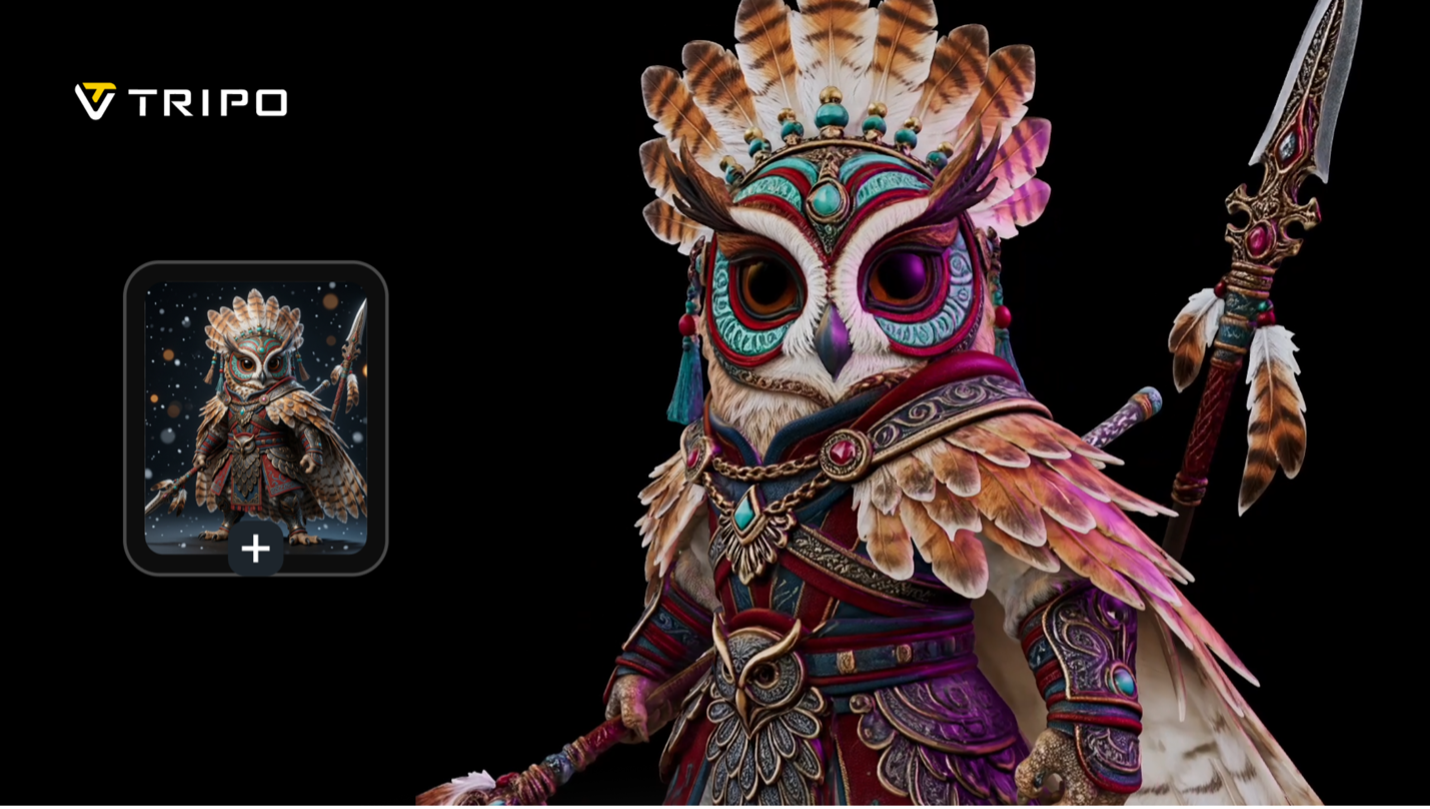
Tripo AI’s 8K texture. (Source: Tripo AI)
What type of hardware/software does the user need?
Cao: Because the 3D generation is handled by Tripo’s cloud servers, users do not need any special hardware, although a GPU capable of decent WebGL/3D rendering performance is helpful for smoothly viewing and manipulating models. Any current web browser with WebGL support can connect to the Tripo Studio workspace.
Do the generated 3D models have the same topology as typical 3D models?
Cao: The output is a conventional 3D mesh, but its topology depends on the workflow. Tripo P1.0 (Smart Mesh) generates lightweight, structured low-poly topology directly and lets the user choose a polygon target. For many real-time assets, that removes or reduces a separate retopology step.
I would not call every result perfect or ready for every use. Complex faces, hero characters, strict mechanical parts, and demanding deformation can still need a manual review pass.
Can the models be brought into major DCC programs for revision?
Cao: Yes. Tripo supports common formats such as GLB, glTF, FBX, USD, STL, and OBJ. FBX is often the practical choice for rigs and animation, GLB for compact textured assets and web use, and STL or 3MF for printing.
These formats move the asset into tools such as Blender, Maya, Unity, and Unreal. Artists should still check scale, materials, topology, skinning, and joint placement after import, especially for final animation work.
What types of applications can the models be used for?
Cao: Our users are creating models for use in areas such as 3D printing, game development, embodied AI, media production, interior design, e-commerce, education, industrial design, and more.
We work with hundreds of companies worldwide, including Riot, EA, Sony, Tencent, and NetEase.
How does your offering compare to other model generators?
Cao: A core difference between us and some of our peers is that we don’t simply optimize ‘generation’ in isolation. Instead, we design our technology and products around the question, Can the output actually enter the production pipeline?
There are many excellent products in the industry today that excel in visual effects or generation speed. However, in actual development, teams care more about whether an asset has a stable structure, clean topology, and whether it can move directly into the production pipeline without requiring extensive post-production cleanup. At Tripo AI, we have continuously updated and even reconstructed our underlying technical roadmap throughout our iterations to meet the needs of our users.
In the long run, I believe the key to this market won’t be who generates the fastest or whose one-off results are the most stunning. It will be about who can consistently provide ‘usable’ assets. This requires several critical capabilities: output consistency and controllability, support for editable and iterative workflows, and the ability to truly integrate into existing production ecosystems.
For us, the test is not only whether a model looks good while it spins on a screen. The harder question is whether a creator can control it, edit it, rig it, animate it, and move it into the intended workflow. That is a more useful measure of progress.
Ultimately, AI in this field is more likely to become infrastructure that amplifies a creator’s talent rather than replacing them. The winner in the long term will be whoever best serves the authentic needs of developers and embeds themselves into the production workflow.
What are its current overall limitations?
Cao: ‘Production-ready’ changes with the asset and the destination. Complex mechanical assemblies, detailed faces, strict symmetry, and final deformation around joints can still need artist review. A high-detail asset may need optimization before real-time use; a low-poly asset may not carry enough detail for a close shot.
Beyond individual assets, as we expand into world models with Project Eden, the broader field faces deeper challenges in computational efficiency, physical fidelity, and the stability of large-scale environment simulation. These are active areas of research across the industry, and we believe continued advances in model architecture, training data, and computing infrastructure will gradually address them.
Let’s talk about Project Eden.
Cao: Project Eden is our world model research preview, designed to support persistent, reusable, and multiplayer interactive environments. It studies how a world can maintain an evolving state separately from the images shown to each viewer. It represents Tripo AI’s next step toward enabling creators, developers, and researchers to create, modify, and enter interactive worlds that can persist over time.
It is a pioneering native architecture that decouples underlying state simulation from visual rendering and establishing a new paradigm for world model development. By decoupling the underlying logic from the pixel rendering, we have unlocked three system-level capabilities that fundamentally alter game creation:
First, object permanence and viewpoint consistency. Because the state is maintained independently of the camera’s frustum, objects do not randomly vanish or mutate. If a player drops an item and returns hours later, the model queries a confirmed objective state rather than relying on a historical pixel context to regenerate it. Long-term memory is natively solved.
Second, reusable worlds and deterministic control. Traditional video generation is a ‘one-shot blind box,’ i.e., the timeline is irreversible. Project Eden allows users and agents to repeatedly intervene, control, and modify an evolving base state. It acts as a reusable, modular sandbox rather than a disposable video clip.
Third, native multi-agent concurrency. This is the ultimate bottleneck for video models. If you try to support a multiplayer environment using a pure video model, your compute cost scales exponentially with every new perspective added. In our decoupled architecture, the compact underlying state is shared and updated synchronously across all agents. The system only needs to render the multiple views based on individual local coordinates. This makes concurrent, multi-perspective interaction computationally economical and mathematically possible.
Editor’s note: In early June, Tripo AI raised nearly $200M in Series A+ and A++ financing to expand development of its AI 3D foundation models and Project Eden research. In July 2026, it raised $150M in Series A3 financing, backed by investors across automotive, gaming, internet, and technology sectors.
What is the plan for Project Eden?
Cao: The immediate plan is research. We are working on stronger state transitions, richer dynamics, larger and more detailed environments, more flexible viewpoints, finer object interaction, and better system efficiency.
Longer term, there are opportunities in both interactive content and agent research. Creators may be able to build and revise persistent worlds with higher-level instructions. Researchers may be able to use those environments for training and evaluation. Progress has to be judged by persistence, causality, rule following, physical behavior, and multi-agent synchronization, not just image quality.
In the future, it can potentially serve three critical domains simultaneously:
First, for creators and consumers, the opportunity is to spend less time hand-authoring every state and interaction while keeping control over the world they are making.
Second, for the scientific research community (specifically embodied AI): A persistent and measurable environment could support training and evaluation, although transfer from simulation to the real world remains an open problem.
Finally, for the interactive industry, the near-term relationship is complementary. Generative systems can create assets, propose changes, and maintain learned state; established engines already provide mature rendering, physics, networking, and production tools. That boundary may move, but Eden is not a general-purpose game engine today.
What comes next?
Cao: We sometimes describe the asset roadmap as skin, flesh, bones, and brain. It is a way to explain the progression, not a claim that every layer is finished.
Skin is appearance and texture. Flesh is usable geometry and topology. Bones are rigging, articulation, and motion. Brain is the longer-term research direction: intelligence, behavior and interaction inside a changing environment. Tripo already offers tools across the first three layers, but general asset behavior and world-level interaction remain research questions connected to Project Eden.

Interest by show-goers at the Tripo AI booth during Siggraph 2026. (Source: Tripo AI)
LIKE WHAT YOU’RE READING? TELL YOUR FRIENDS; WE DO THIS EVERY DAY, ALL DAY.