
Ever notice how a mirror in a game can save your life before you see the danger? A patented technique called Real-time Raster Reflections, or RTRR, turns that idea into a design tool. Rather than treating reflections as eye candy, RTRR renders accurate, dynamic mirroring on curved surfaces, helmets, car bodies, and water drops, even off-screen content, using ordinary raster hardware. The result is reflections players can trust and act on, opening fresh possibilities for presence, awareness, and agency, running smoothly on phones and consoles alike.

A polished sphere hangs above a corridor. The enemy reflected in its surface is not yet visible in the camera view, but the player sees the movement, changes direction, and survives. In another game, a character catches their own expression in a visor and recognizes not merely an avatar, but a version of themselves inside the story. These moments reveal the real value of a reflection: It can carry information, identity, and consequence. (Source: JPR)
The central idea: A reflection becomes engaging when it does more than make a scene look realistic. It should tell the players where they are, who they are, what is happening beyond the camera, and what they can do next.
Humans have always played because games let us experience life in a safe, rule-bound environment: solving problems, planning, making decisions under pressure, and exploring the unknown without real-world consequences. Games offer people a powerful mix of competence, autonomy, curiosity, and social connection, allowing players to improve, choose, discover, compete, and belong.
For decades, real-time rendering has treated reflections primarily as a visual-fidelity problem. Better reflections make metal look like metal, glass read as glass, and objects feel anchored in the same physical world. But for game design, that is only the beginning. When reflective surfaces update accurately, include dynamic and off-screen content, and remain affordable enough to run without disrupting frame time, they can become part of the play itself.
That is the proposition behind Real-time Raster Reflections (RTRR), a patented approach to generating real-time reflections on non-planar surfaces using a conventional raster graphics pipeline. Its most interesting promise is not simply photorealism at lower cost. It is the possibility of turning mirrors, helmets, car bodies, weapons, water droplets, and curved architecture into active interfaces between the player and the game world.
The engagement problem hidden inside a rendering problem
Player engagement is often discussed as if it were a single outcome: more time played, stronger retention, or deeper immersion. In practice, it is built from several connected experiences. The player must feel present in the world, able to interpret it, capable of affecting it, and motivated to keep acting. A graphics feature matters when it strengthens one or more of those links.
Reflections are unusually well-positioned to do this because they sit at the intersection of perception and action. They confirm spatial relationships, expose material properties, and extend visual awareness. In a player’s embodiment experiences, they can also return the player’s own body or identity to them. Research on virtual embodiment distinguishes body ownership, agency, and co-location as separate but related components of feeling embodied; virtual mirrors have been used to reinforce that experience. A recent controlled study also associated virtual-mirror embodiment with a stronger reported sense of presence, although the broader psychological effects were more nuanced.
Design principle: Visual realism alone does not guarantee engagement. The reflection must be coherent with the player’s movement, useful to perception, or meaningful to a decision. Fidelity becomes engagement when it closes the loop between seeing and acting.
1. Presence: The world acknowledges the player
A game world feels more convincing when it appears to obey the same rules from every viewpoint. A reflection that moves correctly with the player preserves perspective across a curved surface and shows the expected nearby objects, reduces the small perceptual contradictions that remind us we are looking at a constructed image.
Embodiment self-perception is a sensual egocentric perspective of the self. For games with embodiment self-perception, the mirror has an additional role. Seeing a synchronized body can strengthen the connection between intention and on-screen consequence: I move, the character moves, and the world returns that movement to me. This is especially relevant for VR, social worlds, character customization, and narrative games in which identity is part of the experience. The reflection becomes a compact form of feedback: The environment is not only being observed by the player; it is responding to the player’s presence.
2. Awareness: The surface becomes a second camera
Screen Space Reflections are fast because they reuse information already present in the rendered frame. Their weakness follows from the same efficiency: an object that is off-screen or occluded is unavailable to the effect. Official Epic Unreal Engine documentation describes this limitation directly. Reflection Captures and Cube Maps can fill gaps, but they may be static, viewpoint-dependent, or inaccurate at close range.
If a real-time raster method can include objects outside the current view, reflective surfaces become more than decoration. A rearview mirror can warn you of pursuit. A curved shield can expose movement around a corner. A puddle can reveal an enemy on a balcony. A chrome appliance can disclose a room the camera never entered. Figure 1 shows a reflective curved car body exposing a dangerous event that must be handled in the blink of eye. The player receives more information without a HUD marker or a forced camera cut, preserving the fiction while expanding awareness.
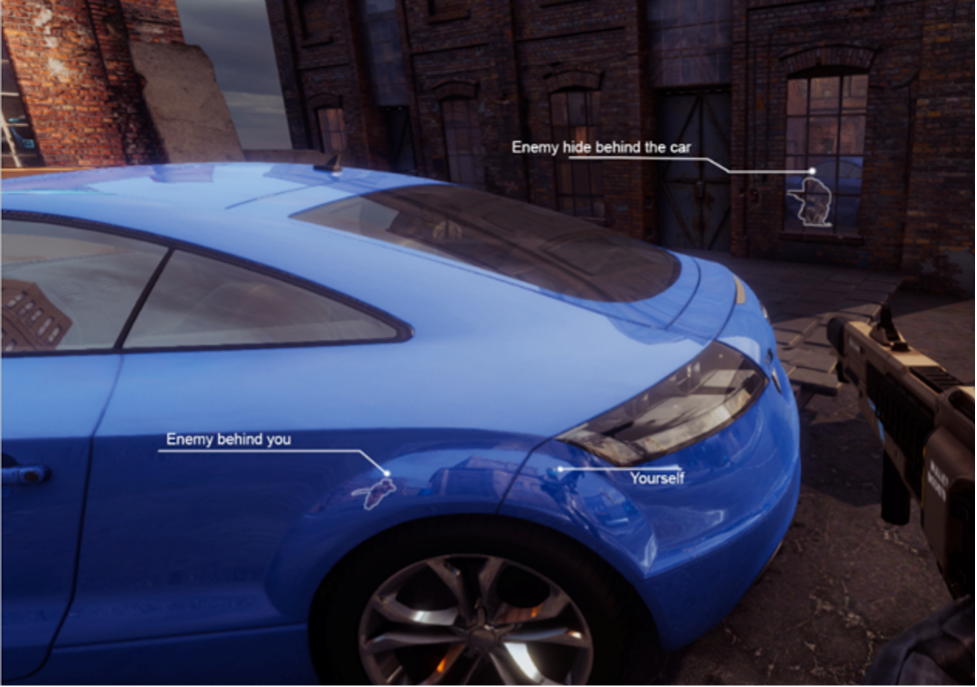
Figure 1. The enemies can appear outside the current view. (Source: RTRR inventor)
3. Agency: Reflections can become rules, not scenery
Engagement intensifies when information supports a meaningful choice. Once reflections can be trusted, designers can build mechanics around them. In stealth, players may read patrol routes from curved machinery. In horror, the reflection may contradict the visible room. In racing, damage to a mirror can remove an information channel. In a puzzle, several non-planar surfaces can relay fragments of a scene that only align from the correct position.
This changes the status of the effect. The question is no longer, How shiny should this object be? It becomes, What does this surface allow the player to know or do? That shift is commercially important because mechanics are more memorable than polish alone. A beautiful reflection may impress once; a reflection that helps the player anticipate, decide, and master a system can support a sustained loop of attention and reward.
4. Continuity: Engagement depends on frame time
A visually convincing effect can still damage the experience if it introduces latency, unstable frame pacing, or a hardware barrier. Engagement is temporal: The player must remain inside an uninterrupted cycle of perception and response. For this reason, the performance ambition of RTRR is not separate from its experiential value. If dynamic curved reflections can run on standard raster hardware, more devices can support them and more of the performance budget can remain available for animation, physics, AI, and input responsiveness.
The point is not that every game should maximize reflective detail. It is that a lower-cost reflection path can give designers a choice: spend the saved budget on more reflective gameplay surfaces, hold a higher frame rate, or redirect resources to the systems that matter most for the intended experience.
Why current techniques force a compromise
Planar reflections are effective for flat mirrors or calm water, but they do not solve the geometry of a helmet, a vehicle body, or a polished sphere. Environment maps are efficient on curved surfaces, yet their captured viewpoint can produce incorrect perspective and occlusion, particularly when objects are close. Screen-space methods are dynamic and economical but cannot reflect information that is absent from the current screen. Ray-traced reflections can include off-screen geometry and complex light paths, but they introduce a different cost, performance and hardware equation.
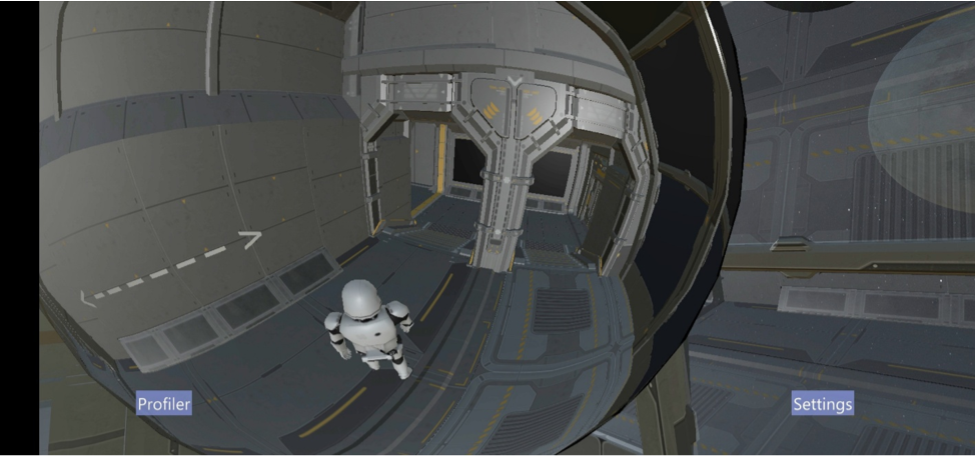
Figure 2. RTRR—A character outside the active camera view appears inside the curved reflection. (Source: RTRR inventor)
Production engines often combine these approaches in a hierarchy, trading accuracy against cost. That pragmatic mixture works, but it also limits when a designer can depend on a reflection as a source of gameplay information. A reflection that fades, misses an occluded actor, or changes character as the camera moves may be acceptable as atmosphere; it is far harder to use as a reliable rule.
What RTRR does differently
The patented (five US patents) RTRR raster technology reframes the problem around the reflective surface. First, the non-planar surface is rasterized into “receiving” pixels, each carrying position and normal (a vector that points straight out from a surface) information. The surrounding scene geometry is organized in an acceleration structure (a spatial data organization method to speed up intersection tests between “receiving” the pixel’s normals and surrounding 3D geometry). A per-pixel search uses that information to locate an intersected target triangle and an associated “emitting” pixel. Visual attributes, including depth, color, lighting, texture, and material data, are copied to the receiving pixels and written into a reflection buffer, and then merged into the final frame.
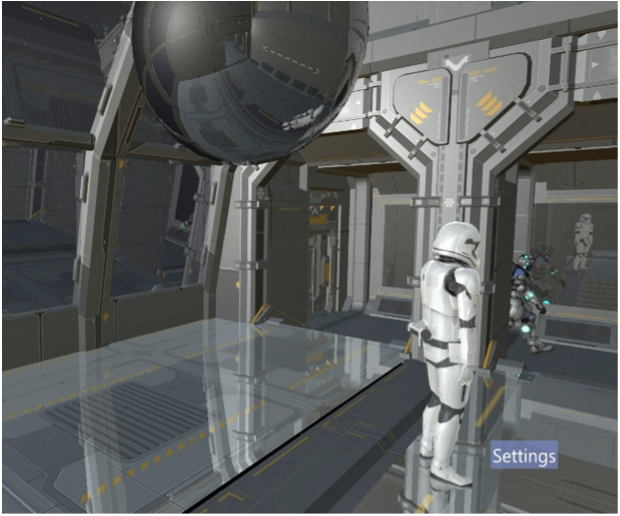
Figure 3. The test scene combines planar and non-planar reflective surfaces with dynamic characters. (Source: RTRR inventor)
In plain language, the method asks each relevant pixel on the curved surface what part of the surrounding scene it should return, then assembles those answers into the reflection. The acceleration structure reduces the search cost, while GPU parallelism allows many receiving pixels to be processed at once. The patent also describes separate handling for dynamic, skinned objects so that animated characters can participate in the mirrored scene.
This is still a raster solution, not a claim that the entire light-transport problem has been solved. The practical value is narrower and more useful: RTRR is designed to produce dynamic reflections on curved surfaces, including content outside the active camera view, within a standard raster-oriented pipeline.
From graphics feature to game-design platform
The strongest product story for RTRR is, therefore, not a checklist for rendering advantages. It is a portfolio of player experiences that become easier to build. A social game can let self-embodied players recognize themselves in shared spaces. A stealth title can place discoverable threats in car paint, helmets, or machinery. A narrative game can use a mirror to reveal an emotional state the character conceals in direct view. A mobile action game can provide peripheral information without crowding the screen. A puzzle game can make reflection chains the core language of the level.
These ideas share a common engagement loop. The reflection attracts attention, the player interprets it, the information changes a decision, and the world confirms the result. That loop supports presence because the world feels coherent, competence because the player learns to read it, and agency because observation leads to action.
The opportunity: Do not market RTRR only as “ray-tracing-like reflections for less.” Position it as a new design surface: a way to embed identity, clues, threats, and narrative information directly into the materials of the world.
The performance demonstration
In developer-supplied material, an Android demonstration on a Samsung Galaxy S25 reports an application output of a 2246 × 1080 resolution at 120 fps, or approximately 8.33 ms per frame. The same on-screen panel indicates a custom reflection resolution of 70%, shown as 1572 × 756. The demonstration is notable because it places dynamic non-planar reflections on a consumer mobile device without dedicated ray-tracing hardware.
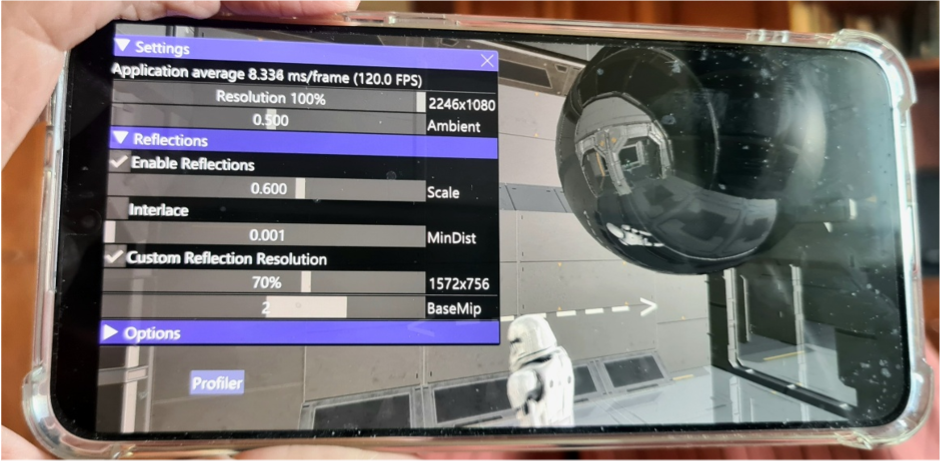
Figure 4. Developer demonstration on a Samsung Galaxy S25: 120 fps application average at 2246 × 1080, with the reflection pass shown at 70% (1572 × 756). (Source: RTRR inventor)
When the image answers back
The future of game graphics will not be defined only by how closely an image resembles reality. It will be defined by how effectively the image participates in play. Reflections are a compelling test case because they can operate simultaneously as light, space, interface, and story.
RTRR matters because it makes that participation practical: accurate enough to trust, dynamic enough to surprise, fast enough to preserve responsiveness, and accessible enough to reach devices beyond high-end ray-tracing hardware. At that point, the player is no longer looking at a polished surface. The surface is looking back, returning information and inviting the player to fully engage. Real-time reflection is not about aesthetics; it is about a new level of challenges and a new generation of gaming.
Further reading
• U.S. Patent No. 12,682,541. “Non-planar real-time mirroring by raster graphics,” issued July 14, 2026. Patent description of the receiving-pixel, acceleration-structure and reflection-buffer method. Open source
• Gonzalez-Franco and Peck (2018). “Avatar Embodiment. Towards a Standardized Questionnaire,” Frontiers in Robotics and AI 5:74. Review of body ownership, agency, co-location and appearance in virtual embodiment. Open source
• Kapah et al. (2026). “Virtual Embodiment in virtual mirrors and presence: effects on adolescent self-esteem,” Frontiers in Virtual Reality. Evidence linking virtual-mirror embodiment with higher reported sense of presence, with important limits on broader causal claims. Open source
• Epic Games documentation. “Reflections Environment in Unreal Engine.” Official description of the view-dependent and off-screen limitations of Screen Space Reflections. Open source
What do we think?
RTRR is compelling because it reframes a rendering feature as a design surface. Five patents, a working desktop and mobile demos, and SDKs suggest real engineering, not just concept art. The bigger question is adoption: Engines and studios must trust reflections as gameplay-critical before mechanics get built around them. If integration partners emerge, RTRR could reshape how designers treat curved surfaces.
Inflection point: Does RTRR forecast an inflection point in real-time graphics? We think it points toward one. For years, reflection quality meant visual polish, a nice-to-have layered onto finished scenes. RTRR argues reflections can instead carry gameplay information, identity, and consequence, closing the loop between seeing and acting. Combined with mobile-class performance without dedicated ray-tracing hardware, this reframing could mark an inflection point where curved surfaces stop being decoration and start being interfaces, reshaping how designers build presence and agency into worlds.
Dr. Reuven Bakalash ([email protected]) is a computer scientist who researched and taught at Stony Brook, NY, Hofstra, NY, and BGU, Israel, and founded four start-ups.
Dr. Tomer Bakalash is a social psychologist, brain and marketing researcher (neuromarketing), specializing in consumer behavior and decision-making.
LIKE WHAT YOU’RE READING? DON’T KEEP IT A SECRET, TELL YOUR FRIENDS AND FAMILY, AND PEOPLE YOU MEET IN COFFEE SHOPS.