
Nvidia reported $96.2 billion in Q2 fiscal 2027 revenue, with Data Center sales reaching $89.0 billion as Blackwell Ultra deployments accelerated. The company paired strong margins and earnings with expanding financial commitments: $279 billion for supply and capacity, $29 billion in cloud agreements, and long-term data center leases and equity investments. Nvidia also committed credit support for AI-cloud infrastructure, including up to $105 billion tied to an Ohio OpenAI campus. The strategy secures demand, power, capacity, and customers, while increasing exposure to financing and counterparty risk.
Nvidia posted $96.2 billion in revenue for Q2 fiscal 2027, up 18% sequentially and 106% year over year. Data Center hit a record $89.0 billion, up 117% year over year and 18% sequentially, driven by the Blackwell Ultra ramp. Hyperscale revenue more than doubled year over year, up 13% sequentially. ACIE (AI Clouds, Industrial, and Enterprise) revenue jumped 138% year over year and 25% sequentially, driven by AI natives, enterprises, sovereign customers, and hyperscalers running AI clouds. China Hopper shipments stayed under 1% of Data Center revenue. Edge Computing reached $7.2 billion, up 27% year over year and 13% sequentially, driven by strong Blackwell workstation sales, though elevated memory and systems prices tempered consumer PC demand.
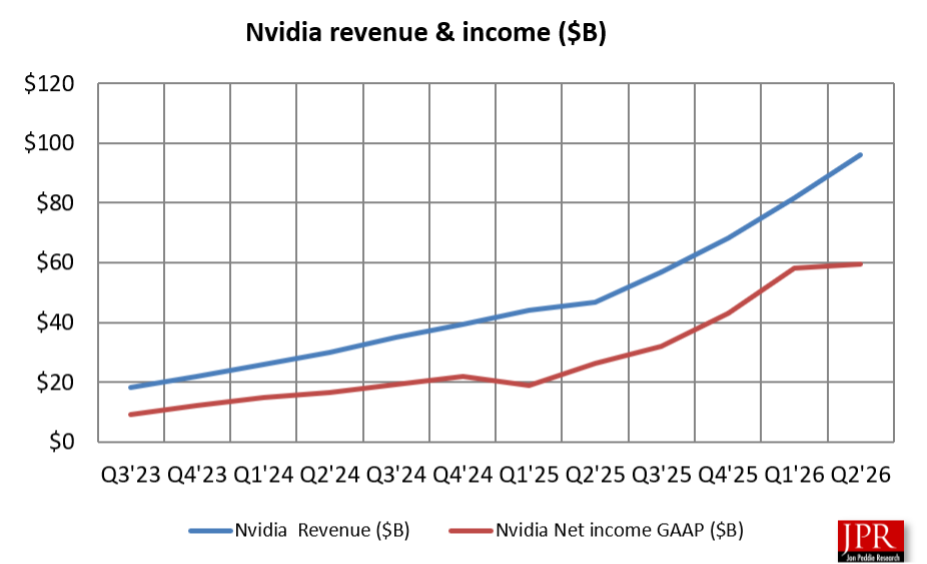
Figure 1. Nvidia’s sales and profits over time. (Source: Nvidia/JPR)
“AI has reached its inflection point. It’s doing useful work. Its tokens are productive and profitable. Now, compute is revenue,” said Jensen Huang, founder and CEO of Nvidia. “And demand is accelerating. This time last year, one lab alone was driving the build-out; today, we have a golden age of new AI labs and start-ups, multiple frontier labs scaling in parallel, a thriving open-model ecosystem and physical AI coming online—with strong momentum across the US and around the world. The AI infrastructure build-out is at full steam. Vera Rubin, now in full production, was built to power exactly this moment.”
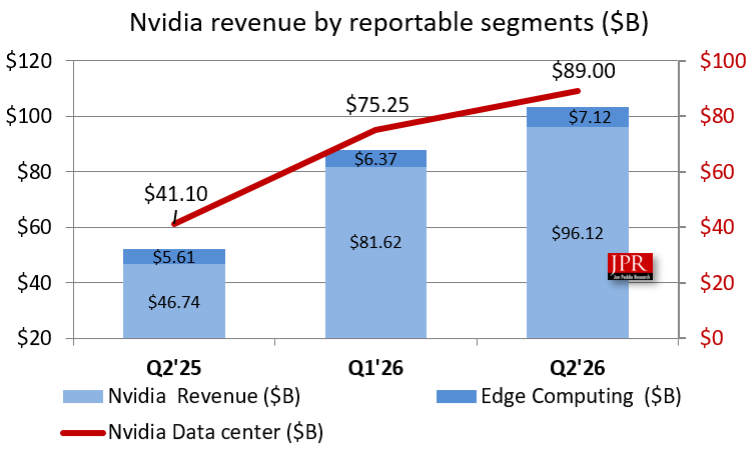
Figure 2. Data Center sales continue to overwhelm all other segments of Nvidia’s business. (Source: Nvidia/JPR)
Both GAAP and non-GAAP gross margins came in at 75.0% for the quarter. GAAP earnings per diluted share hit $2.46, non-GAAP $2.22. Nvidia returned roughly $26.0 billion to shareholders through buybacks and dividends during Q2 fiscal 2027, leaving about $99.0 billion remaining under its repurchase authorization. The next quarterly dividend, $0.25 per share, pays October 1, 2026, to shareholders of record as of September 10.
As part of being a full-stack supplier, Nvidia has to get increasingly involved with its customers’ business and do what it can to ensure their health. Said Colette Kress, Nvidia EVP and CFO, “Nvidia continues making strategic commitments across our supply, infrastructure, and partner ecosystems to capitalize on the substantial growth ahead of us. We’ve partnered with our extensive supplier network to secure critical components needed to meet demand for the next several years. Our commitments increased from $119 billion last quarter to $279 billion, primarily for memory procurement. Our cloud service agreements and data center lease commitments provide the physical and cloud infrastructure powering our R&D—from engineering, designing, and testing our compute chips, networking products, and systems, to developing our open models, including Nvidia Nemotron, Nvidia Cosmos, and GR00T, and our autonomous vehicle software. Our upcoming data center leases run terms up to 20 years, expected to commence between fiscal 2027’s third quarter and fiscal 2033. Our equity investments target AI model makers, infrastructure financiers, and other private companies, subject to certain contingencies.”

Securing land, power, and shell for data centers has become the next phase in the AI infrastructure build-out. AI clouds and model makers see extraordinary demand for AI infrastructure; many are growing faster than their balance sheets and credit profiles support. In response, Nvidia has entered into arrangements helping select customers secure the land, power, and data center capacity their growth needs. “We’ll focus on exceptional sites where visible, durable demand supports multiple generations of Nvidia compute. We’ve partnered with leading AI clouds to broaden access to our AI infrastructure, serving AI start-ups, model builders, enterprises, research organizations, and sovereign customers. Under these agreements, we earn revenue on the upfront infrastructure sale and, where certain criteria are met, participate in revenue share from the AI clouds generated by third-party customers,” said Kress. “We signed data center lease agreements with terms of approximately 15 years, expected to commence between fiscal 2028 and 2029. We expect to reassign these leases to third parties.”
Future commitments by fiscal year as of July 26, 2026, were as follows:

Kress stated: “We guarantee land, power, and shell obligations for certain AI cloud partners’ data center leases in case of default, with maximum gross exposure of $3.5 billion across all agreements. In August 2026, we entered guarantees providing credit support on land, power, and shell build-out to secure approximately 4.25 GW at SB Energy’s PORTS-Pike Technology Campus in Ohio, exclusively hosting Nvidia infrastructure under 20-year leases to OpenAI, subject to limited exceptions. Our guarantee obligations cap at $105 billion total, becoming effective in phases as conditions are met, including data centers reaching service-ready status, with the first expected in fiscal 2029. Exposure declines as OpenAI fulfills lease payments. We also hold the option to phase in credit support for approximately 3.8 additional GW as the site scales. Each generation of Nvidia infrastructure deployed at PORTS-Pike could represent roughly 1.5 million Nvidia GPUs, or $150-200 billion in Nvidia revenue. Over 20 years, the site can support multiple infrastructure upgrade cycles.”
The table below summarizes maximum gross exposure across Nvidia’s guarantees, including the August 2026 SB Energy Corp. guarantees (in billions):

Cash, cash equivalents, and marketable debt securities were $56.6 billion, up from $53.6 billion a year ago and up from $50.3 billion a quarter ago. These changes were driven by higher free cash flow that was used to return a record of nearly $26 billion.
What do we think?
Nvidia beat Wall Street’s Q2 targets on both lines Wednesday and issued a stronger-than-expected Q3 outlook. Adjusted EPS came in at $2.22 versus the $2.09 analysts expected, on revenue of $96.2 billion versus $92.3 billion expected, nearly double the same quarter last year. Q3 guidance calls for $105.8 billion to $110.1 billion in revenue, well above prior estimates. Nvidia stock fell more than 2% on the news anyway, extending a pattern that’s held for a year: The company keeps beating expectations, and investors keep penalizing the stock after each report.
Nvidia’s share price has risen just 12% since the start of 2026, roughly a fifth the gain of a leading chipmaker index. Jensen Huang has answered with a run of dealmaking aimed squarely at demand. On August 10, he announced a partnership with six major Wall Street firms, including BlackRock and Goldman Sachs, targeting $500 billion for AI infrastructure financing. A week later, Nvidia committed up to $105 billion in credit support to help OpenAI lease a massive Ohio data center.
These deals raise real circular-financing concerns: Nvidia funding the same customers that buy its chips. Huang now has to convince investors that the demand this creates justifies the financial risk Nvidia is taking on.
Shares had risen about 2% the day before earnings, snapping Nvidia’s longest losing streak in four years and helping lift the broader market. Given how closely other stocks tend to move with Nvidia’s results, this report and its aftermath carry implications well beyond one company’s balance sheet.
AWS (Nasdaq: AMZN) and Nvidia (Nasdaq: NVDA) announced a major AI collaboration expansion. AWS plans to deploy 2 million additional Blackwell Ultra, Rubin, and Rubin Ultra GPUs across its global infrastructure in 2027–2028, including AI factories.
The companies plan US government AI factories with 100,000 GPUs on secure AWS infrastructure, Nvidia Vera CPU-based infrastructure on AWS, extended NVLink Fusion with NVHBM, and integration between Nvidia’s platform and AWS Nitro and EFA. The collaboration also expands Nemotron model support, GPU-accelerated data processing on Amazon EMR and OpenSearch, and physical AI robotics through Amazon Robotics adopting Nvidia’s Jetson, Omniverse, and Isaac.
Meanwhile, shares of the AI hardware giant surged after the company beat on earnings and signaled strong AI demand throughout next year.
WHATYA THINK? LIKE IT? DON’T BE STINGY, SHARE IT WITH YOUR FRIENDS.