
IBM just showed off a mainframe chip that runs two completely different instruction sets on the same core, natively, with no emulation involved. Announced at Hot Chips, this is the first real product to come out of IBM’s April 2026 partnership with Arm, and it lets future IBM Z and LinuxONE systems run Arm-native Linux side by side with z/OS. We walk through the architecture, the real specs behind the 2 nm chip, and what running two ISAs on one core actually means for enterprise infrastructure teams.
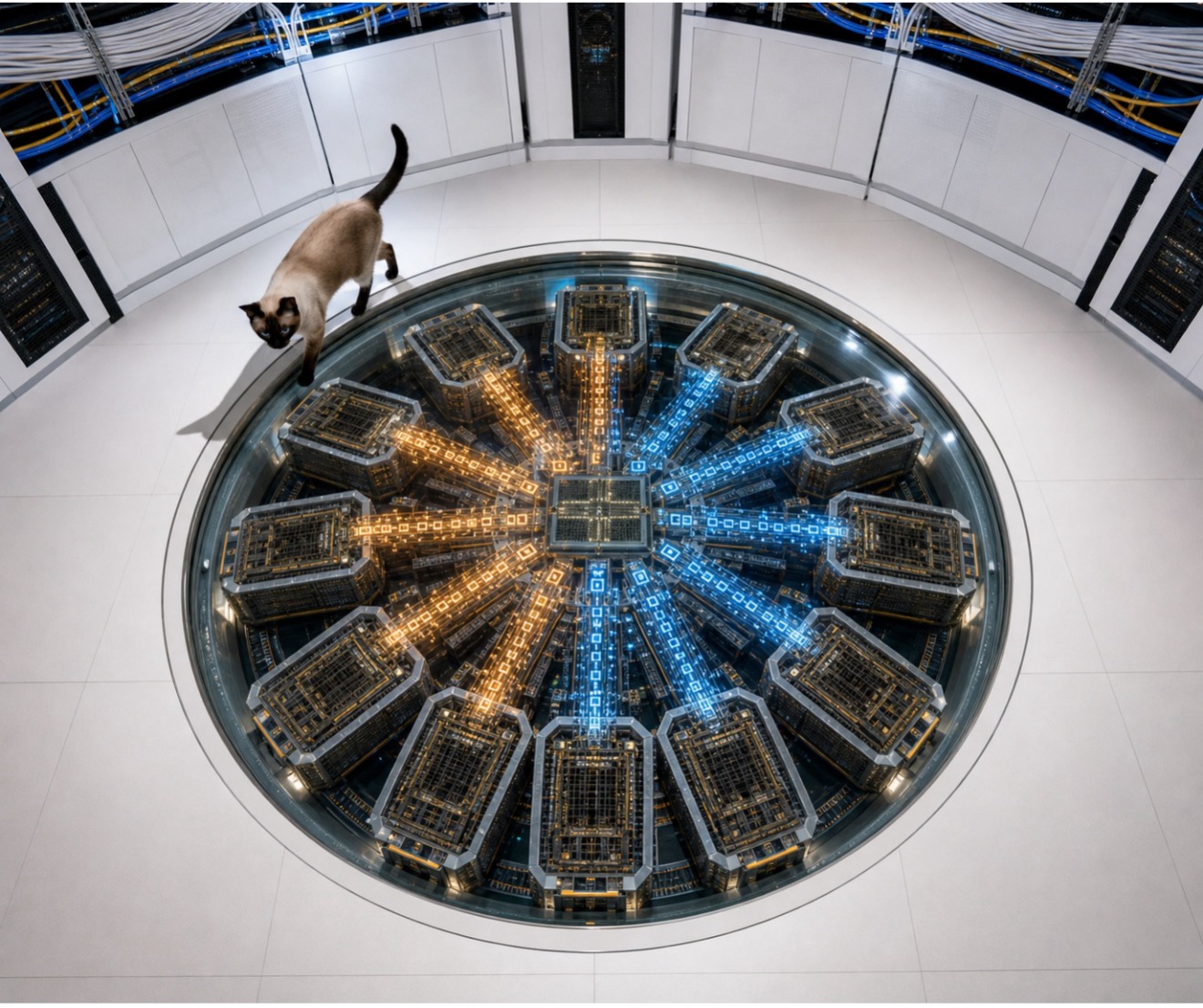
IBM unveiled its first dual-architecture mainframe processor at Hot Chips on August 24, 2026, the first real product to emerge from the IBM-Arm collaboration announced in April 2026. The chip lets future IBM Z and LinuxONE systems run Arm-native Linux environments alongside z/OS and existing Linux workloads, on the same hardware. The core architecture avoids the obvious approach entirely: Instead of pairing separate Arm cores with separate IBM Z cores on one die, every core natively executes both instruction sets, switching between Arm AArch64 and IBM Z or LinuxONE instructions in nanoseconds, with no emulation layer involved.
For silicon teams, the interesting engineering problem sits in the decode stage, not the execution units. A processor that switches ISAs in nanoseconds without emulation needs decode logic that recognizes and dispatches two completely different instruction encodings on the same pipeline, not a software translation layer sitting between the code and the hardware. That distinction matters directly for latency-sensitive transaction workloads, where an emulation or binary-translation approach would add exactly the kind of overhead IBM Z customers can’t tolerate.
The processor runs on a 2 nm process node with 11 high-performance cores clocked above 5.7 GHz. Cache architecture scales for data-intensive enterprise workloads: up to 3.5 GB of virtual L4 cache, 36 MB of private L2, and 432 MB of virtual L3. Dedicated silicon handles AI inference for in-transaction fraud detection, a data processing unit accelerates I/O directly on-chip, and separate units handle compression, cryptography, and sorting, each pulled off the general-purpose cores and given its own hardware path.
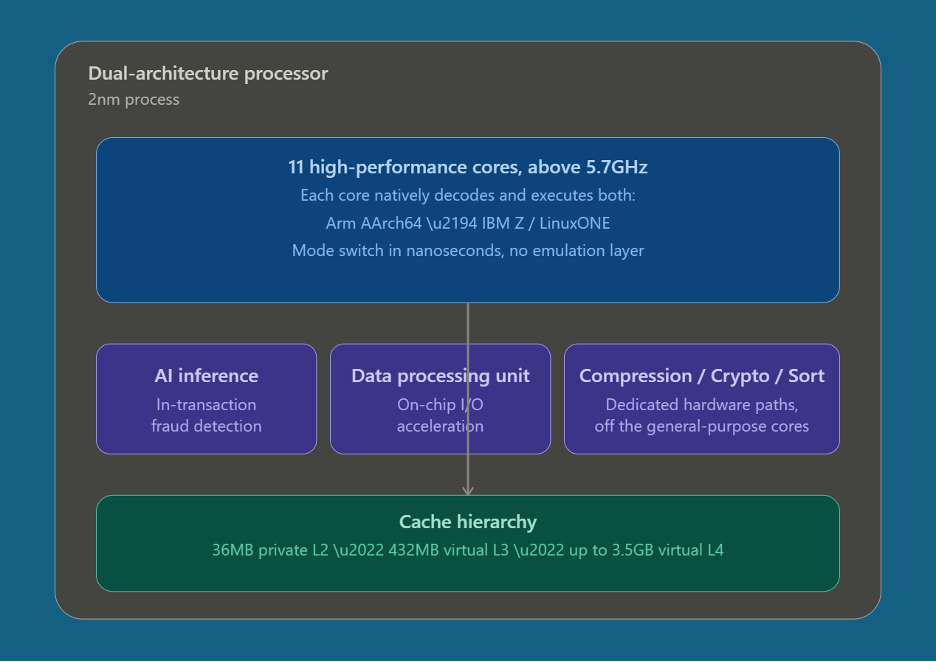
Figure 1. Generalized block diagram of IBM’s unnamed Arm-based IBM Z/LinuxONE processor.
None of those four dedicated accelerators are new categories for IBM Z, and that’s the point. Compression and sorting trace directly back to the batch-processing workloads that mainframes have run for decades—still central to how banks and insurers close books and settle transactions overnight. Cryptography maps to the encryption-at-rest and PCI-compliance requirements regulated industries can’t negotiate away. Fraud-detection AI inference is the newest addition to that list, running as dedicated silicon instead of a general-purpose accelerator call, keeping detection latency inside the same transaction cycle instead of routing out to a separate inference service. Building AI acceleration on the same footing as compression and cryptography signals where IBM expects AI workloads to sit going forward: as core transaction-processing infrastructure, not a bolt-on service.
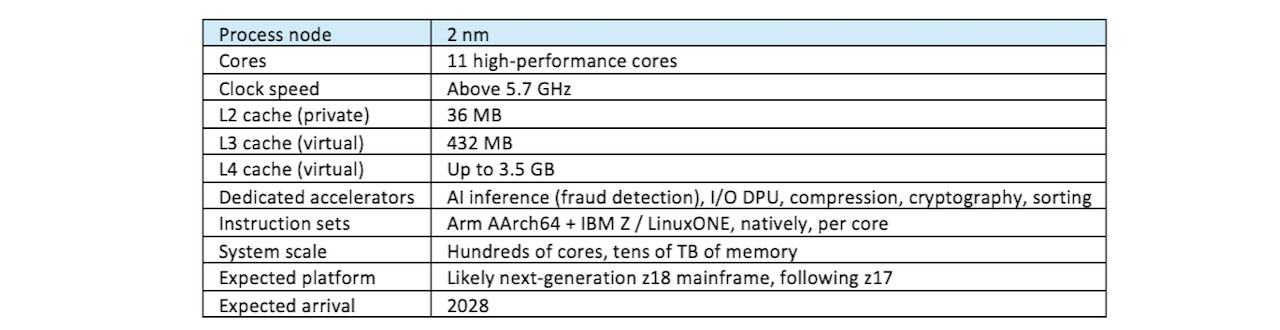
Table 1. Spec detail. (Source: IBM)
IBM Z and LinuxONE systems built around this processor scale to hundreds of cores and tens of terabytes of memory. That scale now carries direct access to Arm’s software ecosystem, more than 22 million developers building cloud, edge, cloud-native, and AI applications, running on infrastructure IBM built for transaction processing and data-intensive operations. Arm workloads inherit IBM’s existing enterprise capabilities in the process: hardware-level fault detection and recovery, advanced encryption, secure key management, and AI acceleration, the same characteristics IBM Z customers already depend on.
Christian Jacobi, IBM’s chief technology officer for systems development, frames the chip as answering a specific organizational need: modernizing application portfolios and integrating AI into core business operations without abandoning the infrastructure already running them. Mohamed Awad, Arm’s executive vice president of Cloud AI, ties the move to a broader shift, more of the computing landscape converging on Arm as AI scales, extending that momentum into regulated industries that depend on IBM Z and LinuxONE for their most demanding workloads.
The strategic reversal here deserves its own line. IBM Z has run on IBM’s own proprietary instruction set for six decades, architectural exclusivity as much a selling point as a technical constraint, the guarantee that mainframe workloads ran on hardware purpose-built for them and nothing else. Opening a core to a second, competing ISA changes that calculus directly: IBM is betting that access to Arm’s ecosystem gravity is worth more than protecting architectural exclusivity, a bet few enterprise hardware vendors with IBM’s installed base and customer lock-in have historically been willing to place.
The practical shift lands on migration math. Enterprises running Arm-native cloud and AI applications no longer need to port that code to run on IBM Z hardware, and organizations running z/OS don’t need to migrate critical workloads off IBM’s platform to gain access to Arm’s ecosystem. Both run on the same silicon, in the same system, switching instruction sets at the core level instead of the application level.
That distinction carries different weight for the two audiences IBM is courting here. For ISVs, it removes the standard justification for skipping IBM Z entirely: An Arm-native application built for cloud deployment no longer needs a separate mainframe port, a separate build pipeline, or a separate QA cycle to reach that customer base. For CIOs, it reframes a decision that used to carry real platform risk. Adopting Arm-based tooling on a mainframe previously meant either running it on separate hardware alongside IBM Z, adding an integration layer, or accepting a rewrite. Native dual-ISA execution turns that into a deployment decision inside infrastructure already budgeted for, not a new procurement conversation.
IBM hasn’t named the processor or confirmed which system ships it first. The timeline points to 2028, likely arriving as part of the next z18 mainframe generation following the current z17 line. The architecture question has an answer now; the product question waits two more years.
What do we think?
This processor solves a real problem, not a marketing one: Enterprises stuck choosing between Arm’s software ecosystem and IBM Z’s transaction guarantees now get both on the same silicon. The harder test comes in 2028, when IBM has to prove native dual-ISA execution holds up under real production fraud-detection workloads at the latency and reliability levels mainframe customers never tolerate compromising.
Inflection point. The real signal here isn’t AI acceleration; every chip announcement claims that now. It’s IBM abandoning ISA purity on its own flagship platform to chase Arm’s ecosystem instead of forcing that ecosystem to chase IBM. When a company built on architectural exclusivity for six decades decides native multi-ISA execution matters more than protecting that exclusivity, that’s the inflection point worth watching: Enterprise infrastructure decisions increasingly follow software ecosystem gravity, not instruction-set loyalty, and even mainframes aren’t exempt anymore.
LIKE WHAT YOU’RE READING? TELL YOUR FRIENDS; WE DO THIS EVERY DAY, ALL DAY.