
At Qualcomm’s invite-only Maui summit, the Snapdragon 8 Elite Gen 5 took the stage like a new lead actor. It pairs the third-gen Oryon CPU—matched to the PC line on Arm v9—with a TSMC N3P build, prime cores up to 4.6 GHz, a faster NPU, and an Adreno GPU redesigned for UE5, DX12, and Vulkan 1.4. An 18 MB HPM cache boosts bandwidth and efficiency. Phones began with Xiaomi 17 in late 2025, with broad OEM rollouts and Samsung’s Galaxy S26 following into early 2026.

At its elite invitation-only September Snapdragon Summit in Maui, Qualcomm unveiled the Snapdragon 8 Elite Gen 5 as its flagship SOC for smartphones. It incorporates the third-generation Oryon CPU, aligning the mobile version precisely with the PC counterpart for the first time. Both platforms run Arm v9 instruction sets. TSMC fabricates the chip using its N3P 3 nm process node, with a focus on transistor performance. The CPU features two high-performance cores that reach 4.6 GHz and six performance cores operating at 3.6 GHz, totaling eight cores. Independent clock-speed tests confirm the 4.6 GHz prime cores surpass all existing mobile Arm processors. The chip’s NPU offers 37% higher throughput than its predecessor. And the Adreno GPU has been equipped with a dedicated high-performance memory subsystem and next-generation slice architecture, resulting in 23% higher peak performance and 20% lower power consumption compared to the previous implementation. The memory controller supports up to 24 GB of LPDDR5X-9600.
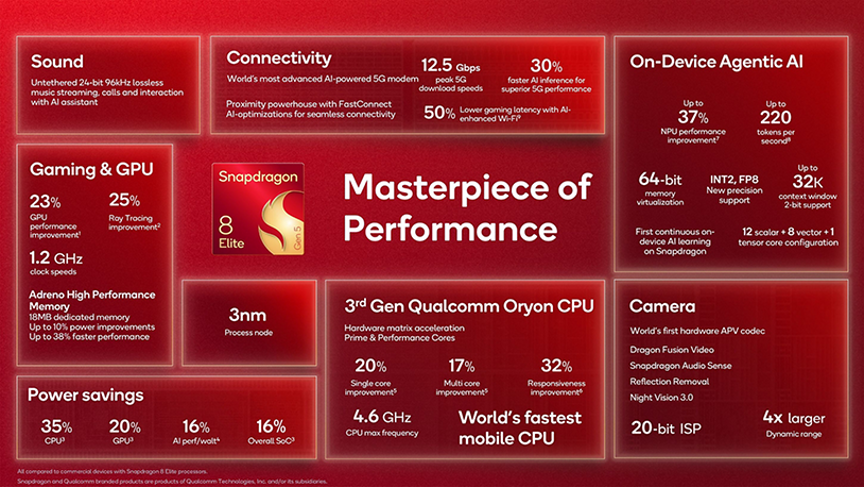
Figure 1. Snapdragon 8 Elite Gen 5 organization. (Source: Qualcomm)
Qualcomm’s dedicated High-Performance Memory (HPM) architecture features an 18 MB cache that improves visual rendering, reduces fetch latency, and boosts power efficiency. HPM boosts memory bandwidth by 38%, enabling smoother and immersive gameplay, console-quality visuals, and faster load times. The HPM architecture is part of Qualcomm’s Snapdragon 8 Elite Gen 5 Mobile Platform, which promises to revolutionize mobile gaming and AI experiences.
The GPU is now compatible with Epic’s Unreal Engine 5, mesh shading, and hardware-accelerated ray tracing. The Snapdragon 8 Elite Gen 5’s Adreno GPU now officially supports DirectX 11 and DirectX 12, as well as Vulkan 1.4. The chip is designed with hardware features that support these modern graphical standards. supporting up to three 4K displays at 144 Hz or two 5K displays at 60 Hz.
Phones with Snapdragon 8 Elite Gen 5 began arriving in late September 2025 with Xiaomi 17. Additional launches follow from OnePlus and others, with Samsung’s Galaxy S26 slated for early 2026. More launches roll through late 2025. Qualcomm lists global OEM partners: Honor, iQOO, Nubia, OnePlus, Oppo, Poco, Realme, Redmi, RedMagic, ROG, Samsung, Sony, Vivo, Xiaomi, and ZTE, all planning devices on the 8 Elite Gen 5. Qualcomm also plans a Snapdragon 8 Gen 5 variant arriving later in 2026.
Qualcomm has positioned the Snapdragon 8 Elite Gen 5 as an AI processor, putting it in competition with 137 other companies. The chip is expected to deliver 100 TOPS, a significant uplift from its original 40 to 45 TOPS.
Vulkan 1.4.332 includes Qualcomm’s VK_QCOM_data_graph_model and positions it to expand machine learning workflows built on Vulkan. The extension strengthens Qualcomm’s push to run ML models directly through GPU-driven data-graph execution. Interest in Vulkan-based AI continues to grow across the industry as vendors search for lower-overhead ML execution paths on modern GPUs.
If you’re interested in the AI processor market, check out our 377-page AIP market report, which includes SWOT, product descriptions, management, and industry background information on all the companies, and market forecasts to 2035, and comes with an in-depth database and consulting time for your unique questions.
We found 137 companies are making AI processors (or saying they will), of which 102 are start-ups.
Fourteen of the start-ups have been acquired by the whales; more are expected. Some have big investors behind them (like Thiel, Bezos, and SoftBank), while others are higher potential for investors. That’s in the report too. You can find a free summary presentation here.
LIKE WHAT YOU SAW HERE? SHARE THE EXPERIENCE, TELL YOUR FRIENDS.