
Qualcomm has split its flagship smartphone silicon into Snapdragon 8 Elite Gen 6 and Snapdragon 8 Elite Extreme Gen 6, using the pair to distribute AI work across the SoC. Both 2nm platforms combine a 5 GHz Oryon CPU, Adreno GPU, Hexagon NPU, Flex Cache, ISP, sensing hardware, and modern connectivity. Elite Extreme adds Adreno Matrix Cores, Neural Fusion, and 18 MB of high-performance GPU memory for neural graphics and larger local AI workloads. The design gives ISVs multiple execution paths for agents, imaging, gaming, and persistent inference, while CIOs gain a clearer foundation for privacy-aware mobile AI deployments.

Qualcomm announced the Snapdragon 8 Elite Gen 6 and Elite Extreme Gen 6 at its Snapdragon Summit event, both built on an unspecified 2nm process and both carrying redesigned Oryon CPU, Adreno GPU, Hexagon NPU, and Spectra ISP blocks. The two chips share an identical eight-core Oryon CPU configuration and two prime cores running up to 5 GHz alongside six Performance cores at up to 4 GHz, a combination Qualcomm calls the first mobile CPU design to reach 5 GHz. Both chips carry the same 16 MB Oryon Flex Cache, a dynamically allocated shared pool the prime cores draw from freely under heavy workloads instead of working within a fixed allocation, Larger working sets can, therefore, remain resident in cache instead of spilling into external memory, reducing latency and memory traffic as work moves between cores. CPU performance rises 10% on the standard Gen 6 and 13% on the Extreme against last generation, with power efficiency up 37% on both, gains Qualcomm attributes mainly to the 2nm process itself.
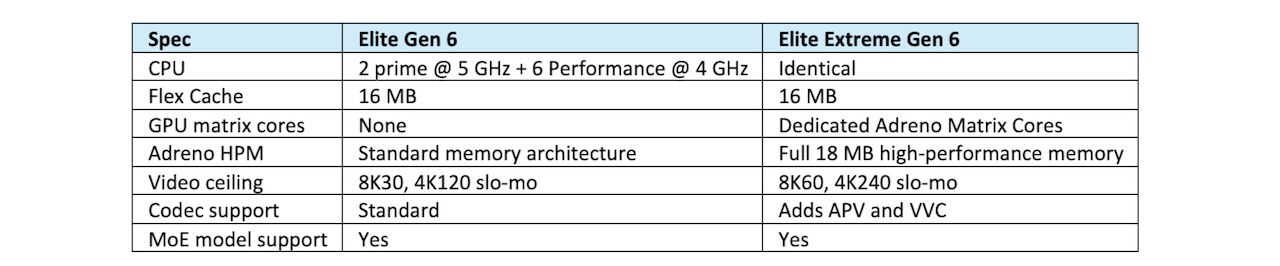
Table 1. Snapdragon 8 Elite Gen 6 specifications highlight Qualcomm’s expanding on-device AI architecture.
Qualcomm concentrates the generation’s real emphasis on agentic AI, where a system works through multiple steps, tools, and tasks instead of answering a single prompt. The redesigned Hexagon NPU adds a new Element Accelerator built specifically for transformer workloads, alongside 12 scalar units, eight vector units, and one tensor unit, plus a shared-memory subsystem 50% larger than the previous generation, keeping model state and intermediate tensors closer to the NPU instead of round-tripping through system memory. Qualcomm says the platform runs mixture-of-experts models exceeding 30 billion total parameters, with roughly 3 billion parameters actually routed and active per token in its own example, a distinction worth holding onto directly: an MoE model at that scale carries nowhere near the computational cost of a genuinely dense 30B-parameter model, since it never executes all its parameters for any single token. INT4 models see up to 50% higher prefill performance alongside faster decoding and enhanced speculative decoding, and Qualcomm supports a precision range spanning INT2 through FP16, including mixed precision.
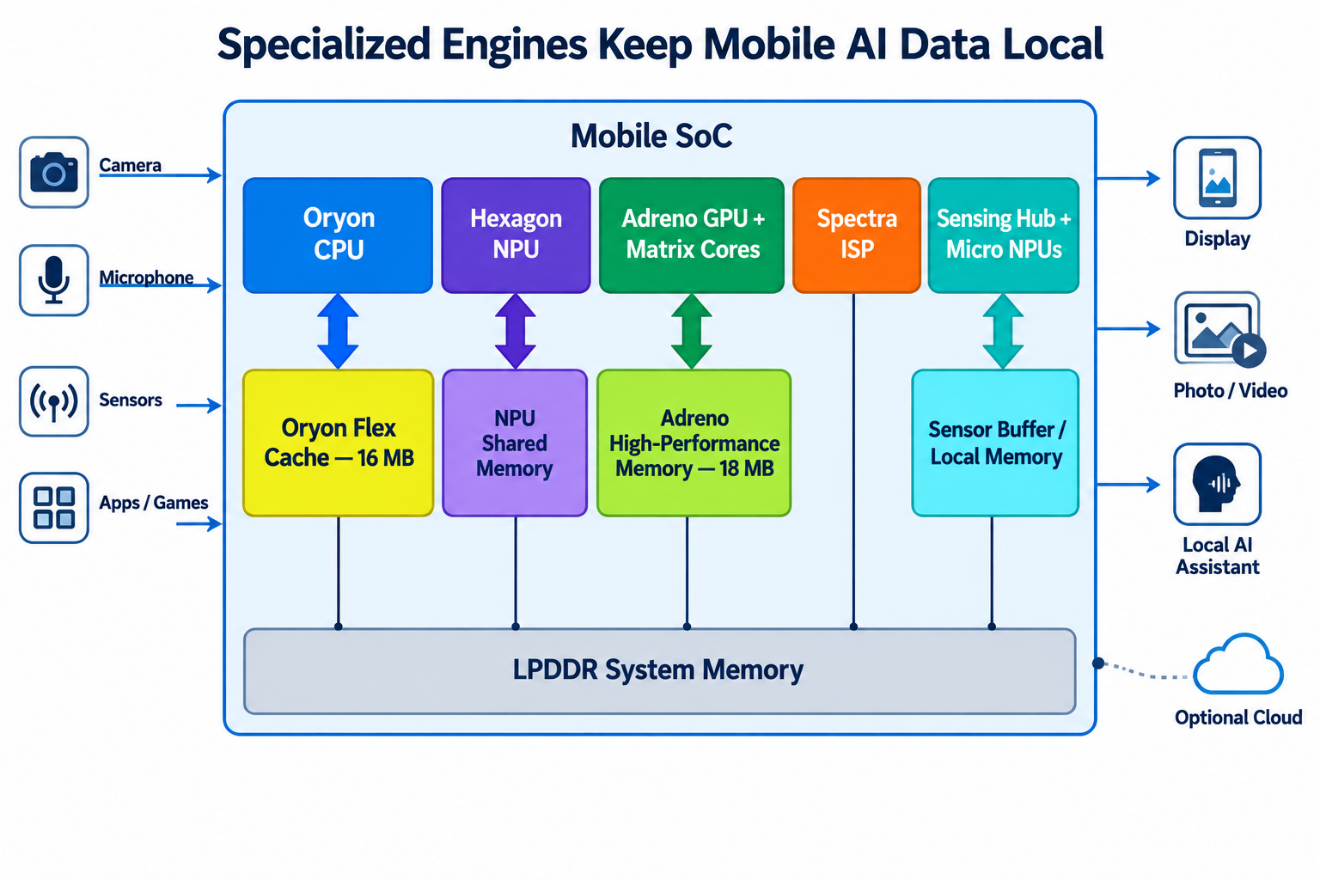
Figure 1. Specialized engines keep mobile AI data local.
A separate Sensing Hub sits alongside the main Hexagon NPU, carrying dual micro NPUs and dual always-sensing ISPs tuned for continuous low-power sensor processing. Qualcomm claims 85% more performance and 20% greater efficiency here than the prior generation, supporting models up to 200 million parameters and powering a Personal Scribe feature that builds personalized knowledge graphs from messages, emails, and phone conversations. Qualcomm states this processing happens on-device. Heavier agentic tasks still lean on cloud servers for additional compute regardless of what runs locally.
The GPU marks the real architectural split between the two chips. Both use a next-generation Adreno design built around three GPU slices, delivering 35% more performance on the standard Gen 6 and 44% on the Extreme against last generation, alongside a 40% gain in GPU power efficiency across both. Only the Extreme adds dedicated Adreno Matrix Cores, AI-specific GPU hardware built to run models directly inside the graphics pipeline, a design Qualcomm compares directly to Nvidia’s Tensor Cores. Those Matrix Cores anchor a new feature called Adreno Neural Fusion, combining AI super-resolution and frame generation directly in the graphics pipeline, functionally similar to Nvidia’s DLSS or Intel’s XeSS, with support built into Unity, Unreal Engine, and other development environments so developers can integrate it without building a separate rendering pipeline. The Extreme also carries the full 18 MB of Adreno High Performance Memory, keeping tiles, frame buffers, and compute data local to the GPU instead of transferring that data through system memory repeatedly, and picks up Unreal Engine 5’s MegaLights feature alongside hardware-accelerated ray tracing for Lumen and Nanite, capabilities the standard Gen 6 keeps at a reduced feature set.
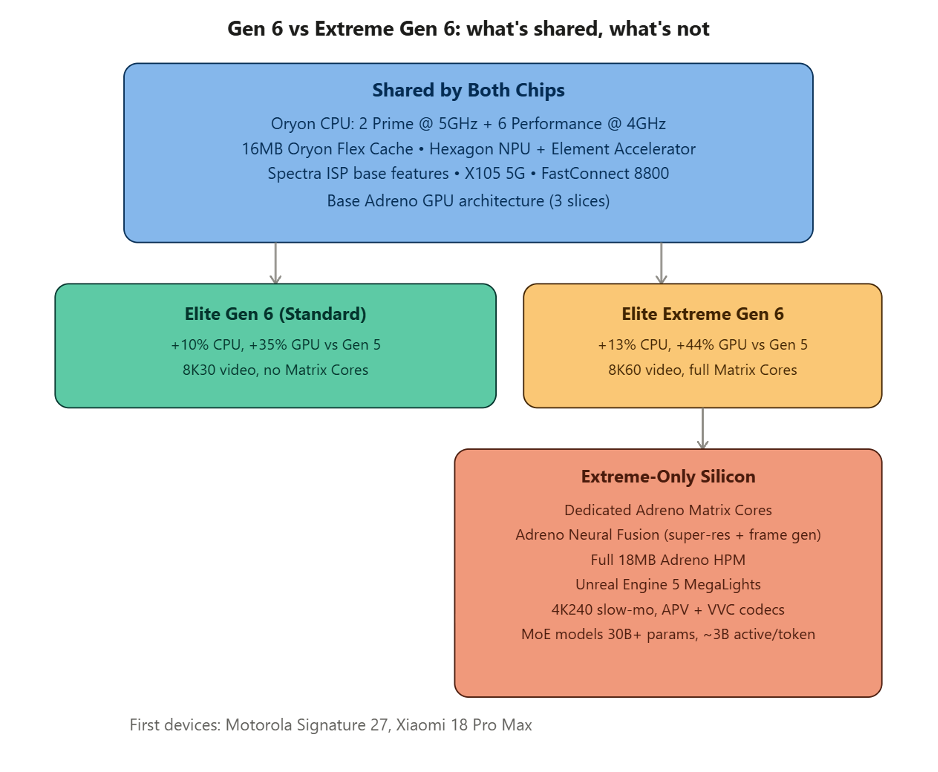
Figure 2. One CPU, two GPUs — dedicated matrix cores define the Extreme tier.
Camera capability follows a similar split. Both chips carry Qualcomm’s Spectra ISP with triple 20-bit AI ISPs, real-time 3D LUT support, and up to 320 MP still capture, alongside AI-assisted noise reduction and ultra-low-light 4K60 video. Qualcomm specifies 16 bits of AI data per pixel and describes the Spectra-Hexagon combination as delivering up to 256 times more granular AI data per pixel than before. The company never confirmed the exact baseline behind that figure; the most likely explanation is a shift from 8-bit to 16-bit precision on the underlying AI tag data. The Extreme raises the video ceiling to 8K60 and 4K240 slow motion against the standard chip’s 8K30 and 4K120, and adds support for the Advanced Professional Video codec developed jointly with Samsung, plus VVC support.
Connectivity stays identical across both chips. Qualcomm’s X105 5G Modem-RF System delivers 14.8 Gb/s peak downlink and 4.2 Gb/s peak uplink, roughly 18 and 14 % faster, respectively, than the previous-generation X85 modem, supporting 5G Advanced in both stand-alone and non-stand-alone modes, up to eight mmWave carriers, six-carrier aggregation with up to 500 MHz of downlink bandwidth, and six-antenna receive configurations. The X105 comes hardware-ready for 3GPP Release 19 and supports both NB-NTN and NR-NTN, opening a path toward satellite connectivity through standard cellular protocols. An integrated fifth-generation Qualcomm 5G AI processor handles additional network optimization directly. The FastConnect 8800 system adds Wi-Fi 8 with an 11.6 Gb/s peak PHY rate, Bluetooth 6.0 with Channel Sounding, Ultra Wideband, and Thread 1.4 support, all part of what Qualcomm frames as making the phone genuinely aware of its surroundings and nearby devices, not simply pushing higher raw throughput numbers.

Figure 3. The Motorola Signature 27 is the first phone to officially support Qualcomm’s new Snapdragon 8 Elite Extreme Gen 6. (Source: Motorola)
Motorola confirmed the Signature 27 as the first Extreme-powered phone, announced on stage at the Summit with a 50 MP Sony Lytia 910 main sensor and 200 MP periscope telephoto. Xiaomi plans an 18 Pro Max built on the Extreme chip, alongside a standard 18 Pro running the base Gen 6, launching close behind Motorola’s announcement.
What do we think?
The MoE claim deserves scrutiny from ISVs. Qualcomm says the platform can run models with more than 30 billion total parameters, with roughly 3 billion active for each token. That creates very different compute and memory requirements from a dense 30B model, where every parameter participates in inference. Treating the two as equivalent overstates the workload actually running on-device.
Qualcomm also spreads AI processing beyond the Hexagon NPU. Adreno Matrix Cores and Neural Fusion bring neural super-resolution and frame generation directly into the graphics pipeline, giving Qualcomm a hardware approach similar to Nvidia’s DLSS strategy.
The Sensing Hub adds another AI tier. Two low-power Micro NPUs process persistent contextual information from sensors and personal data, supporting agentic applications that maintain knowledge about the user while limiting reliance on the main NPU and CPU.
Inflection point. Splitting one flagship chip into two distinct silicon tiers marks a real inflection point in mobile processor strategy: AI capability now justifies its own dedicated hardware line, separate from raw CPU performance entirely. If dedicated matrix cores inside the GPU pipeline become standard practice across the industry, mobile AI stops depending on the general-purpose NPU alone, and graphics silicon itself becomes a genuine AI-compute platform ISVs need to target directly, not an afterthought running inference on borrowed cycles.

(Source: Qualcomm)
LIKE WHAT YOU’RE READING? TELL YOUR FRIENDS; WE DO THIS EVERY DAY, ALL DAY.