
The latest V-Ray 7 does not carry a new release number but rather a new update figure. Nevertheless, the added features and capabilities speak for themselves, making this offering significant. V-Ray 7, update 4 makes real-time rendering available in a multitude of digital content creation applications and, among other things, introduces the first way to relight fully ray-traced Gaussian splats.
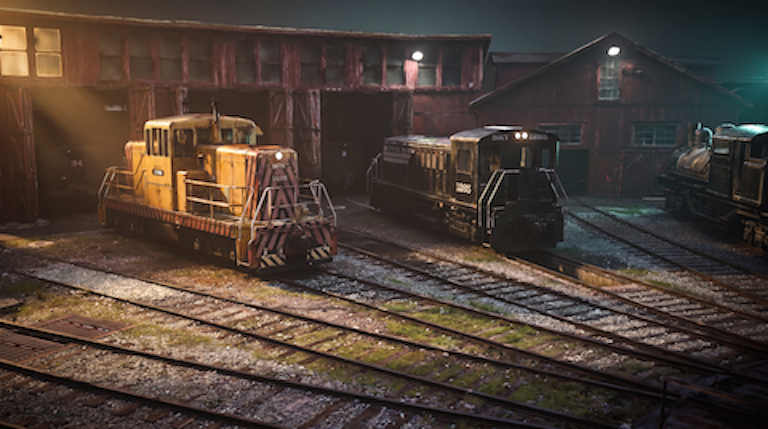
Chaos V-Ray 7, update 4 enables relighting of Gaussian splats. (Source: Chaos)
At Siggraph 2026, Chaos hosted a full day of talks, live demonstrations, and conversations centered around rendering, visualization, AI, and digital production. The day prior, the company kicked off the conference by announcing V-Ray 7, update 4, making real-time rendering with path-traced feedback available directly in almost every major DCC application’s viewport—without exporting assets to a separate game engine. So, from the start of a project, users get instant, path-traced feedback right where the artist works, without any tool switching, fewer conversions, and less rebuilding when working on their V-Ray scene.
The workflow is available through a Vantage Hydra Delegate for Houdini and an enhanced Maya Live Link, with 3ds Max integration introduced earlier this year. Support for Blender is coming soon via Live Link; Chaos is also developing an OpenUSD Hydra Delegate to bring Vantage’s real-time and V-Ray’s offline rendering into other host applications, including Nuke and Katana.
“Artists lose time when a scene has to be converted or rebuilt when it moves between tools,” said Allan Poore, chief product officer at Chaos. “V-Ray 7, update 4 keeps the same asset moving from early exploration to on-set production and final rendering. That means faster feedback, fewer technical interruptions, and more time to focus on the shot.”
With this update, users also can relight fully ray-traced Gaussian splats for blending scanned, real-world environments into 3D scenes. Because scanned environments usually include baked-in lighting that’s part of the original capture image, it becomes difficult to match the lighting to a 3D scene. Gaussian splat relighting, however, allows artists to adjust the lighting of captured environments in Houdini, Maya, 3ds Max, and Vantage (and coming soon to Blender) without re-creating the location or using complex workarounds.
Additionally, the release expands Chaos Arena’s real-time toolset for virtual production with new features such as real-time material editing, real-time depth of field, decal color corrections, and lens encoder support.
According to Chaos, V-Ray 7.4 delivers faster CPU and GPU rendering—GPU interactive previews can now begin up to twice as fast, while CPU rendering is up to 13% faster on supported configurations.
V-Ray 7.4 is available now, extending across Maya, 3ds Max, Blender, and Houdini.
WHAT DO YOU THINK? LIKE THIS STORY? TELL YOUR FRIENDS, TELL US.