
StepX Neo brings a different approach to smartphone AI, combining an agent-native operating system with Syntiant’s ultra-low-power neural processing technology. The phone uses six microphones and a dedicated NDP120 processor to maintain continuous audio awareness while conserving battery power. Its Step Amoo agent coordinates applications, services, and user requests through direct software interfaces. The architecture raises important questions about power efficiency, privacy, security, and the role of specialized AI silicon in smartphones that increasingly operate on behalf of their owners.
Shanghai-based StepFun has entered the smartphone market with the StepX Neo, a device that places an AI agent at the center of its operating system. Founded in 2023 by former Microsoft employees, StepFun previously supplied on-device AI technology to manufacturers including Oppo and Geely. The StepX Neo extends that work into a complete hardware and software platform.
The phone combines StepFun’s Step AOS operating system, its Step Amoo personal agent, a Snapdragon 8-series application processor, and Syntiant’s NDP120 Neural Decision Processor. Six Syntiant SiSonic MEMS microphones provide continuous audio input for voice interaction and environmental awareness.

Figure 1. The Snapdragon-Syntiant-based StepX Neo AI phone.
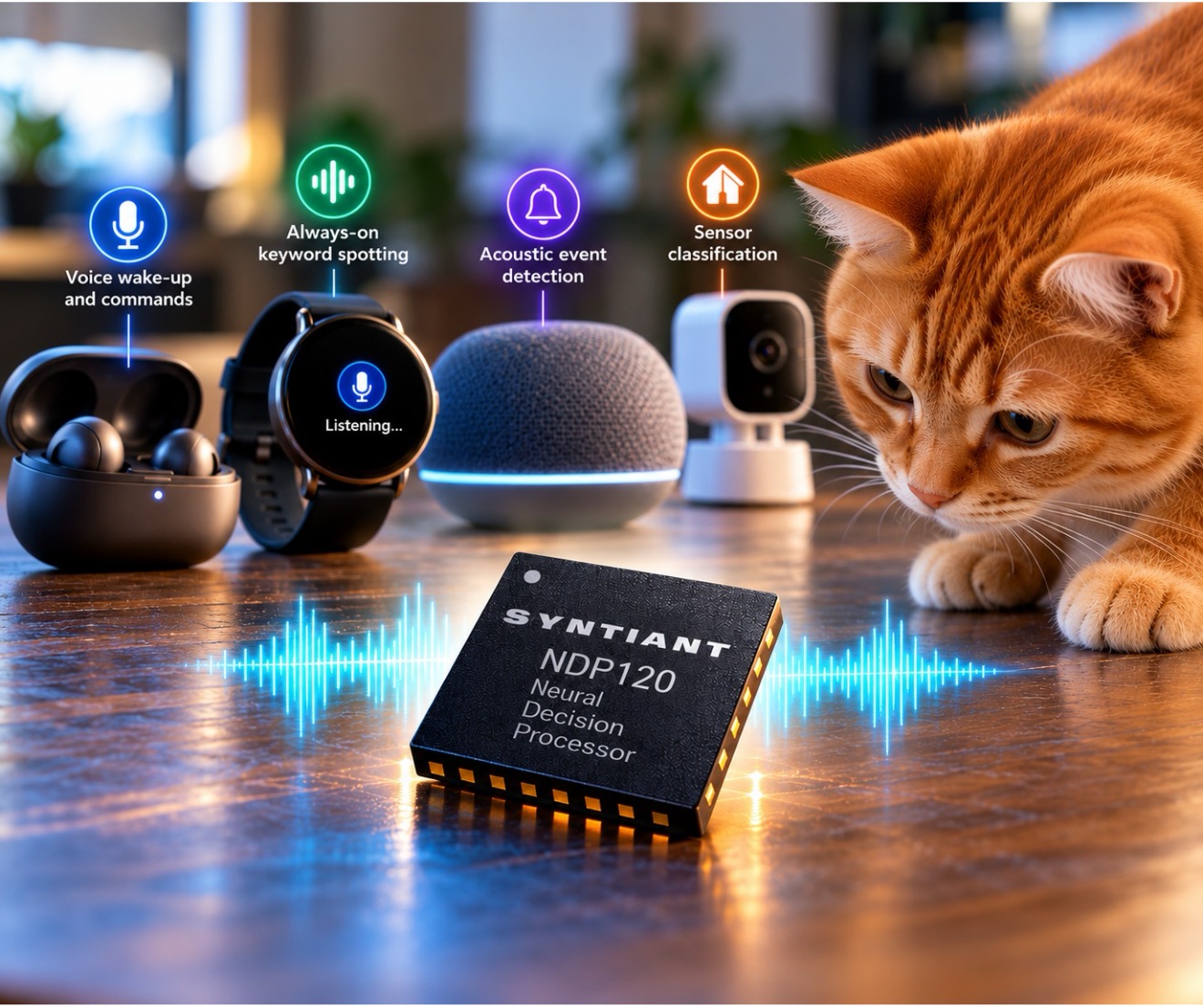
Syntiant supplies the low-power sensing layer that allows the phone to recognize selected acoustic events without repeatedly activating its main application processor. The NDP120 processes audio locally, identifies relevant events, and can signal the host processor when an application requires additional computation.
This division of work gives the phone a hierarchical AI architecture. Dedicated silicon handles persistent sensing, an on-device foundation model processes supported requests, and cloud models provide additional reasoning capacity.
An operating system organized around agents
StepFun describes Step AOS 1.0 as an agent-native operating system that incorporates re-engineered Android, Linux, and RTOS components. Its architecture gives Step Amoo direct access to supported device capabilities through an atomic capability engine. The engine groups system functions into communication, applications, files, and system tools. It exposes those functions through the Model Context Protocol (MCP), allowing an agent to invoke operations through software interfaces. For example, Amoo can request a message transmission, initiate a ride booking, or access a supported payment service through a defined tool endpoint. StepFun also developed H2A2A, a proprietary Human-to-Agent-to-Agent protocol that allows participating services to delegate tasks to specialized agents.
The initial ecosystem emphasizes Chinese applications, including Alipay, Didi, Meituan, JD.com, and Amap. StepFun claims integration with more than 300 Alipay services.
A natural user interface accepts voice and visual commands. A two-domain memory system separates personal information from agent working memory. A tiered decision engine routes requests between the on-device Step Edge model and StepFun’s cloud infrastructure.
Step Amoo can also execute multi-step workflows through a loop mechanism. The system requests confirmation for selected sensitive operations, including payments and file deletion.
Syntiant supplies the continuous sensing layerSyntiant’s NDP120 occupies a specialized position in this architecture. The processor integrates an Arm Cortex-M0 controller, a Cadence Tensilica HiFi 3 audio DSP, and Syntiant’s Core 2 neural accelerator.
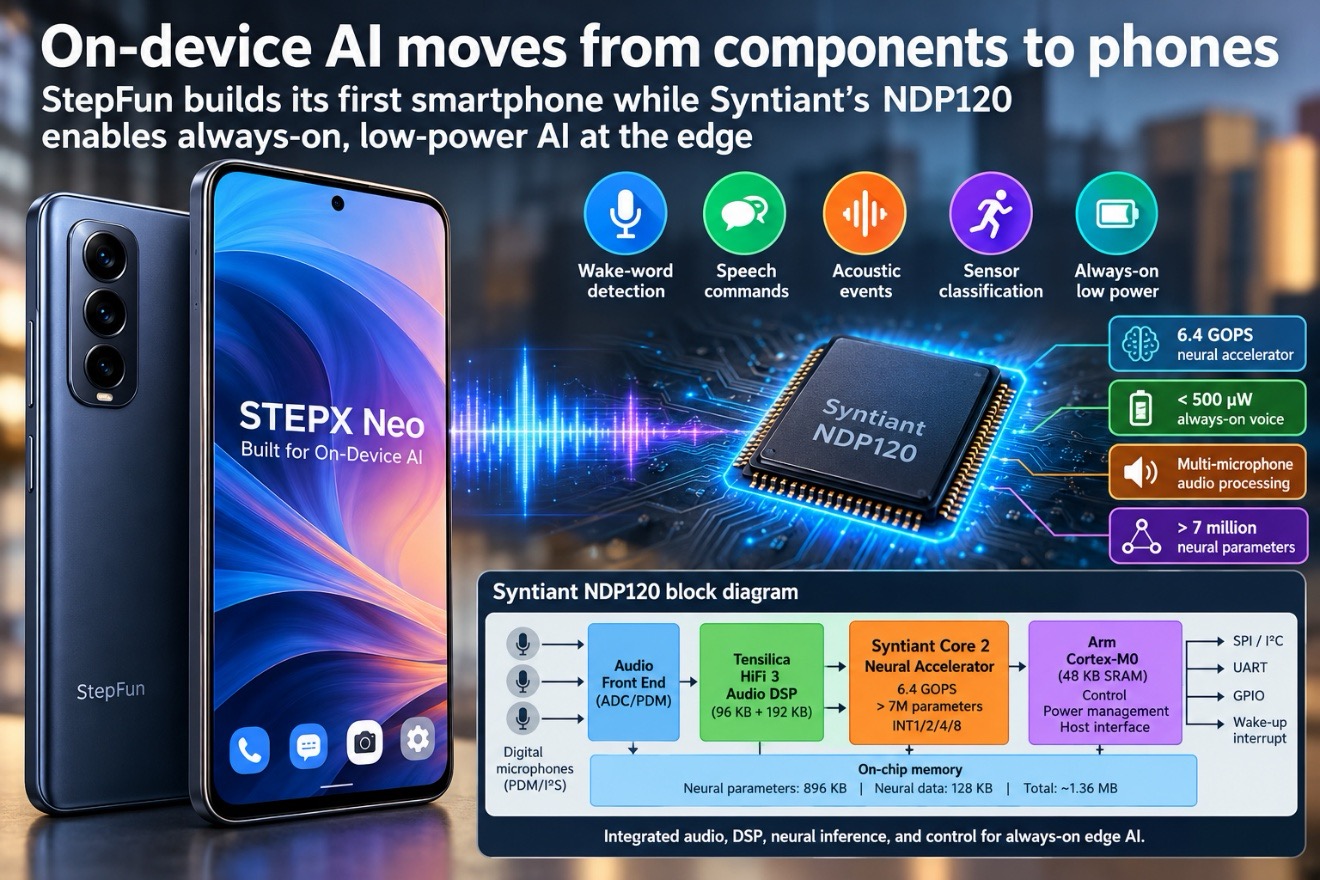
Figure 2. Dedicated neural processing supports continuous sensing and low-power AI inference.
The Core 2 accelerator delivers up to 6.4 GOPS and supports more than 7 million neural parameters. Its quantized architecture supports 1-, 2-, 4-, and 8-bit parameters, letting developers balance model size, accuracy, and memory requirements. The accelerator supports convolutional, fully connected, and recurrent neural networks, including LSTM and GRU structures. It can run multiple models concurrently and chain networks so that additional processing activates when an initial classifier detects a relevant event.
The NDP120 provides approximately 1 MB of dedicated neural memory, including 896 KB for parameters and 128 KB for neural data. Additional embedded memory supports its MCU and DSP.
Syntiant reports sub-500 µW always-on voice operation in specified configurations. A representative keyword-spotting workload consumes approximately 60 µJ per inference with roughly 6 ms latency. Actual energy consumption depends on model complexity, sampling rates, active processing blocks, and operating voltage. These characteristics let the NDP120 monitor audio continuously and selectively wake higher-power processing resources. In the StepX Neo, the processor supports the Intelligent Hearing Enhancement System and provides contextual signals to the phone’s agent software.
StepX Neo hardware and commercial configuration
The StepX Neo Pioneer Edition launches at ¥3,999, about $597. Its hardware includes 16 GB of RAM, 256 GB of storage, a dedicated AI hardware key, and a rear Mini-LED matrix display that communicates agent activity.
The initial purchase includes 12 months of model access with an allowance of 10 billion tokens per month. StepFun has not disclosed the pricing structure after that period.

Table 1. StepFun StepX Neo specifications.
The configuration illustrates how smartphone manufacturers can distribute AI processing across several computational domains. The application processor handles general computing and more demanding AI workloads, while a dedicated neural processor performs persistent sensing with a much smaller energy budget.
Security and enterprise implications
The StepX Neo also introduces security considerations that extend beyond conventional smartphone applications. Its MCP-based capability engine gives an AI agent programmatic access to functions that previously required direct user interaction.
MCP implementations have experienced vulnerabilities involving tool poisoning, excessive permissions, compromised servers, and remote code execution in particular software components. These issues make authentication, tool authorization, audit logging, and transaction confirmation important requirements for agent-native operating systems.
StepFun describes its security approach through four principles: Trusted, Visible, Controllable, and Reversible. The company says its system de-identifies personal information before cloud transmission and requires permission for selected sensitive data. Independent security testing will need to establish how these controls operate across local models, cloud services, third-party tools, and the H2A2A integration layer.
StepFun also operates under Chinese data and intelligence laws. Enterprise customers must evaluate applicable disclosure obligations, data residency, cross-border transfers, and the practical enforceability of privacy controls.
For CIOs, agent permissions and data governance may become as important as traditional mobile-device management.
Commercial prospects and ecosystem development
The StepX Neo enters a market in which smartphone manufacturers increasingly integrate neural processing into application processors. StepFun’s design adds dedicated always-on inference silicon and places an agent runtime at the operating system level. This arrangement could create opportunities for semiconductor suppliers that specialize in low-power sensing, audio processing, and contextual inference.
Developers will also need stable tool interfaces, predictable permissions, and transparent execution logs. Step Studio provides an environment for building and deploying agents, skills, and connectors, although the initial ecosystem primarily supports Chinese services.
The phone’s commercial prospects will depend on agent reliability, software compatibility, security validation, battery performance, and operating costs after the bundled token allowance expires.
The broader architectural question concerns how much intelligence smartphones should execute continuously and which processing resources should handle each workload.
The NDP120 illustrates one answer: distribute inference according to power requirements, memory capacity, and computational complexity. Persistent sensing can remain active in specialized silicon, while application processors and cloud models handle workloads that demand greater computational resources.
That model could influence future smartphone SoC designs, operating systems, and software-development frameworks as agent-based applications expand.
The StepX Neo combines agent-oriented software, conventional smartphone computing, and a dedicated always-on neural processor in one platform. Its architecture demonstrates how specialized inference silicon can supply continuous contextual information to software agents without imposing the full power cost of persistent application-processor operation. The device also exposes unresolved questions about agent security, developer integration, data governance, and long-term service economics. Its commercial performance will provide an early indication of how consumers and developers respond to smartphones organized around autonomous software agents.
What do we think?
The StepX Neo offers a practical demonstration of heterogeneous AI processing in smartphones. Syntiant’s NDP120 addresses the power demands of continuous sensing, while Step AOS provides software agents with structured access to device capabilities. Security controls, software reliability, and developer participation will determine whether this architecture gains broader adoption. Dedicated low-power inference silicon could become an increasingly important smartphone component.
Inflection point. The StepX Neo may signal an inflection point in mobile AI architecture as manufacturers distribute intelligence across specialized processors, application SoCs, and cloud infrastructure. Syntiant’s NDP120 demonstrates how continuous perception can operate within a limited power budget while agent software coordinates higher-level decisions and actions. The significance extends to silicon design, operating system architecture, and application development. Broader adoption will require measurable improvements in reliability, security, energy consumption, and interoperability. The StepX Neo provides an early commercial test of those requirements.
Syntiant is one of the 154 AI processor companies we track in our AI Processor management information system tracker,and its NDP120 is one of the 341 AI processor types. Syntiant participates in the autonomous systems, IoT, and device inference market segments. We also track and report on Syntiant in our AIP Quarterly Update service.
LIKE WHAT YOU’RE READING? INTRODUCE US TO YOUR FRIENDS AND COLLEAGUES.