
Tenstorrent has secured $1.5 billion in Series E funding at a $6.2 billion valuation, more than doubling its valuation since December 2024. The investment will support volume production of its Galaxy AI systems, international expansion, and continued development of its RISC-V CPU and AI accelerator IP. The funding is another significant endorsement of alternatives to established AI computing architectures.
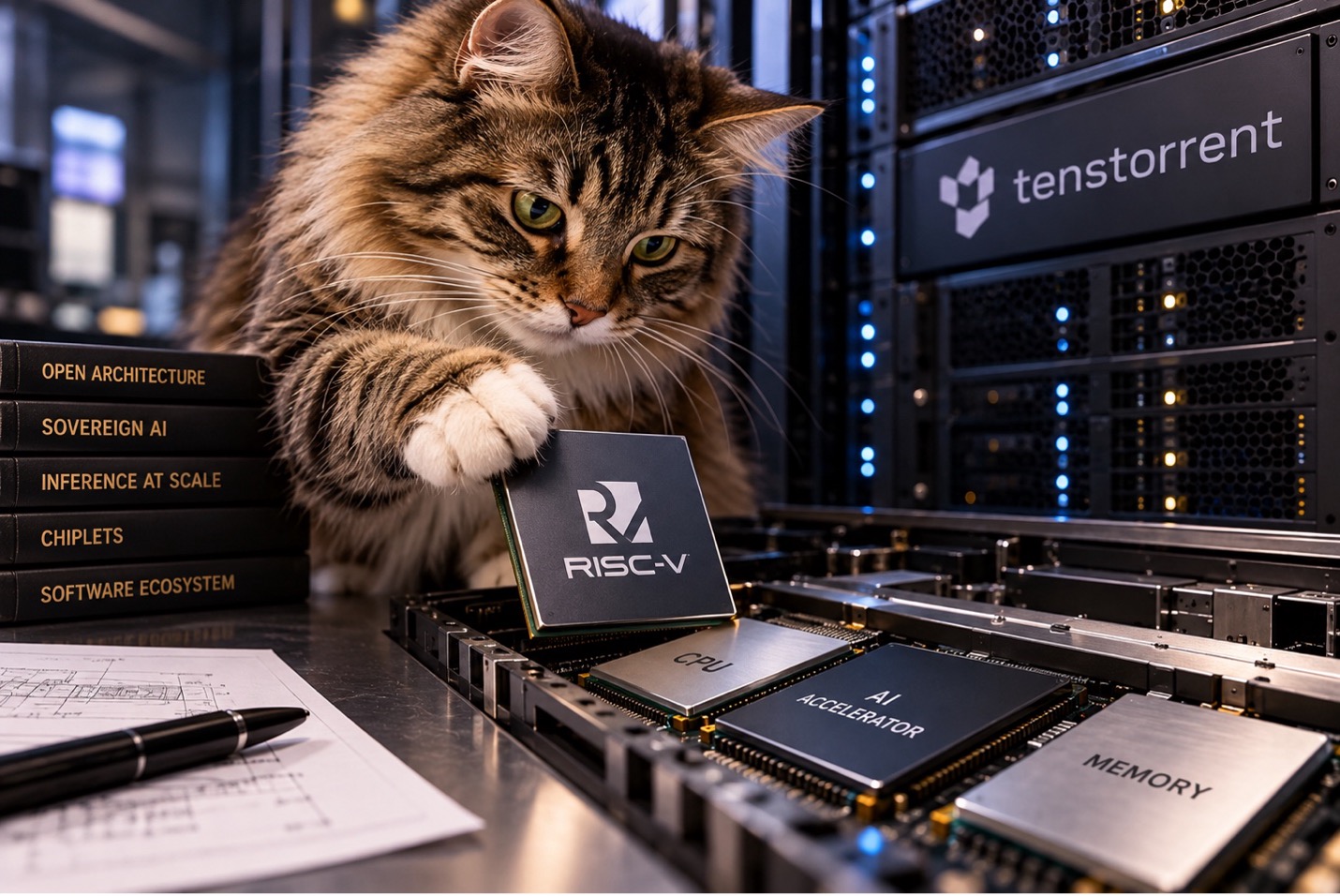
Tenstorrent has raised $1.5 billion in its Series E funding at a post-money valuation of $6.2 billion, giving the Jim Keller-led AI computing company substantial new capital to expand production and commercial deployment of its processors and systems. The size of the investment suggests that investors believe it has an opportunity to become much more than another specialist AI chip supplier. The round was led by Trace Capital and Innovation X, with participation from existing and new investors including ARK Invest, Fidelity Management & Research Company, Morgan Stanley, Sandisk, T. Rowe Price, Cadence Ventures, and Tether Investments.
The valuation represents a significant increase from Tenstorrent’s December 2024 Series D, when it raised more than $693 million at a $2 billion pre-money valuation.
Tenstorrent says it will use the new funding to scale volume manufacturing and deployment of its Galaxy AI servers, expand internationally, and continue developing the CPU and AI accelerator intellectual property it licenses to customers building their own silicon.
The company’s strategy spans a wider range of products and business models than most AI accelerator start-ups. It sells individual accelerator cards, developer workstations, servers, and large-scale computing systems, while also licensing its TT-Ascalon RISC-V CPU, and Tensix AI accelerator IP. (Tenstorrent has identified LG Electronics, Samsung, and BOS Semiconductors among its AI and RISC-V IP customers, with Hyundai Motor Group also participating in its automotive silicon ecosystem. LG Electronics, Samsung, and Hyundai Motor have also invested in Tenstorrent.)
This allows Tenstorrent to address customers that want to buy computing capacity as well as those that prefer to develop proprietary processors and systems using licensed technology.
Tenstorrent’s open-source software strategy is central to its positioning. The company is targeting organizations looking to run open-weight AI models locally or within their own infrastructure, rather than depending exclusively on established cloud and GPU ecosystems.

Jim Keller, CEO
“We built one architecture and sell it at every size,” said Tenstorrent CEO Keller. “The future of compute is open, scalable, and owned by the people building on it.”
The company’s ambitions extend beyond conventional AI infrastructure. Tenstorrent has continued developing RISC-V processor technology for heterogeneous computing, including the TT-Ascalon S CPU IP announced in June 2026, and has been expanding its commercial relationships in Japan.
Its relationships with customers including Samsung and LG also demonstrate how its licensing activities complement its ambitions to sell complete AI computing systems.
For Tenstorrent, the challenge now is converting its architectural ambitions and commercial partnerships into significant production volumes and recurring revenues.
What do we think?
We’ve argued for some time that Tenstorrent is one of the most interesting companies in the RISC-V ecosystem, not least because Jim Keller has been pursuing something considerably more ambitious than another processor IP business. Tenstorrent combines CPUs, proprietary AI accelerators, chiplets, software, and complete systems (plus the kitchen sink), while allowing customers to license the underlying technology. That gives it several routes into markets that might otherwise be difficult to penetrate. It has been called “scattered,” but we think it’s been pulled off well thus far.
This is also consistent with the direction we’ve seen from CoreLab, particularly through its Atlantis partnership with Tenstorrent for automotive and robotics. CoreLab’s approach is to use open architectures as the basis for customized, application-specific computing platforms, rather than simply offering another standard CPU core. Both companies recognize that customers increasingly want computing architectures built around their own requirements, particularly as AI workloads become more specialized.
Our long-standing thesis is that AI could do for RISC-V what mobile computing did for Arm. Arm succeeded by establishing a widely adopted architecture and commercial ecosystem. RISC-V’s opportunity may be more diverse, supporting multiple suppliers and increasingly heterogeneous designs in which CPUs are only one element of a larger computing system.
That brings us back to another point we’ve made repeatedly: It isn’t really RISC-V itself that matters so much as what companies do with it. The instruction set offers freedom and flexibility, but neither guarantees competitive performance or a successful product. Those advantages must come from architecture, implementation, integration, and increasingly the surrounding software ecosystem.
Tenstorrent’s bet is not that RISC-V alone will displace established processors, but that an open, adaptable computing platform can offer customers something that proprietary suppliers may be unwilling to provide.
The funding underlines an important change in the RISC-V market: The ISA is becoming secondary to the ability to deliver a working platform. And $1.5 billion is a considerable vote of confidence. Tenstorrent still has to turn its technology and partnerships into deployments at scale, in a market where Nvidia enjoys enormous advantages in software, ecosystem maturity, and customer adoption.
Perhaps the most important aspect of this funding is that investors appear to be backing the breadth of the strategy rather than any particular processor architecture. That seems to us a strong indication of where the RISC-V industry is heading.
We track start-up funding in our AI Processor management information system tracker. In our Billionaires’ Club (companies that have raised over a billion US dollars before IPO, Tenstorrent has now jumped to fourth place at $2.3 billion in funding. A clever guy like Keller should be able to do a lot with a war chest that size. You can download these free previews here and here.
LIKE WHAT YOU’RE READING? INTRODUCE US TO YOUR FRIENDS AND COLLEAGUES.