
Rising memory costs are reshaping computing dynamics across enterprise and consumer hardware. The ongoing AI boom continues to stretch memory manufacturing capacity as chipmakers prioritize high-bandwidth memory for enterprise AI servers, severely tightening standard PC memory supply and driving up component prices. AMD Chief Executive Officer Lisa Su warned during her November 3 earnings call that high memory costs will push buyers away, creating a double-digit percentage market decline in 2027 PC shipments. Intel similarly expects PC shipments to contract by roughly 10% in 2027 following a 12% drop this year. Gartner reports that global third-quarter PC shipments fell 22.4% year over year to 55.4 million units due to component inflation, and projects overall PC prices will surge 17% as rising memory costs squeeze system margins.
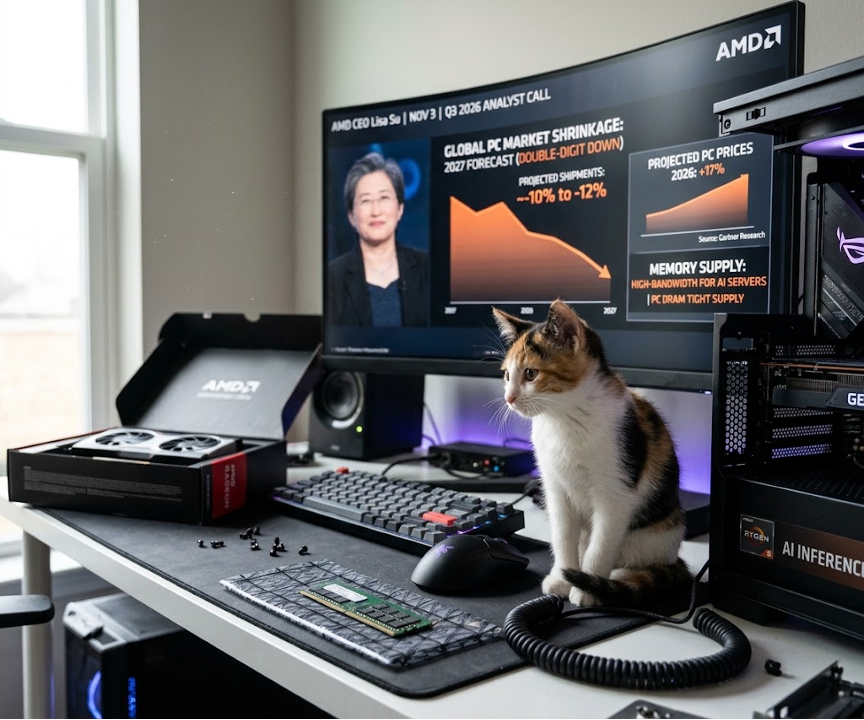
AMD Chief Executive Officer Lisa Su has warned that the PC market will shrink by double digits in 2027, as high memory prices push buyers away. “Our planning assumption for 2027 is that the market will be double-digit percentage down,” she told analysts on November 3.
Intel expects PC shipments to fall about 10% in 2027, after a projected 12% drop this year. Gartner says global PC shipments fell 22.4% in the third quarter to 55.4 million units. Memory makers are shifting capacity to high-bandwidth memory for AI servers, which tightens supply of PC memory. Gartner projects PC prices will rise 17% in 2026.
High memory prices will not kill the AI boom, but they are fundamentally reshaping its hardware economics. Enterprise inference represents a memory-bound workload rather than a compute-bound task, turning memory capacity, bandwidth, and bill-of-materials cost into the primary execution bottlenecks for hyperscaler infrastructure.Standard processor designs that maximize theoretical compute FLOPS struggle with realized memory utilization during long-context LLM execution. As memory manufacturers allocate wafer capacity toward high-margin HBM packaging, rising component expenses across DRAM tiers force silicon architects and CIO decision-makers to re-evaluate system total cost of ownership.

Table 1. Macro PC market contraction projections paired with enterprise memory infrastructure bottlenecks.
Rather than halting deployment, sustained memory pricing accelerates two critical industry shifts: algorithmic compression and alternative hardware topologies. Systems teams aggressively deploy model quantization down to FP8 or INT4 and optimize specialized small language models to fit lower-cost memory tiers. Simultaneously, start-up silicon vendors and hyperscalers bypass expensive HBM interposers by integrating commodity LPDDR5X alongside CXL expansion buses. These domain-specific memory architectures maximize bandwidth utilization per dollar, maintaining market momentum despite persistent component cost inflation.
What do we think?
Persistent memory price escalation serves as an operational filter rather than a fatal structural barrier. It forces the semiconductor ecosystem to abandon inefficient brute-force hardware scaling in favor of domain-specific silicon, alternative memory topologies, and tight software quantization. Vendors delivering optimized bandwidth utilization will capture enterprise workloads as hyperscalers adjust infrastructure spend to match realistic data center economics.
Inflection point. Elevated memory costs establish an inflection point in AI hardware engineering by ending the dominance of raw compute scaling. Instead of relying on expensive interposers and stacked HBM, silicon teams are pivoting toward memory-first architectures, commodity LPDDR integration, and dynamic pipeline acceleration. This shift proves that sustaining the AI boom requires solving data delivery bottlenecks rather than simply adding floating-point processing elements.
LIKE WHAT YOU’RE READING? TELL YOUR FRIENDS; WE DO THIS EVERY DAY, ALL DAY.