
Banana Pi has introduced the BPI-SM10 developer kit, built around SpacemiT’s K3-CoM260 RISC-V AI CPU module. The board claims 60 TOPS of AI compute, support for 30B-class local language models, up to 32 GB LPDDR5 memory, and carrier-board compatibility with Nvidia’s Jetson Orin Nano format. It is another sign that RISC-V is moving from curiosity boards and microcontrollers into platforms aimed at local AI agents, robotics, and industrial edge systems.
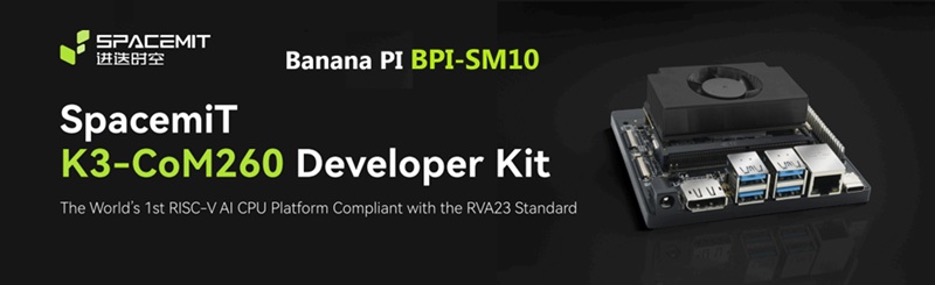
Banana Pi has released details of the BPI-SM10, a developer kit based on the SpacemiT K3-CoM260 module. It’s a compact RISC-V edge AI platform capable of running local 30B-class large language models, with claimed inference performance above 10 tokens per second on 30B workloads. Banana Pi lists the platform at up to 60 TOPS of general-purpose AI compute and positions it for edge AI agents, service robots, and autonomous devices.
The module combines eight X100 64-bit RISC-V CPU cores running at up to 2.4 GHz with eight A100 AI CPU cores. The X100 cores are described as four-issue out-of-order designs compliant with the RVA23 profile, with RVV 1.0 vector support and 256-bit VLEN. The A100 AI cores add 1,024-bit vector processing and their own cache and tightly coupled memory, keeping the programming model close to standard CPU software—no separate NPU island to wrestle with.
The BPI-SM10 core board supports 8 GB, 16 GB, or 32 GB of 64-bit LPDDR5-6400, plus UFS, SD card, and external NVMe storage. The carrier board offers two MIPI CSI-2 camera connectors, two M.2 Key M slots, an M.2 Key E slot, four USB 3.0 Type-A ports, USB-C device mode, Gigabit Ethernet, DisplayPort 1.2, MIPI DSI, and a 40-pin expansion header. Power consumption is listed at 18 W to 35 W, which puts it well above hobbyist microcontroller territory but directly in the zone where Nvidia Jetson, Raspberry Pi AI add-ons, and industrial edge boxes compete.
Banana Pi also says the carrier board is hardware-compatible with Nvidia Jetson Orin Nano, a clever move. That does not make the platform a Jetson replacement overnight—software is the real moat—but it lowers the mechanical and carrier-board friction for developers that already understand the Jetson ecosystem.
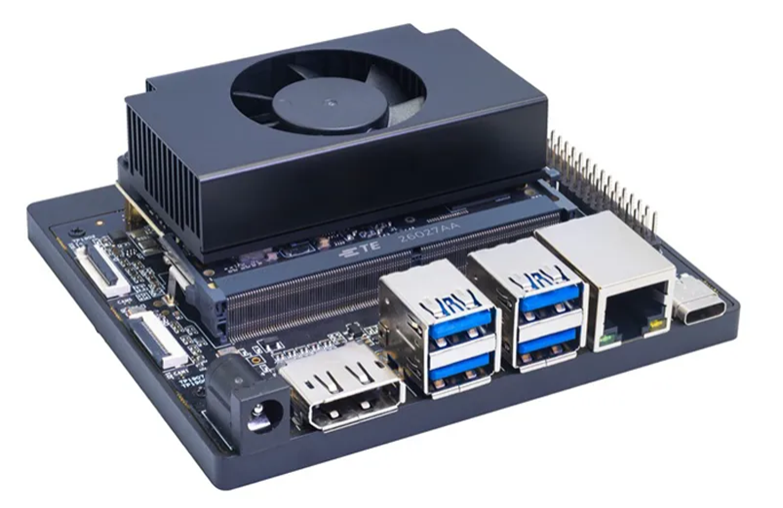
Figure 1. BPI-SM10, a developer kit based on the SpacemiT K3-CoM260 module. (Source: Banana Pi)
RISC-V International ratified the RVA23 profile in October 2024 to improve software portability across 64-bit application processors running rich OS stacks. Without it, RISC-V stays stuck on fragmented evaluation boards. Canonical has also said Ubuntu 26.04 LTS enablement on SpacemiT’s K3 will support RVA23-compliant systems, which gives the platform a more credible Linux story than many earlier RISC-V boards.
SpacemiT’s own K3 positioning reinforces that direction. Its K3 brief describes the chip as a high-performance RISC-V AI CPU capable of running 30B large models, aimed at AI consumer hardware including smart home devices, AI-powered office products, and content creation systems. Banana Pi’s forum announcement adds that the BPI-SM10 and K3 Pico-ITX SBC are being released as 60 TOPS, 30B local-inference platforms for edge AI, robotics, industrial control, cluster computing, and on-device LLM terminals.
What do we think?
TOPS numbers do not win markets. Nvidia’s advantage comes from CUDA and developer muscle memory. Banana Pi and SpacemiT need a clean, repeatable path for LLM inference, vision pipelines, and robotics workloads before anyone serious switches allegiance. The foundation for this offer is more credible than most RISC-V boards. RVA23 compliance, Ubuntu enablement, 32 GB LPDDR5, and a Jetson Orin Nano-compatible carrier board give developers something to actually work with—not just a curiosity.
WHATYA THINK? LIKE IT? DON’T BE STINGY, SHARE IT WITH YOUR FRIENDS.