
AMD is taking a system-level approach to physical AI with the Ryzen AI Embedded X100 series, combining Zen 5 CPU cores, RDNA 3.5 graphics, an XDNA 2 NPU, and unified memory in one embedded processor. AMD targets robotics, industrial automation, medical imaging, aerospace, and other systems that need AI inference alongside deterministic control. The architecture emphasizes CPU headroom, heterogeneous processing, memory efficiency, long operating life, and an open software environment rather than relying primarily on accelerator performance.
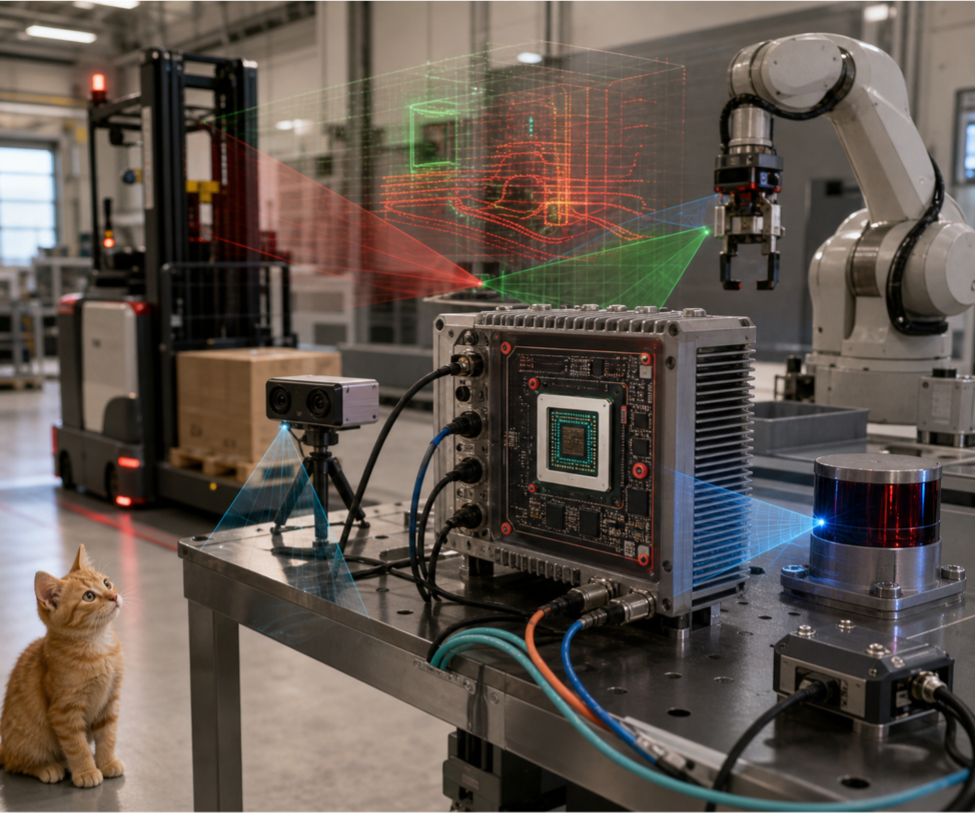
AMD is positioning the Ryzen AI Embedded X100 series around a basic premise: Autonomous machines need more than AI inference. A robot processes sensors, maintains localization, identifies objects, plans movement, executes control loops, communicates with other systems, and increasingly runs AI reasoning workloads all at once. AI inference exploits GPU and NPU acceleration; planning, orchestration, control, middleware, and networking still consume substantial CPU resources. AMD argues physical AI needs a balanced heterogeneous architecture instead of an oversized accelerator bolted onto an undersized host processor.
The X100 combines up to 16 Zen 5 CPU cores and 32 threads, as many as 40 RDNA 3.5 compute units, and an XDNA 2 NPU delivering about 50 TOPS. The processor supports AVX-512 and up to 128 GB of unified memory at 273 GB/s of bandwidth, three compute engines sharing one memory architecture.
Memory movement creates a real bottleneck in robotics. Cameras, lidar, and other sensors generate data that perception algorithms consume before planning and control software acts on the results, and moving that data repeatedly among separate memory pools adds latency and overhead. The X100 lets its CPU, GPU, and NPU share memory directly, backed by a 32 MB shared MALL cache supporting zero-copy data sharing among the engines. For ISVs, this shifts the optimization problem toward workload placement and concurrency, not treating each compute engine as its own memory island.
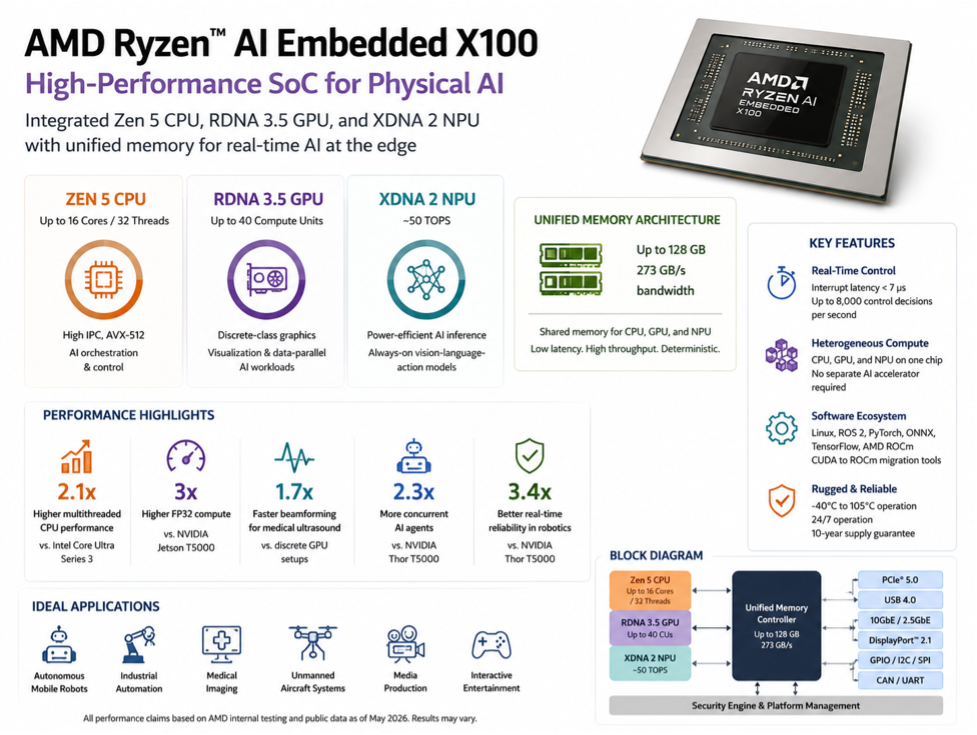
Figure 1. AMD takes aim at GPU-centric robotics with UMA heterogeneous SoC.
AMD’s argument gets more interesting under real-time constraints specifically. The OpenNav Robotics Workload Benchmark models an autonomous forklift processing lidar, RGB-D camera, vision, and inertial data, running localization, perception, planning, and model-predictive control continuously, with a vision-language model running concurrently instead of pausing the robot mid-query. AMD reports the X100 delivering up to 3.4× better real-time reliability than Nvidia Jetson T5000, measured by fewer missed control-loop deadlines across 10 missions, plus up to 1.6× more spare compute capacity and up to 2.7× better CPU utilization for navigation. These come from AMD/OpenNav testing specifically and read as workload-specific results, not general performance rankings.
The architectural point matters more than any single ratio. A GPU keeps processing its assigned workload only as long as the rest of the system supplies instructions, data, and application context fast enough. Saturated CPU resources cause planning and control tasks to miss deadlines even when accelerator capacity sits idle.
Salil Raje, SVP and GM of AMD’s Adaptive and Embedded group, says customers frequently pair a GPU-based robotics computer with a larger Intel or AMD CPU for extra orchestration capacity, adding system complexity and latency. The X100 consolidates those functions: The NPU handles power- and latency-sensitive always-on AI workloads, RDNA 3.5 graphics supplies parallel compute and visualization, and Zen 5 handles control, orchestration, planning, and general-purpose work that doesn’t map onto an accelerator. The full chip reaches 126 TOPS INT8, with roughly 50 TOPS from the NPU alone. This doesn’t eliminate the GPU; it moves the GPU from the center of the machine to one member of a heterogeneous system.
Robotics buyers also weigh characteristics conventional AI benchmarks rarely capture. AMD specifies up to 10 years of continuous 24/7 operation for the X100 Embedded series, with selected industrial SKUs supporting junction temperatures from -40°C to 105°C and a 10-year product lifecycle, versus Nvidia’s specified five years of continuous operation for Jetson T5000 and a -25°C to 80°C maximum range. Industrial OEMs deploying equipment for years weigh availability, thermal range, software stability, and deterministic execution as heavily as peak inference throughput.
Hardware alone won’t displace established robotics platforms. AMD builds the X100 around familiar x86 development environments and ROCm, with HIP and HIPIFY offering paths to move CUDA workloads onto AMD hardware, preserving an average of 83% of CUDA code across foundational GPU workloads, 71% across compute-intensive applications, and 72% across AI/ML workloads. AMD also plans a Kria AI SoM built on the X100 using the COM-HPC format, with a robotics development platform including a carrier card, and plans to open-source the schematics, bill of materials, and RTL for the Spartan UltraScale+ FPGA on that card. AMD continues building out its ecosystem with OEMs, model developers, middleware companies, and sensor suppliers, work that matters given how fragmented robotics software remains.
For CIOs, the X100 raises a broader platform question: Physical AI procurement may increasingly depend on how well a processor handles the complete concurrent workload, not which device posts the largest TOPS number. For silicon teams, it signals CPU capability becoming relevant again as AI moves from servers into machines that sense, reason, plan, and act under real-time constraints.
AMD’s real challenge lies in execution. Robotics developers already carry substantial investment in Nvidia software, tools, and modules. AMD needs ROCm, its robotics SDK, development hardware, and partner ecosystem to make migration practical. Success gives OEMs a genuine architectural choice for consolidating physical-AI workloads onto one heterogeneous embedded processor.
Physical AI changes the definition of processor performance. Robots cannot suspend navigation while an AI model finishes inference, and industrial machines cannot tolerate unpredictable control timing simply because an accelerator remains busy. Ryzen AI Embedded X100 addresses that requirement by distributing work across CPU, GPU, and NPU resources while sharing memory and software infrastructure. AMD is making the case that successful robotics platforms will depend on sustained system behavior, workload concurrency, and deterministic execution as much as accelerator throughput.
What do we think?
AMD has identified a genuine weakness in accelerator-centric comparisons: TOPS alone says little about how a robot behaves when perception, inference, planning, and control run concurrently. X100’s combination of Zen 5, RDNA 3.5, XDNA 2, and unified memory gives AMD a credible architectural argument. The harder task will involve software adoption and persuading robotics developers to move established workloads onto ROCm.
Inflection point. Physical AI may mark an inflection point in processor architecture because AI moves from generating answers to controlling machines operating under deadlines. That shift increases the importance of CPU headroom, deterministic execution, memory architecture, I/O, and heterogeneous workload scheduling. AMD’s X100 reflects that change. If robotics developers begin evaluating complete concurrent workloads instead of isolated inference benchmarks, processor competition will broaden from accelerator performance toward system-level compute architecture, opening opportunities for x86, NPUs, GPUs, and adaptive processing.
LIKE THIS KIND OF INFORMATION, INSIGHT AND COVERAGE? TELL YOUR FRIENDS.