
AMD announces financial results for the second quarter of 2026, delivering record revenue and profitability as Data Center revenue more than doubled year over year.
(Source: AMD and JPR)
AMD’s financial results for the second quarter of 2026 were very good. Revenue was $11.5 billion, gross margin was 54%, operating income was $1.9 billion, net income was $2.3 billion, and diluted earnings per share were $1.38. On a non-GAAP basis, gross margin was 55%, operating income was $3.1 billion, net income was $2.8 billion, and diluted earnings per share were $1.66, all of which beat analysts’ forecasts.
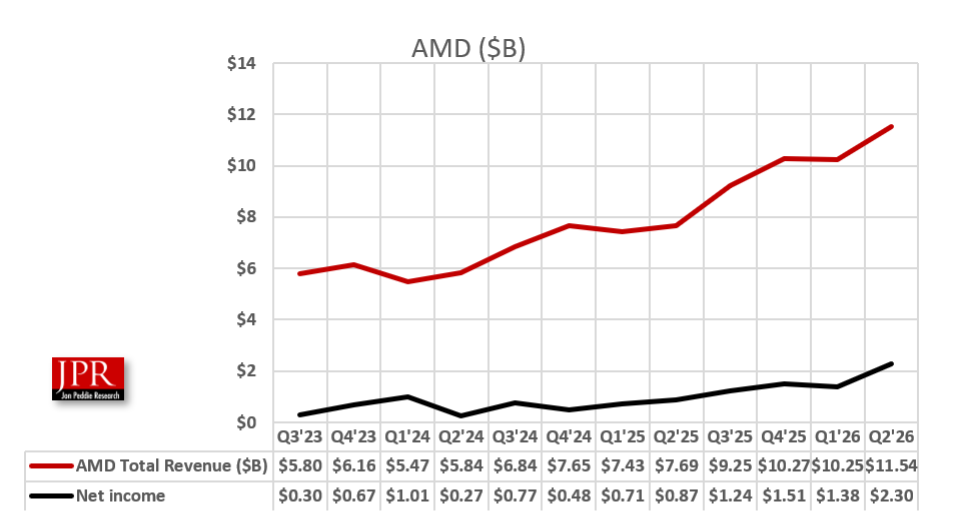
Figure 1. AMD revenue and net income over time. (Source: AMD and JPR)
Data Center segment revenue was $6.7 billion, up 107% year over year, driven by strong demand for AMD Epyc processors and the continued ramp of AMD Instinct GPU shipments.
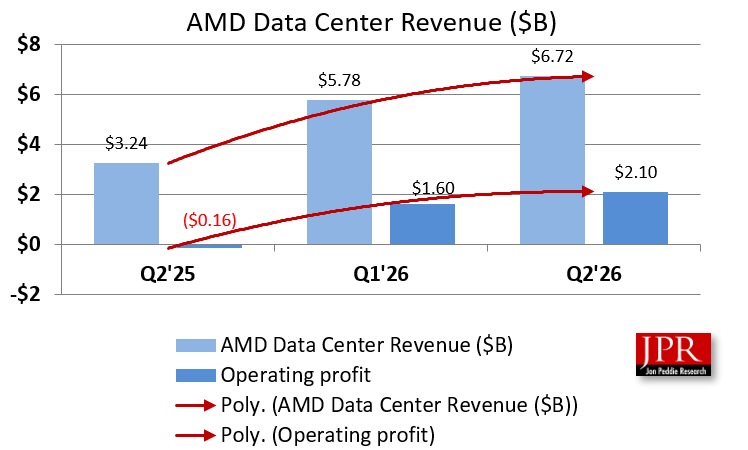
Figure 2. AMD’s Data Center results—sequential and year over year. (Source: AMD and JPR)
Client and Gaming segment revenue was $3.8 billion, up 6% year over year. Client business revenue was $3.1 billion, up 23% year over year, primarily driven by strong demand for Ryzen processors and continued market share gains. Gaming business revenue was $780 million, down 31% year over year due to lower semi-custom revenue.
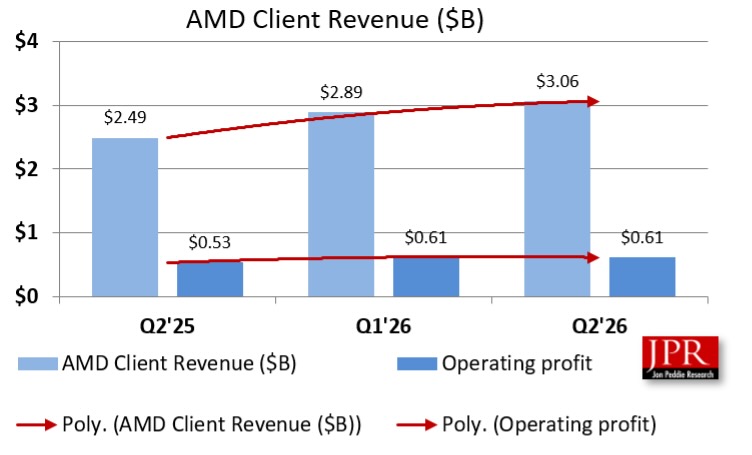
Figure 3. AMD’s new consolidated client results—sequential and year over year. (Source: AMD and JPR)
“We delivered an excellent quarter, with record revenue and profitability as Data Center revenue more than doubled year over year,” said Lisa Su, AMD chair and CEO. “We enter the second half with strong momentum as Epyc demand accelerates, Instinct deployments scale, and Helios begins to ramp. More broadly, AI is driving a significant expansion in demand for compute across all of our markets, and our leadership portfolio and growing customer visibility position us exceptionally well to capture this expanding opportunity and deliver substantial revenue and earnings growth in the years ahead.”
“Revenue increased 50% year over year to a record $11.5 billion, driven by continued strength in our Data Center business, which represented 58% of company revenue in the quarter,” said Jean Hu, AMD executive vice president, chief financial officer, and treasurer. “We expect Data Center sales to accelerate in the second half of 2026, driving stronger overall revenue growth and continued earnings expansion.”
AMD announced a broad portfolio of high-performance and AI computing solutions and strategic partnerships to accelerate AI deployments at scale, while extending its PC offerings for enterprises, developers, and gamers.
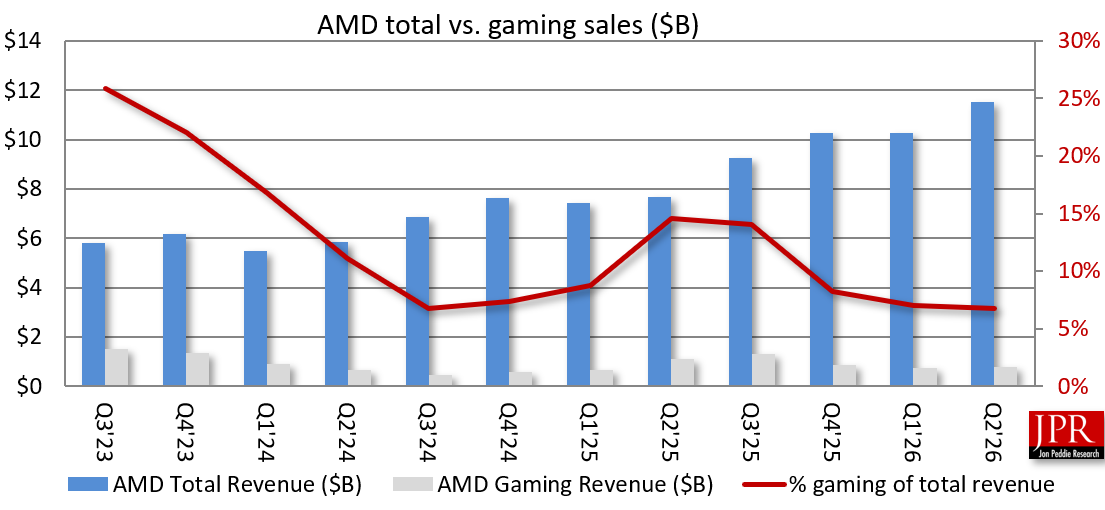
Figure 4. Total sales versus gaming sales over time. (Source: AMD and JPR)
AMD released the Instinct MI400 GPU lineup, featuring the MI455X for large-scale training and inference and the MI430X for high-performance computing (HPC) and sovereign AI. Company engineers designed the 6th Gen AMD Epyc server CPUs to handle agentic AI, enterprise computing, and general-purpose workloads. Furthermore, AMD deployed ROCm.ai, an AI-native developer stack that accelerates software deployment, troubleshooting, and platform optimization.
Outlook
For the third quarter of 2026, AMD expects revenue to be approximately $13 billion, plus or minus $300 million. The mid-point of the revenue range represents year-over-year growth of approximately 41% and a sequential increase of approximately 13%.
What do we think?
AMD demonstrates solid execution by capitalizing on hyperscale infrastructure demand. Data center expansion offsets legacy gaming stagnation, proving their multi-generational pivot toward high-performance computing succeeds. Accelerated enterprise adoption of Epyc hardware alongside upcoming Instinct deployments sets a firm foundation for sustained margin strength through the back half of the fiscal year.
Inflection point
This performance marks a structural shift. Compute demand no longer tracks traditional consumer upgrade cycles; instead, enterprise agentic workloads and massive cluster deployments dictate market expansion. By scaling architectures like Helios and the MI400 family alongside open developer stacks, AMD proves that multi-vendor enterprise adoption has matured, signaling a definitive inflection point in the AI hardware economy, where alternative high-performance silicon providers secure permanent co-dominance.
AND IF YOU LIKED WHAT YOU READ HERE, DON’T BE STINGY, SHARE IT WITH YOUR FRIENDS.