
Apple’s Surprise and Shine event focuses on connectivity and health as the company unveils new devices, a new Siri, and a new form factor for the iPhone.
(Source: Apple)
A lot of excitement had been building for the Surprise and Shine iPhone event this year as Apple introduced a shiny new CEO, John Ternus, the former SVP of hardware engineering and a bunch of new products in the iPhone family. Ternus was head of engineering since 2021 and has worked on the Apple Watch, AirPods, and Vision Pro. He is credited with improving Apple’s product design with an emphasis on performance and innovation but also focus.
Tim Cook has moved up to executive chairman, where he promises to run interference for Apple’s management team. Part of that translates to: executive in charge of dealing with messy issues such as politics, diplomacy, Trump. It is hoped Cook will be in a position to preserve Apple’s highly nuanced support for human rights, civil liberties, and climate.
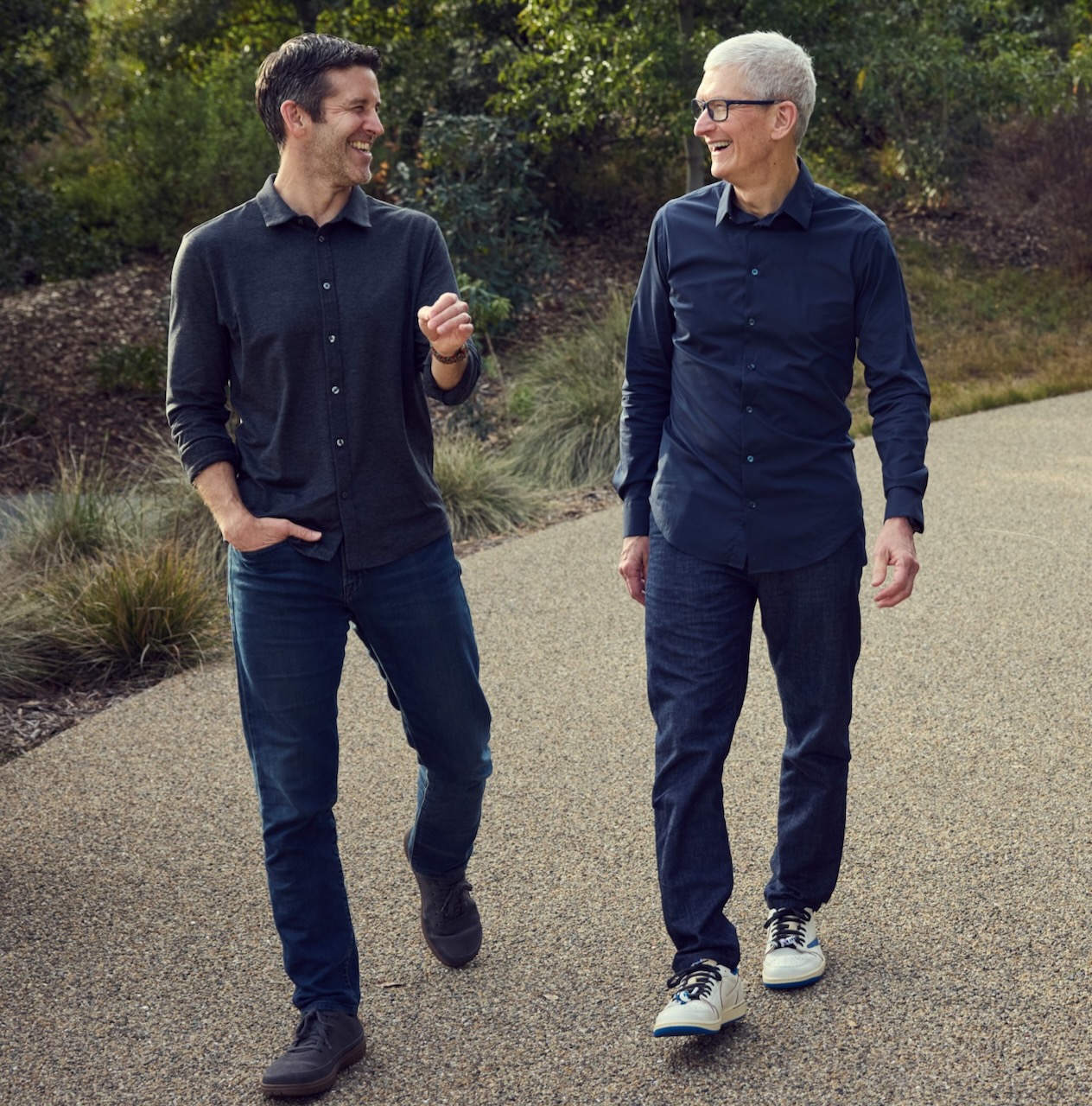
John Ternus (left) and Tim Cook (right). (Source: Apple)
As expected, the Surprise and Shine event unleashed a lot of new AI-enriched products. Apple’s tight control of hardware and software makes sure there are improvements for legacy products and new clues for future ones.
Fixing the plumbing, moving the furniture
As is always true with Apple, the hardware is only part of the story. Apple spent considerable time on its software updates. It had become embarrassingly obvious that Apple had fallen behind in the AI race. While pledging to fix Siri, Apple reached out to two obvious partners, OpenAI and Google, in what seems to be a pretty adroit dance of flirting, collaboration, and dealmaking. At the heart of it all, though, Apple is working towards building its own AI and processors. Apple worked with OpenAI to use ChatGPT to improve Siri, and later engaged in deeper collaboration with Google to use its Gemini models to build its own system wrapped in Apple tech.
Currently, Apple is concentrating on on-device AI (using its AFM 3 core foundation models) backed up by Google’s Gemini models in the cloud. At present, Siri can also turn to ChatGPT for generative AI and complex data queries. Even as Apple built its own models, it has relied on Google’s Gemini to improve them. When a query drives an Apple device to turn to Private Cloud Compute, Apple says it has no access to its customers’ data on the device or in its secure cloud servers.
So, as an example, during the demo at Surprise and Shine, it suggests a person can call an airline to check reservations and see the data that’s on their phone as they talk to the agent. Users can check into the office, and AI can show them information on upcoming meetings or past results, and so on. Clearly, all this is going to work a lot better if you live in Apple calendars, email, apps, etc.
Bloomberg has claimed that Apple is paying Google about $1 billion a year, so that’s the figure the industry is working with. The cooperative deals with Google and OpenAI also include options for turning to Anthropic’s Claude and other engines. It all serves to improve Apple’s own development, which includes server AI chips code-named Baltra. But progress on that front is unclear. If Apple operates true to form, it could buy or partner with established developers, but its goal will be to have its own technology, possibly based on its M2 chips
Mostly, Apple’s plan is to make your walled garden a much more comfortable, beautiful, and useful place. But there are big hurdles. The EU’s Digital Markets Act (DMA) will hold up Siri’s debut in Europe until Apple and the European Commission can come to an agreement. The DMA says Apple will have to grant the company’s competitors the same access to rivals as it does to Siri. (Yes, you’ve seen similar arguments break out between the EU, US, and other companies with broad product platforms such as Microsoft, Google, etc. Find a comfortable seat; have some popcorn.) Likewise, China and Apple are still tussling over rights and AI models.
Meanwhile, Apple has enough dominance in the US and Canada to tinker with Siri AI after this rollout and get a feel for how customers will use it. If/when the diplomatic kinks get worked out, Apple will be ready with an updated Siri AI. To state the obvious, AI is a fast-moving target, so Apple’s alliances and initiatives allow the company to stay nimble while picking its shot.
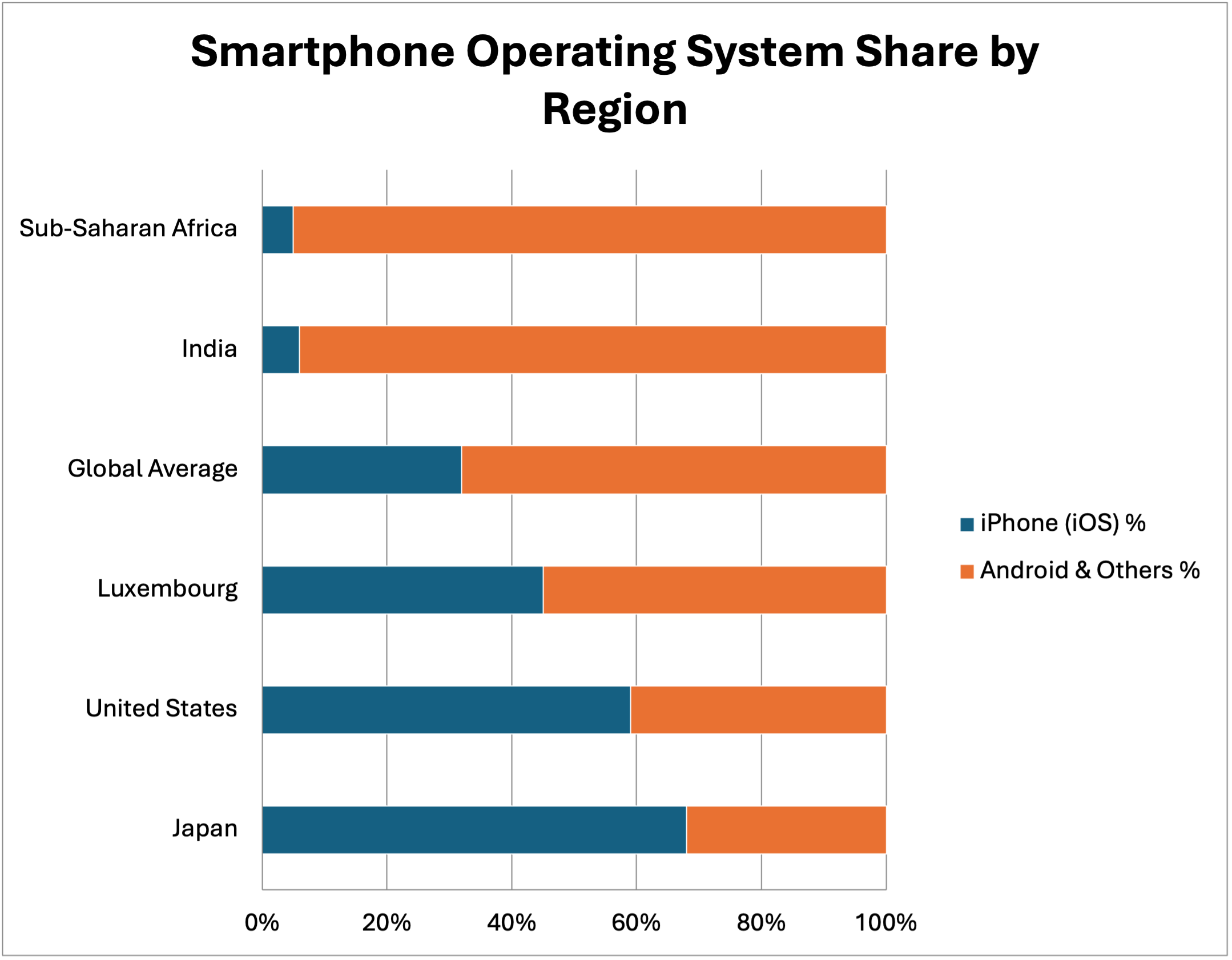
Figure 1 The data used to construct the comparative chart is synthesized from leading global macroeconomic tracking firms, mobile industry analytics, and independent research institutions. (Source: Gemini AI)
Let’s just go look at the new hardware updates and devices, and let AI go off and solve itself for a while.
Meeting expectations
There’s a lot more to AI than answering questions and writing press releases and college papers—not to mention, creating spreadsheets, developing applications, and ending life as we know it on earth. Apple’s introduction of new products and features suggests there’s plenty of AI work going on behind the scenes in apps and on the new devices.
We didn’t hear anything about new Home devices in this latest presentation, but some new Home products could arrive with Siri updates and the Duo rollout in October.
But, we did get new AirPods and Apple Watches.
Apple announced AirPods 5 with two new models equipped with Active Noise Cancellation (ANC).
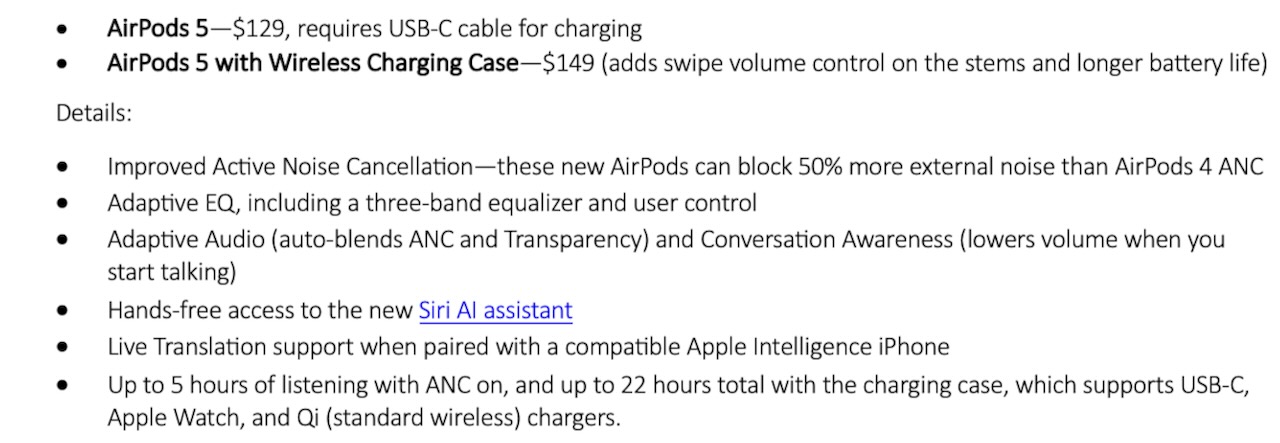
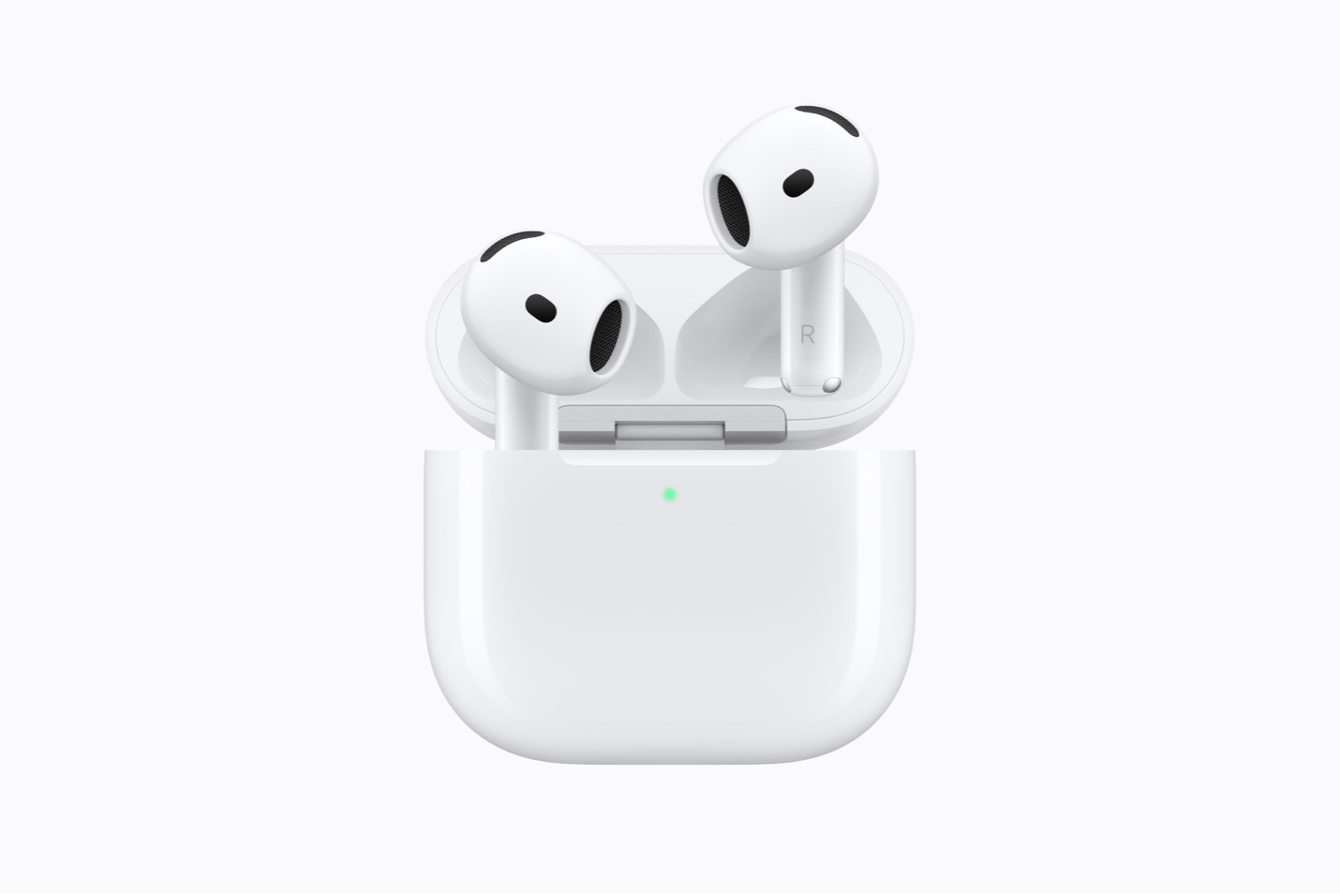
Figure 2. Listen up, Apple AirPod 5 is available for pre-order. (Source: Apple)
It was rumored that Apple was also planning an AirPod version with a camera so that the devices could gather more information about location, etc. That didn’t happen, but maybe October? (Or, maybe 2027?) The AirPods Pro 3 have heart rate sensing during workouts.
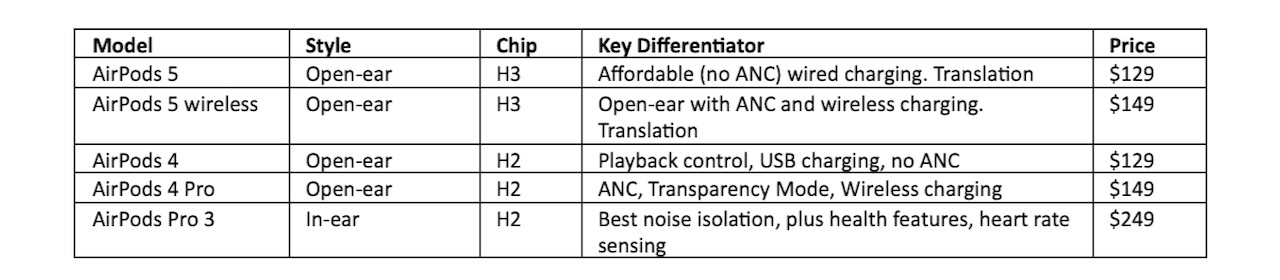
Table 1: The current AirPods lineup. Notice, there’s a fairly big gap between the AirPod 3 and the just-announced AirPod 5. Apple is expected to fill in the blanks in upcoming announcements.
It looks like buying AirPods is going to get even more confusing as new devices come out with specialized talents like health monitoring and translation. So maybe people will have AirPods for travel, AirPods for the gym, headphones for home.
Something to watch over you…
Apple’s new smartwatch lineup includes the flagship Apple Watch Series 12 and the very ultra Apple Watch Ultra 4. The SE 3 is the basic model with health and fitness, starting at $249.
Apple Series 12 has “comprehensive health monitoring” with increased heart rate tracking, improved sleep tracking, and stress monitoring. The watch’s new sensor enables it to offer advice on your workout, telling you to “go for it” or maybe hang back a bit and rest. Also big news is Siri’s updated AI and Audio Intelligence. Users can play back a conversation with Live Rewind to catch something they may have missed or recap conversations. The watch can recap the day’s interactions. The watch’s audio can identify sounds to warn users about alarms, car honks, sirens, etc. Shazam can automatically tell you what song is playing.

Figure 3. Apple Watch Series 12 introduces readiness, a new feature that analyzes a user’s recent activity, training load, vitals, and sleep score, and then provides a 0-10 score each day with a clear, actionable recommendation. (Source: Apple)
The Apple Watch Ultra comes with a very snazzy base price of $799. Its case is larger, at 49mm, and is titanium. It has the highest battery life of the new watches at 50 hours. New features for sports add precision dual-frequency GPS, a built-in depth gauge, water-temperature sensor, and support for scuba diving down to 40 meters. And, speaking of sirens, with all the action gear, the Ultra user might have need of its 86 dB emergency siren, satellite communication options, and advance health sensors.
The entry-level Apple Watch SE 3 also gets plenty of praise as a bargain. It keeps its base price of $249, even with a new S10 processor derived from the A20. It has a 64-bit dual-core processor and a four-core Neural Engine, which speed up Siri’s cogitation and support the advanced double-tap gesture. Its fitness tracking includes heart rate and core safety functions. It does not have ECG or blood oxygen tracking. Also, it only has heart rate tracking, unlike the Series 12 and Ultra watches, which add recovery information through high-frequency background heart rate tracking and hypertension notifications.
All three new watches have Always-On Retina displays (which can be turned off to improve battery life, sleep apnea notification, and wrist temperature sensing (for cycle tracking, period predictions, fertile windows, and perimenopause/menopause support.
Seriously, iPhones
Yes, it is about time we talked about phones. That’s at least a big reason why Apple threw this little shindig.
Apple placed its new A20 Pro processor built on TSMC’s 2nm process at the center of the event. The A20, which new iPhones come with, has a six-core CPU with two super cores, and four efficiency cores. The performance cores are 20% faster than the A19 Pro performance cores) and four efficiency cores to pick up the slack on low-power demands, stand-by operations, and background processes, and boost battery efficiency. The GPU provides 40% graphics processing and 50% increased memory bandwidth compared to the A19 Pro.
Apple has beefed up this chip for AI work. Its Neural Engine has dual 16-core blocks, which add up to 32 cores—and that is double the AI throughput of the A19 Pro.
Apple has updated the thermal design on the A20 Pro to support the increased demands of AI. Rather, we should say, Apple’s redesigned processor has been engineered to enable large AI models on-device and provide longer than ever battery lives for new devices.
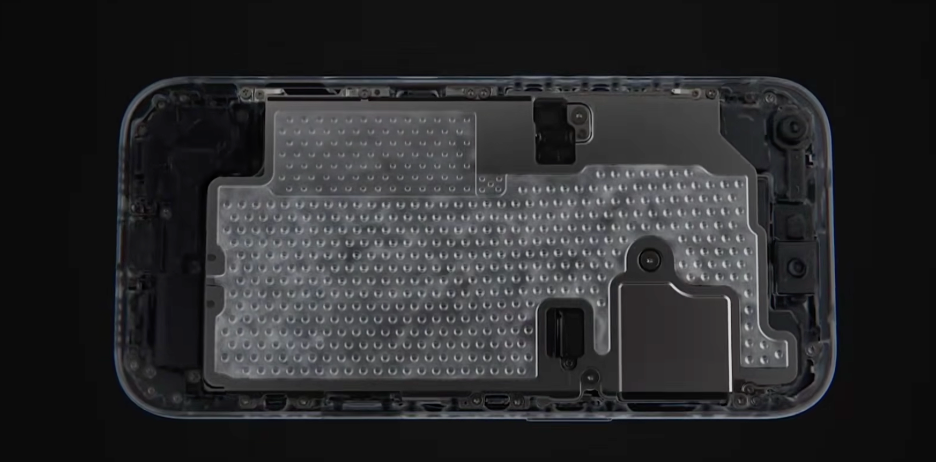
Figure 4. Apple’s vapor chamber, positioned over the core logic, features a metallic plate that acts as a heat sink. The move to 2nm enables a new design strategy for the iPhone. The CPU, GPU, and Neural Engine cores can be placed next to the DRAM, thus isolating the DRAM from the heat of the core logic. The core logic (CPU, GPU, Neural Engine cores) can then connect directly to a vaper chamber cooling system. Apple says this scheme also allows the bus interface to be expanded to 96 bits, a 50% increase in memory bandwidth. The design also enables improved performance during heavy workloads. (Source: Apple)
The iPhone 18 and Duo
The first products featuring Apple’s new processor and processor design are the iPhone 18 Pro and Pro Max. Again, thanks to the update to 2nm, the phones can be designed with a smaller Dynamic Island—the small rectangle screen “hole” in the screen. The phones also have a variable-aperture camera, LPTO+ OLED.
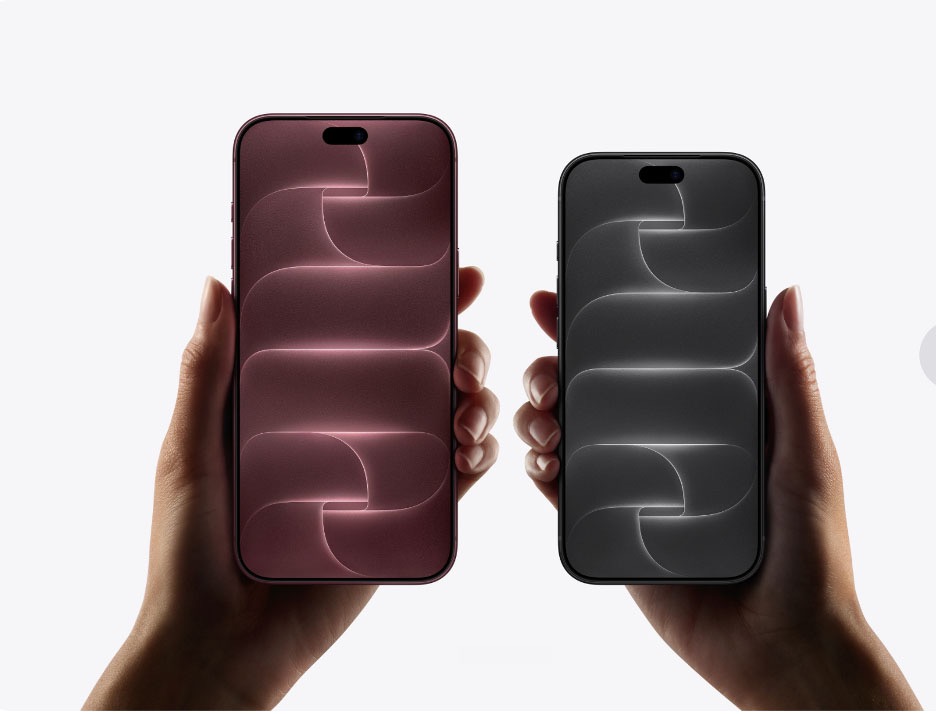
Figure 5. The iPhone 18 features LPTO+ OLED display and a smaller Dynamic Island. It has a variable aperture, increased depth of field, additional photographic styles, new presets, new shutter speed options, short replay capabilities, allowing users to run back the audio (if you didn’t quite get what just happened), and faster speeds, to name a few advances. (Source: Apple)
These phones have a wealth of new features and capabilities, including faster recharges—50% charge in15 minutes; the longer battery life we mentioned adds up to 24 hours per charge. The adjustable aperture that we blew by lets photographers adjust and save settings to create new effects. The phones have support for 4K Dolby Vision HDR with time-lapse, high dynamic range, slo-mo, and immersive audio.
It’s a lot. New users will want to go to school to see what all these phones can do.
Ironically, John Ternus kind of tossed it all away when he followed up with the two-screen Duo—the one more thing. Everyone promptly lost their mind, both pro and con.
It’s a foldable iPhone that he described as “passport-sized,” around 5.5-inches folded and around 7.6 inches open. This phone will not have Face ID because its camera system doesn’t have support TrueDepth. It has two rear lenses, no telephoto.
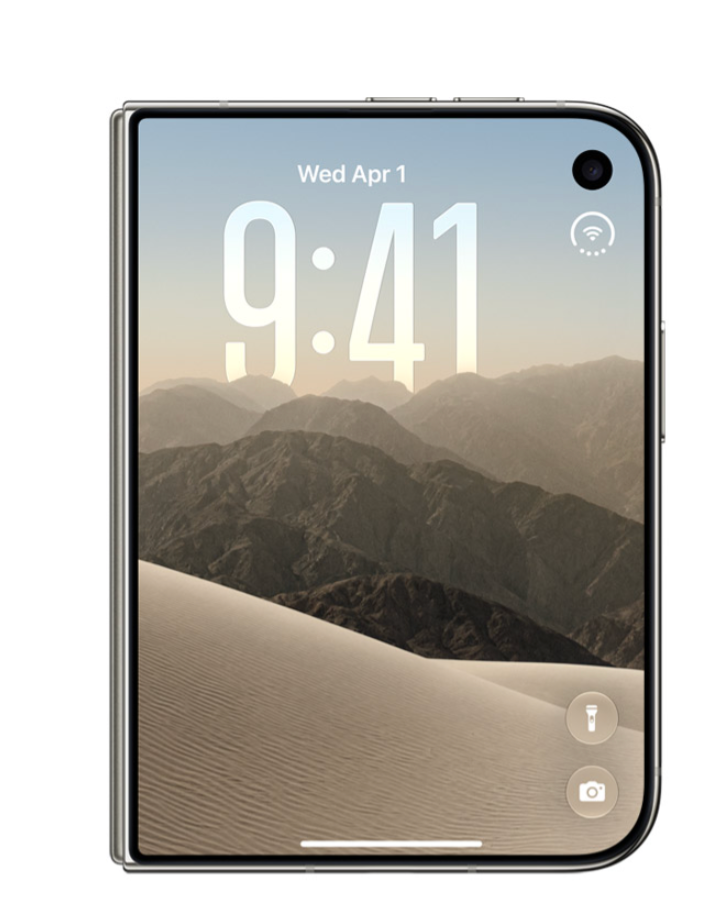
Figure 6: The iPhone Duo, says Apple, provides a 7.6 XDR display when open, but the Super Retina image quality is consistent across the inner and outer screen. (Source: Apple)
Apple has solved the challenge of a seamless dual display that resolves as the phone is opened. Check it out: The Internet is lousy with suspicious young men opening the phone ever so slowly, looking for the seam—as if they could beat the refrigerator light.
The ability to fold like a book, sit upright like a computer, or be used with a front and back offers a myriad of use cases. For instance, you can call mom, in front of your new lover and introduce them, and they can chat face-to-face. You can prop it up and take a group shot, and everyone can see how they look. You can create a cozy meeting with slides, and images, or video.
The Duo is beautiful, and a lot of people are going to want it right off the bat, but do they really? There are choices to be made. For most people, the first big one is, do I want to spend $2,000? It’s heavier. It doesn’t have face recognition.
Now, come over here and look at this classic iPhone with all the gen 18 features—advanced camera, lightweight, convenient, at least a familiar form factor, longer battery life. So, calm down, you’ve got decisions to make.
What’s really interesting and suggests a change in outlook at Apple HQ is that the Duo mounts a strong challenge to the iPad. (Yeah, dang, I forget to mention it supports the Apple pencil as well.) If you don’t need an iPad and an iPad, that $2,000 investment makes a little more sense. That kind of reasoning used to give some Apple executives the heebie-jeebies. Now, they’re seeing a future in a range of competitive, collaborative, interactive devices.
What do we think?
The top line on John Ternus is that his Apple is going to be churning out a raft of devices with a range of features. For a sneak peek into your potential future, open your bedside table: Do you have a bunch of earphones and ear buds? There ya go, better get a bigger drawer for watches and iPhones.
In this announcement, Apple talked use continuity across devices. You could already use your iPad, Apple Watch, Mac, and Apple TV together. At Surprise and Shine, Apple announced that the new Handoff feature will enable users to share their phone number across different iPhones. Sadly, this does not extend to the Apple Watch. In order for the watch to work on its own in the wild, you’ll still need a separate SIM.
Just the devices we think we know are coming: Home Pod, Home Pod Mini, maybe a Home Hub, new Apple TV—please, God, send us a new remote. Oh, and new computers, will people even use computers in this land of gadgets?
Apple’s gadget CEO could really knit up a lot of loose ends.
WHATYA THINK? LIKE IT? DON’T BE STINGY, SHARE IT WITH YOUR FRIENDS.