
Bolt Graphics has completed its first round of testing for Zeus, a GPU architecture that combines conventional graphics and HPC processing with dedicated hardware for electromagnetic simulation. The company reports encouraging results from its 12nm test chip and plans commercial production using TSMC’s 5nm process. Zeus targets scientific computing, digital twins, semiconductor design, and professional rendering. Its combination of native FP64 performance, specialized physics acceleration, high-capacity LPDDR5 memory, and conventional Ethernet could give engineers another option for computationally demanding workloads.

Bolt’s test chip (the little green square is the 12nm FPGA. (Source: JPR)
Bolt Graphics has completed initial testing of Zeus, a GPU architecture targeting high-performance computing (HPC), digital twins, electromagnetic simulation, and professional graphics. The company also announced it is opening an office in Taiwan as it prepares for additional silicon development and eventual manufacturing at TSMC.
The announcement centers on a dedicated hardware engine that executes algorithms based on Maxwell’s equations. These equations describe electromagnetic fields, wave propagation, and how electromagnetic energy interacts with materials. Engineers use numerical solutions to model antennas, semiconductor structures, photonic circuits, electrical systems, and other complex physical environments.
Bolt claims its architecture adds dedicated Maxwell-equation acceleration to a commercial GPU design. The company’s initial test chip demonstrates the concept, but the full production GPU is still under development.

Figure 1. Darwesh Singh, Bolt CEO and founder. (Source: JPR)
Darwesh Singh, Bolt Graphics’ founder and CEO, says the company implemented an electromagnetic simulation algorithm into a fixed-function silicon block. The accelerator executes the computational sequence independently of Zeus’ vector cores and integrated CPU.
This approach gives Bolt a specialized execution path for electromagnetic workloads while preserving its general-purpose resources for other calculations.
Specialized engines complement conventional GPU processing
Bolt founded its development program in 2020 around scientific computing and graphics applications. These markets require several numerical formats, different memory-access patterns, and substantial computational throughput.
Scientific simulation frequently depends on FP64 arithmetic for numerical stability and accuracy. Rendering and graphics workloads commonly use FP32 and FP16, while certain matrix operations benefit from integer formats.
Zeus addresses these requirements through vector cores supporting FP64, FP32, and FP16, matrix cores supporting INT16 and INT8, and its dedicated electromagnetic simulation engine.
The architecture reflects Bolt’s assessment of opportunities in scientific computing, digital twins, and professional rendering. Nvidia and AMD have expanded their AI acceleration capabilities, with their respective product families offering different combinations of numerical precision and throughput.
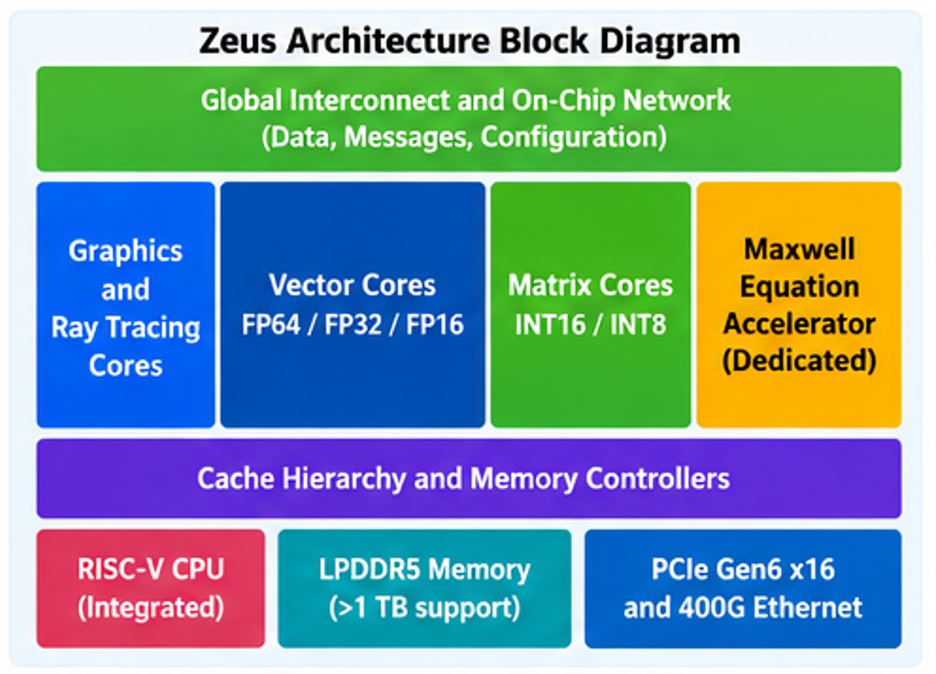
Figure 2. Zeus combines graphics, compute, and dedicated EM acceleration. (Source: JPR)
For independent software vendors, the critical question involves how effectively Zeus can execute existing numerical algorithms. Fixed-function acceleration can reduce instruction overhead and improve energy efficiency for supported operations. Application developers must still evaluate numerical accuracy, supported solvers, memory behavior, programming interfaces, and integration with established simulation workflows.
Early silicon demonstrates the architectural concept
Bolt completed tape-out of its test chip in April and subsequently finished its first testing round. The experimental device occupies approximately 6mm² and uses TSMC’s 12nm manufacturing process.
The following table summarizes Bolt Graphics’ announced design targets. Production specifications remain subject to validation.
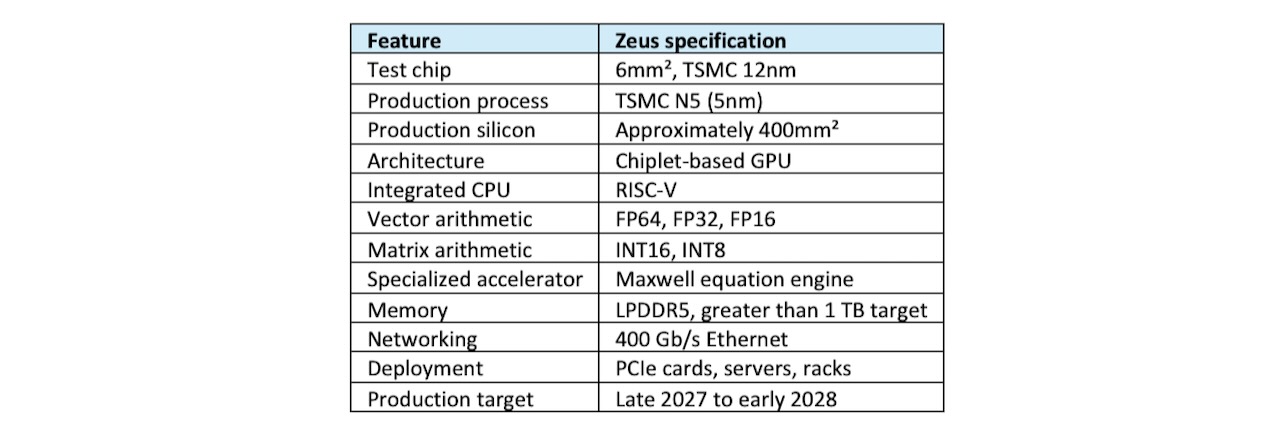
Table 1. Bolt Graphics’ announced Zeus architecture and production targets.
The specifications indicate a deliberate emphasis on numerical precision, memory capacity, and specialized electromagnetic acceleration. Application benchmarks will determine whether these architectural decisions deliver competitive performance and cost advantages in production systems.
According to Singh, initial measurements exceeded the company’s internal performance and power expectations. Bolt has not supplied independently verified benchmark results in the material accompanying the announcement.
The company expects its production architecture to use TSMC’s N5 process. Its planned GPU will use a chiplet architecture, an integrated RISC-V CPU, and about 400mm² of silicon, according to the announced specifications.
Bolt currently targets production around late 2027 or early 2028, with commercial shipments expected in 2028.
The decision to use N5 reflects the company’s cost and manufacturing strategy. Singh says Bolt selected the process early in architectural development to improve wafer availability and control manufacturing expenses.

Figure 3. Bolt’s future Zeus AIB. (Source: JPR)
Process selection influences transistor density, operating frequency, leakage, yield, and packaging requirements. Bolt must balance these factors against the computational density and memory bandwidth necessary for its target applications.
Memory capacity and networking shape the system
Bolt’s memory strategy also reflects its target markets. Zeus uses LPDDR5 memory and aims to support configurations exceeding 1 TB of capacity.
Large electromagnetic models and digital twins can require extensive working memory, particularly when engineers represent detailed geometries, materials, and multiple interacting physical systems.
LPDDR5 offers a capacity-oriented system design with different bandwidth, power, and packaging characteristics from HBM. Actual application performance will depend on the relationship between memory bandwidth, data locality, cache behavior, and computational intensity.
Bolt also plans PCIe accelerator cards for existing workstations and servers, along with larger systems using 400 Gb/s Ethernet connectivity.
These interfaces give IT organizations familiar integration options and allow customers to evaluate Zeus without committing immediately to a proprietary system architecture.
For CIOs and infrastructure architects, procurement considerations extend beyond accelerator pricing. Power delivery, cooling, network configuration, memory capacity, software maintenance, and utilization determine total system cost.
Photonics and digital twins create application opportunities
Electromagnetic simulation represents Bolt’s initial specialized physics workload. The company intends to expand its architecture toward broader physical modeling and simulation.
Photonic-integrated circuits provide one potential application. Engineers must analyze optical waveguides, material interfaces, electromagnetic coupling, component spacing, and other geometric properties before manufacturing a design.
Dedicated acceleration could help designers evaluate additional configurations and shorten simulation cycles. Semiconductor engineering, antenna development, advanced packaging, and optical networking present related opportunities.
Singh also identifies co-packaged optics as a possible future direction. Bolt does not plan to incorporate the technology into its first-generation product, citing implementation costs. The company continues exploring the approach for a subsequent generation.
Digital twin applications introduce further requirements. Complex models frequently combine electromagnetic, thermal, structural, and fluid simulations. Successful deployment will require software frameworks that coordinate these solvers and exchange results efficiently.
Commercial execution remains the next challenge
Bolt reports discussions with national laboratories, defense contractors, hyperscalers, film studios, and game developers.
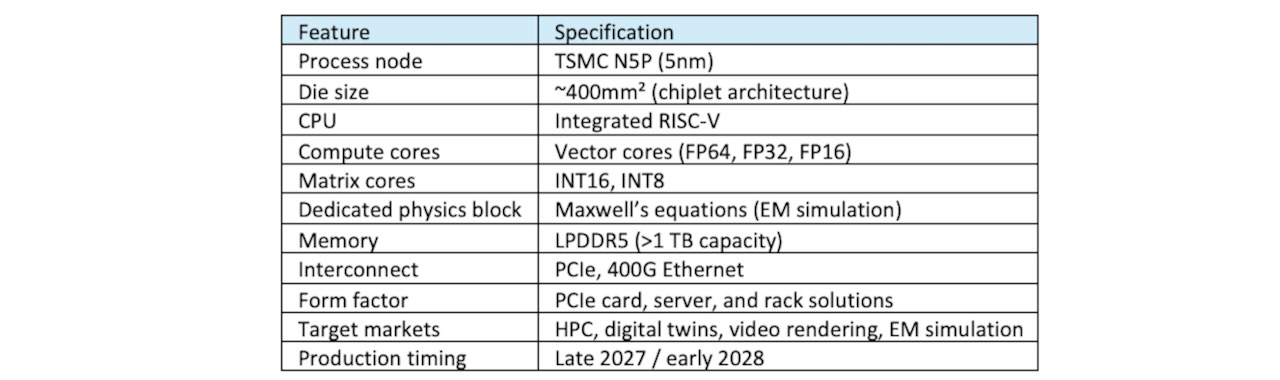
Table 2. Zeus spec sheet planned production GPU.
These customers represent different performance requirements and procurement cycles. Laboratories prioritize numerical accuracy and established simulation codes. Studios emphasize rendering throughput, software compatibility, and predictable production schedules.
Bolt will need production silicon, a mature software stack, application benchmarks, and reliable system partners to convert technical interest into commercial deployments.
Its early test results establish an initial hardware milestone. Subsequent validation must demonstrate how the dedicated physics engine performs within complete applications, including workloads that combine computation, memory transfers, and distributed processing.
The company’s commercial opportunity will depend on measured application performance, system economics, software adoption, and the availability of production hardware.
What do we think?
Bolt Graphics has identified a credible opportunity in physics-oriented acceleration. Dedicated Maxwell equation hardware could improve electromagnetic simulation efficiency, particularly in semiconductor design and photonics. The company’s memory and manufacturing choices also support a practical cost strategy. Production performance, numerical accuracy, software compatibility, and customer adoption will determine whether Zeus can establish a sustainable market position.
Inflection point. Zeus may signal an inflection point in specialized scientific acceleration. Its dedicated electromagnetic engine illustrates how GPU developers can move frequently executed numerical algorithms into application-specific hardware. If Bolt demonstrates meaningful performance and energy advantages, other silicon developers may pursue similar approaches for computational physics. The implications extend to semiconductor design, photonics, digital twins, and industrial simulation. The broader AI market could also benefit as specialized physics engines support simulation-generated training data and increasingly sophisticated engineering workflows.
LIKE IT? WE’VE GOT LOTS MORE. TELL EVERYONE YOU KNOW. WE’D LOVE TO HEAR FROM YOU AND THEM.