
Intel beat its guidance again. Third-quarter revenue reached $16.5 billion, up 21% from a year earlier. Data Center and AI sales climbed 78% to $7.3 billion, the clearest sign that server demand is driving the recovery. GAAP EPS came in at $0.60, and non-GAAP EPS reached $0.52. Intel generated $5.1 billion in operating cash flow. The outlook is less exuberant: Management expects the PC slowdown to continue through at least the first half of 2027 and forecasts Q4 revenue of $15 billion to $16 billion.
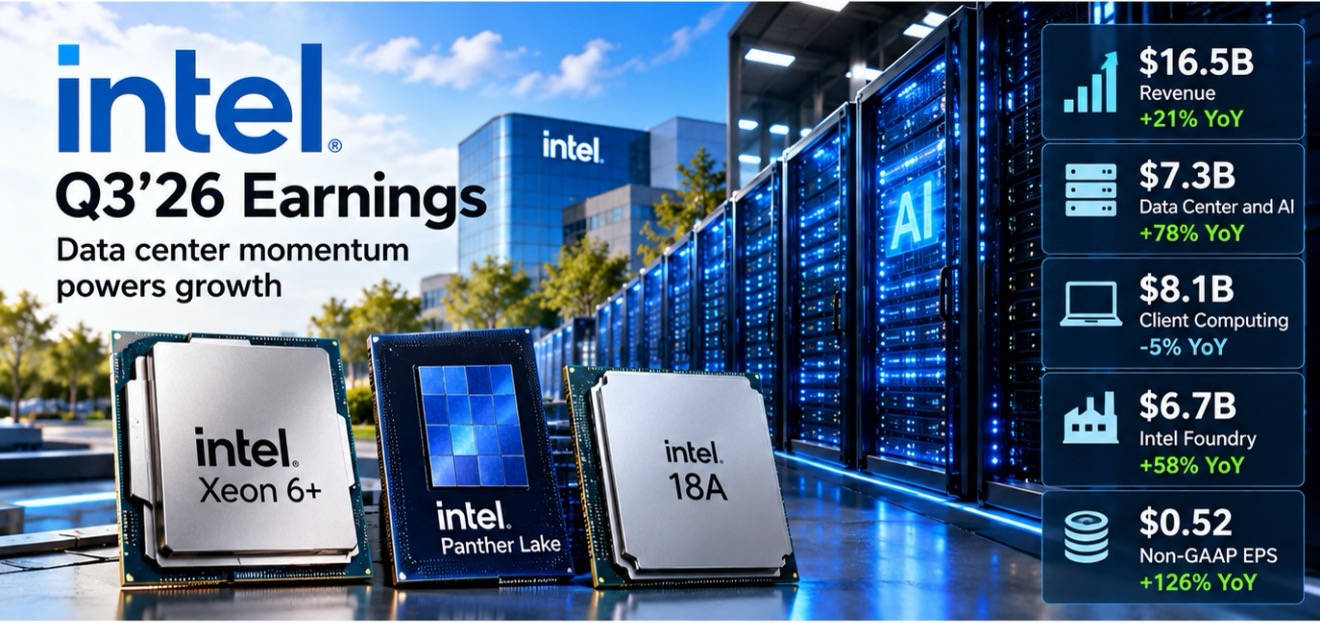
Intel’s profitability improved with sales. GAAP gross margin rose 4.8 percentage points to 43.0%, and operating margin reached 15.3%, up from 5.0% a year ago. Non-GAAP operating margin climbed to 19.6%, compared with 11.2% in Q3’25. Non-GAAP net income rose 169% to $2.8 billion. GAAP net income, however, declined 18% to $3.3 billion, and GAAP EPS fell from $0.90 to $0.60. Those differences make it important to keep the two earnings measures separate.

Figure 1. Intel’s Q3 revenue grew 21% year over year. (Source: Intel and JPR)
The data center does the heavy lifting
Data Center and AI (DCAI) revenue rose 78% to $7.3 billion. The Client Computing and Physical AI Group (CCPG) reported $8.1 billion, down 5%. Intel Products revenue totaled $15.4 billion, up 22%. Foundry revenue increased 58% to $6.7 billion, although that figure includes intersegment business and cannot be added directly to consolidated sales. Intel reported $6.3 billion of intersegment eliminations.
The data center acceleration matters for the company’s manufacturing plans. Intel says it must expand Xeon supply to satisfy demand, while a slowing PC market creates a different capacity and inventory challenge. Zinsner expects the PC weakness to persist at least into the first half of next year. The combination makes product mix, manufacturing yields, and working capital especially important over the next several quarters.
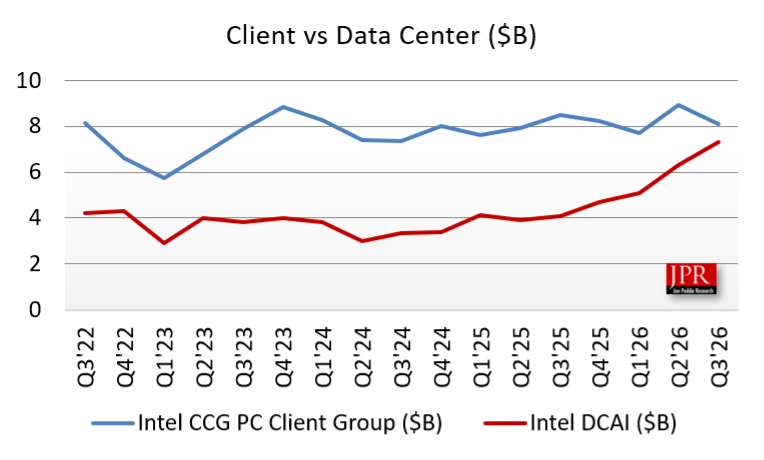
Figure 2. Intel’s data center sales climbed as client revenue declined. (Source: Intel and JPR)
“Our Q3 results demonstrate improving execution, meaningful progress expanding supply, and continued advancement of our process technology,” said CEO Lip-Bu Tan. Intel’s immediate priority, he added, is increasing supply for the Xeon family. CFO David Zinsner said the quarter exceeded guidance for revenue, gross margin, and EPS, and delivered the company’s strongest data center revenue growth in 15 years.
Products, process technology, and capital
Intel completed a $23 billion public equity offering to support growth and its balance sheet. It also announced plans to acquire quantum software developer Classiq. Neither announcement establishes near-term processor revenue, but both affect the company’s capital allocation and technology strategy.
On the product side, Intel outlined a multiyear Xeon collaboration with Oracle Cloud Infrastructure, including planned X14 systems using the next-generation Diamond Rapids server processor. Intel also shared details of its GPU D-Series, formerly Crescent Island, and showed Xeon-based rack designs at the OCP Global Summit. Its demonstration of support for Meta’s Muse Spark Open on upcoming GPU D-Series and Xeon platforms emphasizes the software work required to turn new AI hardware into usable infrastructure.
Intel presented Diamond Rapids, GPU D-Series, and Core Series 3 as complementary architectures for agentic AI and enterprise workloads. The company also worked with AMD to bring x86 CPU optimizations for PyTorch together in oneDNN and announced a collaboration with SAP involving physical AI. Those initiatives address the software and deployment ecosystem alongside silicon performance.
Foundry advanced its 14A process design kit to version 0.9 in October. Intel also announced work with ASML on High-NA EUV readiness, with Lens Technology on glass-based advanced packaging, and with Lam Research and Applied Materials on facilities for manufacturing-equipment research and capacity. The company reported completion of its RAMP-C program. These are development milestones; the earnings release does not identify a new external high-volume 14A customer or provide foundry operating profit.
Q4 guidance tempers the momentum
Intel expects fourth-quarter revenue between $15.0 billion and $16.0 billion, with a midpoint of $15.5 billion. The company projects GAAP gross margin of 37.1%, non-GAAP gross margin of 38.0%, GAAP EPS of $0.10, and non-GAAP EPS of $0.25. Each measure sits below the third-quarter result. Management’s caution about PC demand and its plans to invest in capacity and working capital will test whether the data center gains can support continued improvement.
What do we think?
Intel’s Q3 gives its turnaround another quarter of evidence. Xeon demand, improving operating margins, and stronger non-GAAP earnings support management’s execution story. The $23 billion equity raise adds financial capacity, while the Q4 forecast highlights a less uniform market. We want to see sustained server shipments, better foundry economics, and supply expansion without excessive inventory or margin pressure.
Inflection point. The 78% increase in DCAI revenue is the quarter’s clearest inflection signal. It shows how AI infrastructure spending can lift Intel’s CPU franchise even as client demand softens. An inflection point for the whole company requires more: dependable Xeon supply, competitive next-generation products, progress with external foundry customers, and margins that survive a weaker PC cycle. The next two quarters should help distinguish a lasting operating recovery from a concentrated burst of data center demand.
AND IF YOU LIKED WHAT YOU READ HERE, DON’T BE STINGY, SHARE IT WITH YOUR FRIENDS.