
Microsoft has introduced two DirectX Raytracing features that could substantially reduce the cost of rendering complex, changing scenes. Clustered geometry organizes triangles into reusable groups, while partitioned top-level acceleration structures update only the portions of a scene that change. In one Radeon RX 9070 demonstration, frame rates increased from 1.2 to 79 fps. The preview supports current Nvidia, AMD, and Intel graphics hardware. Developers can now evaluate the techniques before Microsoft moves them into its retail software development environment.
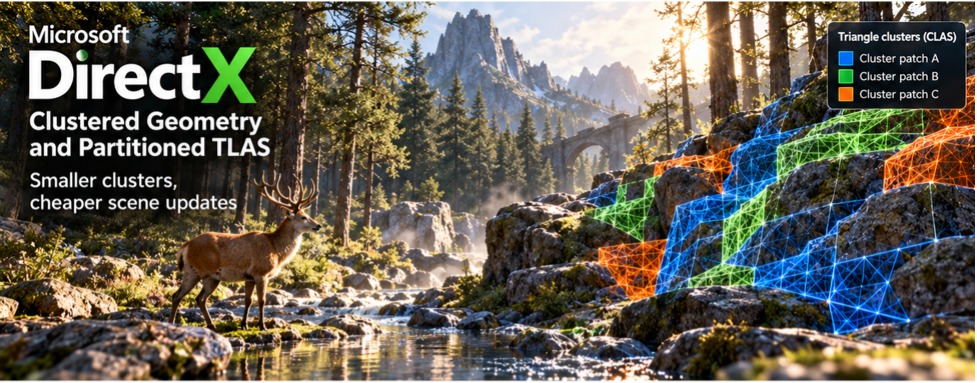
Microsoft has introduced clustered geometry and partitioned top-level acceleration structures (PTLAS) in DirectX Agility SDK 1.722 Preview, giving game developers new tools to reduce the cost of maintaining ray-tracing data in complex, dynamic scenes. The October 2026 release also introduces a unified GPU-driven interface for building and updating acceleration structures.
The changes address a growing problem in real-time graphics. Game engines continually update animated characters, vegetation, terrain, and objects as players move through increasingly detailed environments. Ray tracing requires acceleration structures that organize this geometry so the GPU can calculate ray intersections efficiently. Building and updating those structures consumes processing time and memory.
Microsoft’s approach divides geometry into smaller reusable elements and organizes scene instances into independently maintained partitions. Developers can apply the techniques separately or combine them within the same rendering pipeline.
The preview builds on DirectX Raytracing (DXR), which Microsoft introduced in 2018. Subsequent updates expanded ray dispatch, shader execution, and geometry handling. The latest changes concentrate on acceleration-structure construction and maintenance.
Smaller geometry units reduce rebuild costs
Traditional ray-tracing pipelines organize geometry into bottom-level acceleration structures (BLAS), which describe individual objects, and top-level acceleration structures (TLAS), which organize their instances within a scene. Animation, procedural geometry, and streaming can require repeated BLAS construction. Large structures increase the amount of work even when applications change relatively small portions of an object.
Clustered geometry introduces the cluster-level acceleration structure (CLAS), which contains an indexed mesh of up to 256 triangles and 256 vertices. Applications assemble multiple CLAS objects into a Cluster BLAS and subsequently reference that structure through a TLAS or PTLAS. Multiple Cluster BLAS objects can share the same CLAS.
This arrangement allows engines to reuse previously constructed triangle groups when streaming geometry or changing levels of detail. Meshlet-based rendering systems already organize geometry into similarly sized groups, providing a potential starting point for integration.
Each CLAS carries a 32-bit ClusterID that hit shaders retrieve through ClusterID(). PrimitiveIndex() identifies triangles within the individual cluster. Together, these values help shaders locate material, normal, and other per-primitive information.
Shader Model 6.10 also introduces triangle-position access functions, including TriangleObjectPositions(), that allow shaders to retrieve object-space positions directly from acceleration structures.
Compression and templates support changing geometry
Clustered geometry supports floating-point and normalized integer vertex formats. Its COMPRESSED1 format represents vertex positions as packed integer offsets from a shared anchor, using a power-of-two scale.
Developers can select precision and coordinate ranges that match the geometric content.
The API also supports optional truncation of low mantissa bits after conversion to 32-bit floating-point positions. These controls allow rendering engineers to evaluate precision, storage requirements, and performance.
Clustered geometry does not support conventional refitting. Instead, cluster templates preserve topology and other position-independent information for geometry that changes shape.
For an animated mesh, an application creates templates, generates current vertex positions through a compute shader, instantiates CLAS objects from the templates, and assembles the resulting Cluster BLAS.
The engine then updates the corresponding top-level instances.
This workflow suits animated characters, deforming surfaces, and procedurally generated objects whose topology remains predictable across successive frames.
Templates also support changes in geometric detail through the selection of different clusters.
Partitioned TLAS localizes scene updates
PTLAS addresses the cost of updating large scenes containing many independent objects.
A conventional TLAS update can require substantial processing even when only a small number of instances change. PTLAS organizes persistent instance records into spatial partitions and maintains their acceleration structures independently.
Applications can retain unchanged partitions across frames and rebuild the partitions that contain modified instances.
Frequently moving objects can enter a global partition, where the implementation manages each instance independently during construction and traversal.
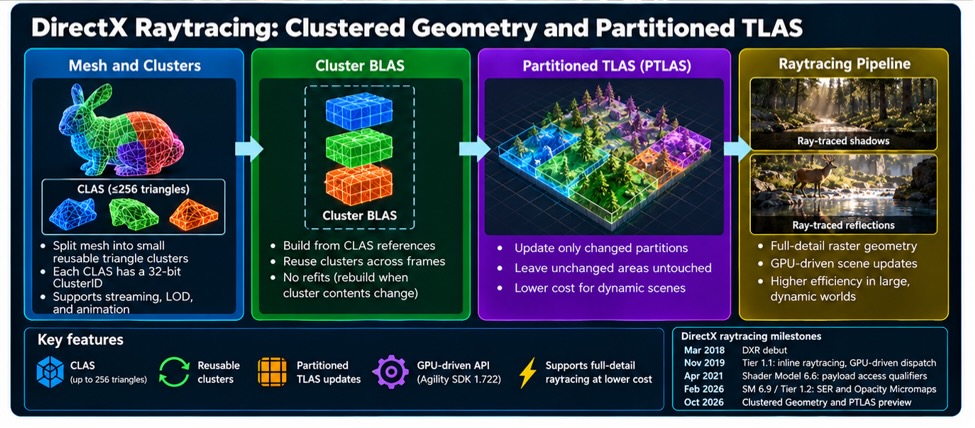
Figure 1. DirectX clustered geometry and partitioned TLAS reduce acceleration-structure rebuild costs in dynamic raytracing scenes.
Microsoft provides three principal operations for managing PTLAS instances.
WRITE_INSTANCE creates or modifies complete instance records, including transforms and partition assignments. UPDATE_INSTANCE changes the referenced BLAS address and hit-group-table contribution without modifying the transform. TRANSLATE_PARTITION changes the translation of an entire partition, supporting large-world coordinate management.
A persistent InstanceIndex identifies each record across frames.
Developers must consider partition boundaries and object movement when organizing their scenes. Excessive overlap between partition bounds can reduce traversal efficiency.
GPU-driven construction changes scheduling
The preview introduces an acceleration-structure operation interface that supports indirect execution.
GetRTASOperationPrebuildInfo() reports conservative memory requirements for results and temporary construction storage. ExecuteIndirectRTASOperations() processes batches of operations using argument arrays that reside in GPU memory.
Compute shaders can generate those arguments, reducing the CPU’s involvement in preparing individual construction operations.
Operations within a single call can execute in any order, so dependent stages require separate calls and synchronization barriers. For example, an application builds CLAS objects, assembles Cluster BLAS objects, and then constructs the corresponding PTLAS through successive operations. This scheduling model gives engine developers additional control over GPU workloads while introducing synchronization and resource-management requirements.
Early measurements show substantial gains
Microsoft’s D3D12RaytracingClusteredGeometry sample demonstrates the potential effect of reducing acceleration-structure construction costs. On an AMD Radeon RX 9070, the sample increased frame rate from 1.2 to 79 fps when it replaced conventional BLAS rebuilds with clustered geometry. Total acceleration-structure memory declined from 7,519 MiB to 774 MiB, a reduction of approximately 89.7%. The sample also reduced GPU acceleration-structure build time from 788 ms to 3.11 ms.
These figures reflect one implementation and hardware configuration. Actual results will depend on scene complexity, geometry organization, animation, GPU architecture, and driver behavior.
The clustered approach also increases temporary scratch-memory requirements, which developers must account for when allocating GPU resources.
A separate falling-dominoes demonstration reduced top-level rebuilding time from 2.88 ms to 0.79 ms through localized PTLAS updates.
Hardware support and deployment
Microsoft reports that the features require no additional hardware capability beyond existing ray-tracing support, although GPU vendors must implement appropriate driver support.
The preview supports Nvidia GeForce RTX GPUs, AMD Radeon RX 9000-series processors, Intel Arc B-series products, and supported Core Ultra integrated graphics. Qualcomm support is scheduled for 2027. Support for some earlier raytracing GPUs remains uncertain.
Gears of War: E-Day provides an early example of clustered geometry through Nvidia’s RTX Mega Geometry interface. DirectX standardization gives developers a common API for implementing related techniques across supported vendors.
Microsoft also released Agility SDK 1.620 for retail use, adding improvements to Advanced Shader Delivery, DirectX Dump Files, and other graphics-development capabilities.
Shader Model 6.10 remains in preview, with a retail release planned for early December.
For game-engine developers and ISVs, clustered geometry and PTLAS offer additional control over dynamic ray-tracing workloads. Silicon teams gain another standardized interface for evaluating driver efficiency and acceleration-structure performance.
The commercial significance will depend on engine integration, driver maturity, and measurable improvements in shipping applications.

Figure 2. A ray-traced forest with cluster-patch overlays echoing the sample scene.
Microsoft’s DXR preview advances the management of geometric data for ray tracing. Clustered geometry reduces the amount of construction work associated with detailed objects, while PTLAS confines scene updates to affected regions. GPU-driven execution gives developers additional control over how those operations reach the hardware. The techniques offer substantial opportunities for complex real-time scenes, and production software will establish their practical benefits across GPU generations.

Table 1. DirectX Raytracing development milestones.
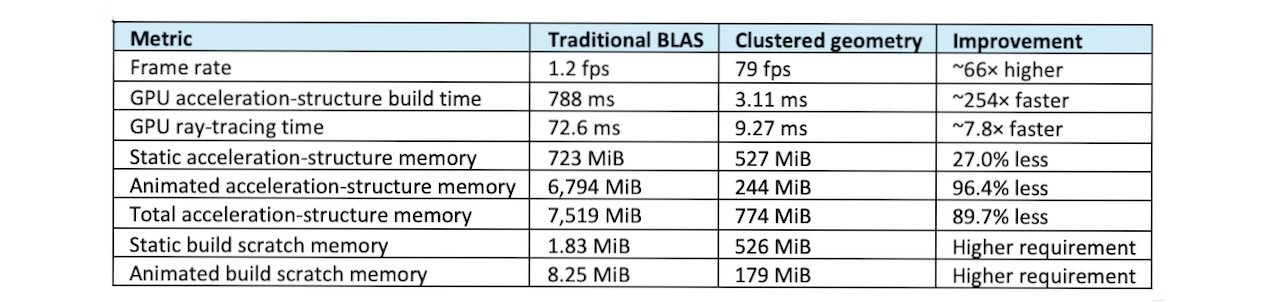
Table 2. Traditional BLAS versus clustered geometry on Radeon RX 9070. (Source: Microsoft DirectX Raytracing clustered-geometry sample results, as reported in the supplied material. Measurements represent a specific development configuration.)
What do we think?
Microsoft addresses a significant limitation in dynamic ray-tracing: acceleration-structure construction and maintenance. The early results demonstrate substantial opportunities for reducing frame time and memory consumption. Increased scratch requirements and uneven driver availability warrant attention. Engine developers should begin testing clustered geometry with animated assets and streaming environments. Production workloads will establish the achievable gains across hardware platforms and engines.
Inflection point. This preview does not create an inflection point in AI. It could establish one in real-time graphics by reducing the cost of maintaining detailed geometry for ray tracing. Clustered structures and localized scene updates provide a standardized foundation for more complex dynamic environments. The inflection point will depend on engine adoption, driver coverage, and measurable performance in commercial games. Developers gain additional control over acceleration structures, while GPU suppliers gain a common interface for optimizing geometry processing across successive hardware generations and applications.
WHAT DO YOU THINK? GOOD ENOUGH TO TELL YOUR FRIENDS ABOUT IT? YOU HAVE OUR PERMISSION TO SHARE IT.