
China’s LineShine supercomputer—the all-CPU exascale machine we reported in May—is now officially the world’s fastest computer, confirmed at 2.198 EFLOPS on the TOP500 list published this week in Hamburg, Germany. Built entirely from domestic Chinese chips, networking, and software, it’s the first system ever to sustain more than 2 EFLOPS using CPUs alone, and the first Chinese machine to lead the list since 2017. It’s a genuine achievement. The AI benchmark tells a more complicated story.

In May, we reported that China’s National Supercomputing Center in Shenzhen, Guangdong, China, had unveiled LineShine, a homegrown exascale supercomputer built entirely from domestic chips, interconnects, and storage—and, unusually, with no GPU accelerators anywhere in the design. The machine was said to target 2 EFLOPS using Armv9-based LX2 processors, the proprietary LingQi fabric, and Chinese storage, the whole effort framed by Shenzhen officials as proof of self-reliance “across the entire stack.”
At the time, we flagged the obvious caveat: 2 EFLOPS was a claim, not a verified benchmark, and China had not submitted a Linpack result to the TOP500 since 2019. The number needed independent validation.
This morning it got it.
The 67th TOP500 list, published at the ISC High Performance 2026 conference in Hamburg, Germany, confirms the claim, and then some. LineShine enters straight in at No. 1 with 2.198 EFLOPS on the High Performance Linpack (HPL) benchmark—around 80% of its 2.736 EFLOPS theoretical peak—making it the first machine ever to sustain more than 2 EFLOPS of double-precision performance using CPUs alone. It pushes the US Department of Energy’s El Capitan into second place at 1.809 EFLOPS. It is the first time a Chinese system has led the list since 2017.
The official entry credits a custom Chinese processor on a platform called “LingKun”— 13.79 million cores built from 304-core LX2 chips running at 1.55 GHz, linked by the LingQi interconnect and running the domestic Kylin operating system. The list does not name a chip vendor, but we reported in May that this is Huawei.
LineShine also takes the top spot on HPCG, the benchmark that better reflects the data-intensive patterns of real applications.
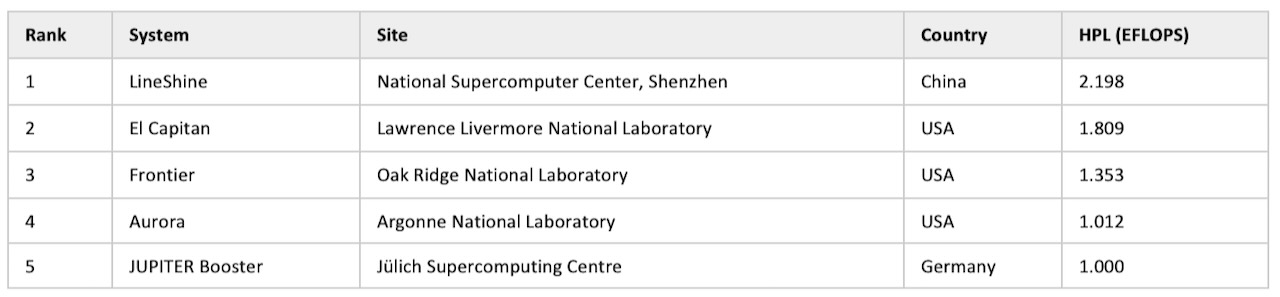
Table 1. Five systems now sustain more than 1 EFLOPS on HPL—and, for the first time, they sit across Asia, North America, and Europe at once.
On HPL-MxP—the mixed-precision benchmark that tracks the kind of lower-precision math AI training actually relies on—LineShine lands only in fourth place, at 7.92 EFLOPS. Its mixed-precision score is just 3.6 times its standard Linpack result, where the accelerated American machines clear nine times. That small multiplier is the signature of a system with no dedicated low-precision hardware: outstanding at traditional 64-bit science, comparatively ordinary at AI.
There is a power problem; LineShine draws roughly 42 MW to reach the top, for an efficiency of about 52 GFLOPS per watt; El Capitan delivers its slightly lower score at nearly 61. To picture 42 MW: that is the entire installed capacity of RWE’s new Serra Giannina wind farm in southern Italy—six turbines built to power some 39,000 homes. And because the supercomputer runs around the clock while a wind farm only generates when the wind blows, LineShine at full tilt would consume more electricity over a year than that whole wind farm produces. China reached No. 1 with scale and electricity rather than efficiency.
What do we think?
China has genuinely done it. LineShine is now the world’s fastest supercomputer on the industry’s official list, and it’s built entirely from Chinese parts: the processors, the networking, even the operating system. The whole point of US export controls was to stop China reaching this level. China hasn’t held the top spot since 2017, so this is a real statement.
But it’s worth understanding how they got there. Almost every other top machine uses specialist accelerator chips, the same kind of chip that powers AI. China couldn’t get those, so instead, it used enormous numbers of ordinary processors and a lot of electricity: LineShine burns a colossal 42 MW to edge ahead. It’s a triumph of scale and determination rather than of cutting-edge efficiency.
On the benchmark that actually reflects AI training—the thing the export controls were really about—LineShine sits in fourth place, well behind the American systems. So China has built a magnificent machine for traditional science: drug discovery, climate and weather modeling, and engineering simulation. What it hasn’t done is close the gap as much in AI. The export controls didn’t stop China from building a supercomputer. But so far they have stopped building an AI supercomputer.
LIKE WHAT YOU’RE READING? INTRODUCE US TO YOUR FRIENDS AND COLLEAGUES.