
Nvidia will launch DLSS 5 with NBA 2K27 on September 3, introducing 3D-guided neural rendering to GeForce RTX 50-series GPUs. The technology moves DLSS beyond resolution reconstruction and frame generation by using a specialized diffusion transformer to modify lighting, materials, shading, and other image characteristics in real time. The approach gives developers controls intended to preserve artistic direction, while Nvidia’s initial performance numbers also show that neural rendering carries a substantial computational cost.

Nvidia first introduced DLSS (Deep Learning Super Sampling) in September 2018, alongside the GeForce RTX 20-series/Turing architecture. The company has steadily expanded DLSS from its original AI upscaling role. Earlier versions rendered a game below the display resolution and reconstructed a higher-resolution image. Nvidia subsequently added frame generation, ray reconstruction, and other neural techniques that reduced the amount of conventionally rendered work required to produce the displayed image.
DLSS 5 changes the relationship between AI and the rendering pipeline. Nvidia calls the new technique 3D-guided neural rendering. A specialized pixel-space diffusion transformer receives the rendered frame plus information from the game engine and generates changes to lighting interactions, materials, shading, and other visual characteristics.
DLSS becomes part of the renderer
The model can consume considerably more than a finished color buffer. Inputs can include G-buffer information such as albedo, surface normals, depth, roughness, metalness, and motion vectors. Developers can also supply masks and adjust structure and tone intensity to control how strongly DLSS 5 changes different parts of a scene.
That distinction matters. DLSS 5 does not simply enlarge an image or reconstruct missing samples. It interprets information about a 3D scene and uses a neural model to alter the final presentation.
Neural rendering still needs conventional rendering.
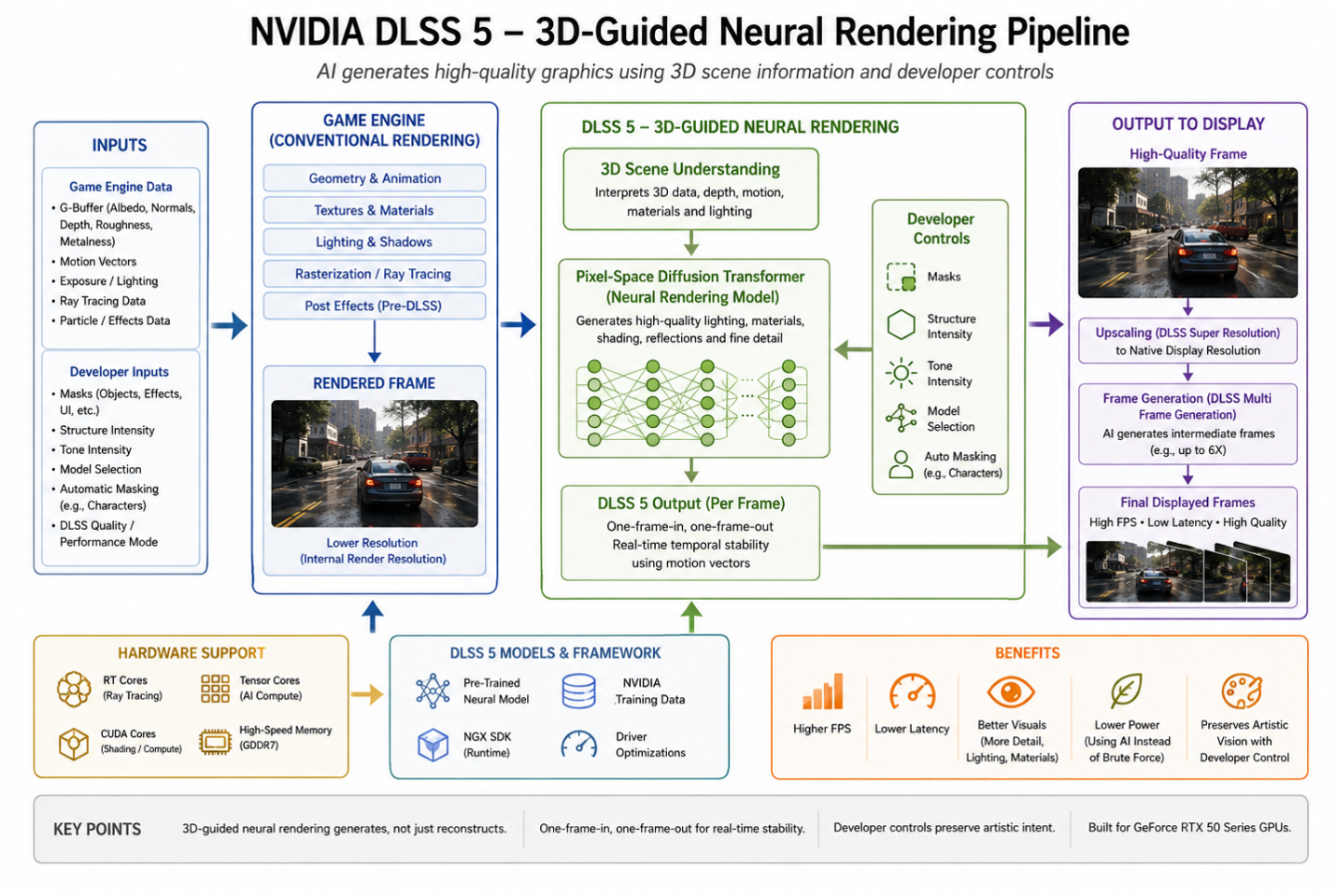
Figure 1. DLSS 5 does not replace the game engine.
Geometry, textures, animation, rasterization, ray tracing, and other conventional rendering operations still establish the scene. Nvidia says better source imagery gives DLSS 5 better information from which to generate its output. A low-resolution texture remains a low-resolution source asset, basic geometry remains basic geometry, and the model cannot turn incomplete reflection information into a physically accurate ray-traced reflection.
This creates a hybrid rendering architecture. Conventional graphics establishes geometry and physically derived scene information; neural rendering interprets that information and generates portions of the final visual result.
For silicon designers, that increases the importance of balancing conventional shader throughput, ray-tracing hardware, Tensor Core performance, memory bandwidth, and latency. Neural rendering does not make the traditional GPU pipeline irrelevant. It adds another computational stage.
One frame at a time
Real-time operation creates a problem that conventional generative video systems do not face. Video-generation models can process groups of frames and use previous results to maintain temporal continuity. Interactive games cannot tolerate that latency.
Nvidia trained DLSS 5 to operate one frame at a time. It uses engine information, including motion vectors, to maintain temporal stability while independently processing each rendered frame.
That architecture addresses latency, while creating another engineering challenge: DLSS 5 must generate consistent lighting, materials, and shading from one independently processed frame to the next. Motion, therefore, becomes a critical test. A still screenshot can look convincing while temporal artifacts, shimmering, or inconsistent generated detail become visible once the scene moves.
Nvidia’s initial NBA 2K27 numbers illustrate another issue: Displayed FPS no longer directly represents rendering throughput.
At 4K with ray tracing and the Ultra preset, Nvidia reports 233 fps for the RTX 5080 and 370 fps for the RTX 5090. Those results use DLSS Performance mode and 6× Multi Frame Generation. Dividing the displayed rates by six implies underlying output rates of roughly 39 fps and 62 fps, respectively, before accounting for frame-generation overhead.
The same issue appears at lower resolutions. At 1440p, Nvidia’s reported figures imply approximately 99 fps for the RTX 5090, 69 fps for the RTX 5080, 59 fps for the RTX 5070 Ti, and 44 fps for the RTX 5070 before the 6× frame multiplication.
Those numbers do not establish DLSS 5’s isolated performance penalty. Nvidia has not published an otherwise-identical DLSS 5 on/off comparison that separates neural rendering from Super Resolution and Multi Frame Generation. Independent testing, therefore, remains necessary.
For CIOs, ISVs, and silicon teams, this makes render rate and display rate two increasingly different metrics. Future GPU analysis will need to report both.
Developers get control of the neural output. Nvidia has also concentrated heavily on artistic control. Developers can define masks, adjust structure intensity and tone intensity, select among different neural models, and use automatic masking to identify characters. Nvidia says these controls allow artists to determine how strongly neural rendering modifies particular elements.
That capability addresses a fundamental issue with generative graphics. A renderer traditionally executes rules established by artists and engineers. A generative model introduces interpretation. If that interpretation changes a face, material, lighting cue, or environment in an unintended way, the rendering system has changed creative content rather than simply reproducing it.
DLSS 5, therefore, turns model configuration into part of graphics production. ISVs will need to test neural output as carefully as shaders, textures, lighting, and conventional rendering settings.
RTX 50 gets the official launch
Nvidia has announced official DLSS 5 support for the GeForce RTX 50 series. Modders have demonstrated leaked versions on earlier RTX generations, including RTX 40-, 30-, and 20-series hardware, though those experiments do not constitute Nvidia-supported implementations.
Performance may ultimately determine the practical hardware floor. A neural renderer that technically executes on an older GPU has limited value if its processing cost pushes the underlying interactive render rate too low.
NBA 2K27 provides the first production test. Nvidia has also identified numerous future DLSS 5 titles, including Assassin’s Creed Shadows, Hogwarts Legacy, Resident Evil Requiem, Starfield, and several others.
DLSS 5 changes the graphics discussion from using AI to reconstruct rendered information toward allowing AI to participate in creating the final image. That transition makes GPU performance harder to describe with a single frames-per-second number and gives developers another layer of visual control. The important questions now concern temporal consistency, latency, computational cost, developer adoption, and whether gamers prefer the generated result. NBA 2K27 will provide the first opportunity to evaluate those questions in a shipping implementation.
What do we think?
DLSS 5 represents a meaningful architectural change because Nvidia has moved a generative model directly into the interactive rendering pipeline. The technology could reduce dependence on brute-force rendering while increasing dependence on Tensor Core throughput and software integration. Nvidia’s performance presentation makes independent testing essential. Displayed fps alone no longer describes how quickly the game itself renders.
Inflection point. DLSS 5 could signal an inflection point for computer graphics. AI previously helped reconstruct pixels and generate intermediate frames; it can now influence lighting, materials, and the appearance of the final rendered image. If developers adopt this approach broadly, graphics architecture will increasingly divide work between deterministic rendering and neural generation. That shift could change GPU design priorities, game-engine architecture, benchmarking, and the economics of producing photorealistic interactive content.
WHAT DO YOU THINK? WORTH READING, VALUABLE INSIGHTS? TELL YOUR BUDDIES.