
Intel’s Hot Chips 2026 disclosures outline a three-part approach to agentic AI: Diamond Rapids for enterprise orchestration, Crescent Island for high-throughput inference, and Wildcat Lake for mainstream client and edge deployments. The portfolio puts heterogeneous compute, advanced packaging, shared memory bandwidth, and open chiplet interconnects at the center of deployment planning. For ISVs, silicon teams, and CIOs, the practical question shifts from choosing one accelerator to assigning each AI stage to the right hardware and power envelope.

Intel has framed agentic AI as a systems problem rather than a single-chip race. At its Hot Chips 2026 presentation, it divided the workload across three architectures: Diamond Rapids, a next-generation Xeon for enterprise-scale orchestration; Crescent Island, a data center GPU focused on AI inference; and Wildcat Lake, the Intel Core Series 3 client SoC for laptops and intelligent edge systems. Each part targets a separate operating point in the same deployment chain: plan and coordinate in the data center, run large-scale inference efficiently, and execute local or latency-sensitive AI near users and devices.
That division matters because agentic AI consumes resources differently from a single request-response model. Agents retrieve context, call tools, execute multi-step plans, coordinate with other agents, and retain state. Some work needs CPU flexibility, large memory pools, fast I/O, and reliable orchestration. Other work needs dense matrix throughput, high token-generation rates, and enough memory capacity to keep larger models and long context windows active. Edge deployments require a smaller, power-aware platform that still runs local models, filtering, personalization, and hybrid AI functions. Intel has organized its announced portfolio around those distinct needs.
Intel also links the three architectures through its foundry and packaging strategy. The company cites Intel 18A and 18A-P process technology, Foveros Direct 3D packaging, and UCIe interconnect technology as the foundation for modular AI systems. UCIe matters beyond a packaging detail: It gives Intel a path to build mainstream and enterprise parts from multiple chiplets, then tune compute, I/O, memory, and accelerators for different price and power points. Wildcat Lake marks Intel’s first announced processor use of UCIe, bringing that approach into a mainstream client-class product.
Diamond Rapids: Orchestration layer
Diamond Rapids serves as the compute foundation for enterprise-scale agentic AI. Intel positions it as a new Xeon architecture that combines adaptable compute blocks, a unified memory fabric, and flexible I/O. The design uses Intel 18A-P, Foveros Direct 3D, UCIe-S interconnect, high-bandwidth memory, Advanced Performance Extensions (APX), and enhanced Advanced Matrix Extensions (AMX).
The disclosed configuration reaches up to 256 new cores and 1.28GB of last-level cache. It supports 16 memory channels at 12,800 MT/s and provides 128 lanes of PCIe Gen6 plus CXL 3.0. Those specifications map directly to agent infrastructure needs: many concurrent service threads, large memory pools, connectivity to accelerators and storage, and composable resources across a rack or cluster.
For ISVs, Diamond Rapids suggests an architecture where the CPU resumes a central role in AI deployment. The CPU handles retrieval pipelines, tool calls, scheduling, data transformation, policy enforcement, and agent coordination. GPU inference still handles much of the model execution, yet agent systems often spend significant time outside the primary matrix kernels. A platform with large cache, broad memory bandwidth, CXL expansion, and dense I/O can reduce stalls between those stages.
For CIOs, the decision point involves platform consolidation. A server that combines high core density, memory scale, accelerator connectivity, and expansion fabric can simplify how IT teams assemble agentic workloads. The key deployment metric will not be raw model performance alone. Teams need to evaluate end-to-end task completion, inference cost per completed workflow, memory utilization, tool-call latency, and how efficiently the infrastructure supports concurrent agents.
Crescent Island: Inference economics
Crescent Island focuses on the part of AI infrastructure that often dictates production cost: sustained inference. Intel describes it as an air-cooled, 350W PCIe GPU designed for AI inference, with 32 Xe cores and 256 XMX engines based on the Xe3P architecture. It supports up to 480GB of LPDDR5X memory.
That memory specification stands out. Large model capacity and long context windows often force organizations toward expensive accelerator configurations or complicated model partitioning. A card with up to 480GB of LPDDR5X aims to keep larger models, more context, and more concurrent agent states local to the accelerator. Intel’s design emphasizes token throughput, model concurrency, deployment density, and air-cooled operation within conventional data center environments.
The product points to a shift in AI infrastructure procurement. Training hardware still commands attention, yet many enterprises now face a production inference problem: serving models to users and autonomous workflows at predictable cost. Inference clusters must deliver enough tokens per second, fit within power and cooling limits, and operate reliably without specialized facility upgrades. Crescent Island targets that operational layer.
ISVs should evaluate it through model-serving behavior, not peak arithmetic throughput. Useful tests include batch-size sensitivity, tokens per second at target context lengths, multi-model scheduling, quantization support, memory allocation behavior, and software-stack maturity. CIOs should measure rack density, watts per useful token, model capacity per server, and integration with existing PCIe-based infrastructure. Air-cooled deployment can reduce the time and capital needed to scale inference, particularly in sites that cannot accommodate liquid-cooled systems.
Wildcat Lake: Client and edge
Wildcat Lake extends Intel’s agentic AI strategy into price-sensitive laptops and intelligent edge devices under the Intel Core Series 3 brand. The SoC uses Intel 18A and combines two performance cores, four efficiency cores, Xe3 integrated graphics with XMX acceleration, and an NPU rated at up to 17 TOPS for hybrid AI. It supports LPDDR5X-7467, Wi-Fi 7, and Bluetooth 6.0.
This is not a platform for replacing data center inference. It is a platform for placing the right work locally. A client or edge system can run lightweight models, classify or filter data before transmission, preserve privacy, support intermittent connectivity, personalize user experiences, and reduce cloud inference demand. The NPU handles efficient local AI tasks, the Xe3 GPU with XMX supports graphics and accelerated workloads, and the CPU coordinates applications, operating-system services, and general-purpose code.
The 17-TOPS NPU figure also reinforces a segmentation reality that software teams must handle. Wildcat Lake brings AI acceleration to mainstream systems, yet it does not target the same local-model class as premium Copilot+-oriented laptops or workstation-grade GPUs. ISVs need capability-aware software rather than a single AI PC feature path. Applications should discover NPU, GPU, memory, and thermal constraints at runtime; select smaller models or narrower tasks for mainstream devices; and preserve CPU or cloud fallbacks when local acceleration cannot satisfy latency or quality requirements.
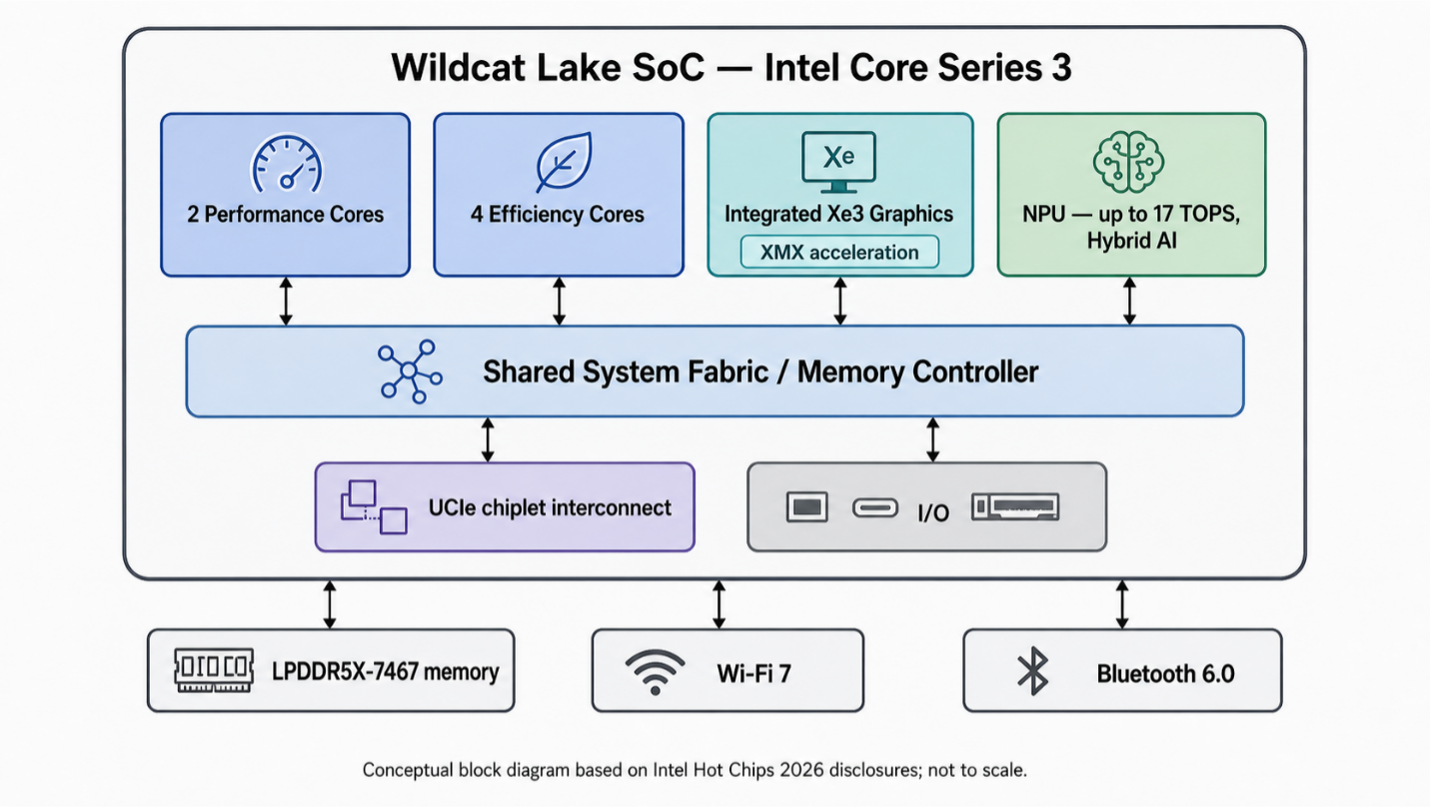
Figure 1. Conceptual block diagram of Intel’s Wildcat Lake SoC, the Intel Core Series 3 platform for mainstream client and edge AI.
The resulting architecture changes planning for both software and infrastructure. ISVs should break agent workflows into explicit stages: data intake, retrieval, planning, model inference, tool execution, post-processing, and local user interaction. Each stage should target a chosen execution domain rather than defaulting every task to the largest available GPU. Silicon teams need to optimize memory movement and software scheduling across CPUs, GPUs, NPUs, and chiplet-connected components. CIOs need governance that spans cloud, data center, branch, and endpoint environments, including data location, observability, model updates, security policy, and total cost per completed business task.
The shared theme is workload placement. Diamond Rapids supports the control plane and memory-heavy enterprise layer. Crescent Island targets the inference plane. Wildcat Lake supports the local and edge plane. Intel’s architecture does not eliminate complexity; it makes heterogeneous deployment the default design assumption.
Intel’s Hot Chips portfolio puts agentic AI on a path from monolithic accelerator deployments toward tiered systems that distribute work across enterprise CPUs, inference GPUs, and client SoCs. That approach fits how production agents actually operate: they need orchestration, retrieval, memory, inference, local context, network access, and policy control in the same workflow. The value for technical teams lies in treating the three platforms as connected deployment layers and designing software, hardware, and procurement models around the handoffs among them.
What do we think?
Intel has presented a credible architectural split for agentic AI: CPUs coordinate complex workflows, GPUs carry sustained inference, and client SoCs keep selected intelligence local. Crescent Island’s 480GB LPDDR5X capacity may matter more to enterprise buyers than headline compute figures because model size and context length increasingly shape inference economics. Wildcat Lake’s UCIe adoption matters too; it signals chiplet economics reaching mainstream AI PCs.
Inflection point. This portfolio signals an inflection point in how enterprises deploy AI. The key transition does not come from a single faster accelerator. It comes when organizations design agent workflows across CPU orchestration, memory-rich inference GPUs, and capable edge systems as one operating model. Diamond Rapids, Crescent Island, and Wildcat Lake outline that stack. If software ecosystems mature around portable scheduling, runtime capability discovery, and measured task-level economics, agentic AI can move from isolated pilots into managed, distributed production infrastructure.
WHAT DO YOU THINK? WORTH READING, VALUABLE INSIGHTS? TELL YOUR BUDDIES.