
Intel’s Q2 beat the room: revenue up 25%, EPS at $0.42, stock up 3% on strong Q3 guidance. Investors liked it. Geopolitical tensions and new tariffs still hang over the sentiment, though. The uglier number sits underneath: Intel Foundry lost $2.1B, and a $12.5B non-cash CHIPS Act escrow charge dragged the GAAP bottom line to an $11B net loss. Intel CEO Lip-Bu Tan, driving the ongoing turnaround, stated, “Our Q2 results represent our strongest revenue growth in more than 15 years, enabled by greater speed, accountability, and customer focus.” He added that “AI is driving unprecedented demand for compute.”

Intel’s execution backs up the optimism. Non-GAAP operating margin swung from -4% a year ago to 17%. Operating cash flow jumped 242% YoY, to $7.01 billion. Panther Lake hit high-volume manufacturing, and Xeon 6+ became the first server chip built on Intel 18A.
Market cap: $503.76 billion. The stock’s up 178% year to date.
“AI is driving unprecedented demand for compute, and as we continue to execute, Intel is well positioned to capture sustainable growth across our CPU franchise, ASICs, advanced packaging, and vast wafer foundry network,” said Lip-Bu Tan, Intel CEO. “Our Q2 results represent our strongest revenue growth in more than 15years, enabled by greater speed, accountability, and customer focus.”
“We delivered a strong second quarter, exceeding our financial guidance on robust demand and improved execution, including volume upside driven by higher factory yields and improved cycle times,” said Dave Zinsner, Intel CFO. “AI-driven compute continues to strengthen, and to support expected growth this year and next across products and foundry, we are meaningfully increasing our investments in equipment, clean room space, and substrates.”
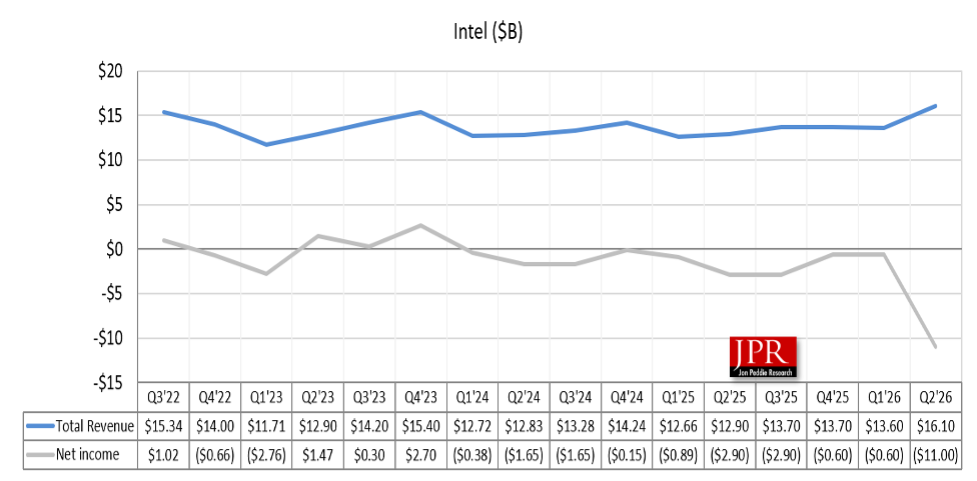
Figure 1. Intel’s Q2 2026 sales leaped in Q2. (Source: Intel and JPR)
Every segment pulled its weight. Data Center and AI revenue jumped 59% to $6.26 billion. Client Computing grew 13% to $8.88 billion. Foundry climbed 31% to $5.77 billion. Guidance for Q3: $15.8–$16.8 billion revenue, beating the $15.06 billion consensus, with non-GAAP EPS of $0.38.
Altera skews the year-over-year comparison. We sold 51% of Altera, our FPGA and programmable semiconductor unit, closing September 12, 2025. Altera’s numbers ran through our consolidated financials up to September 11, then dropped out entirely. So any YoY comparison spanning that date isn’t apples to apples anymore; it’s a structurally different company on paper.
This week’s data center layoffs still raise questions about the workforce. But hyperscaler AI CapEx keeps climbing, Alphabet’s quarter was strong, Nvidia guided Q2 revenue up too, so near-term demand still favors Intel’s products and its foundry pipeline.
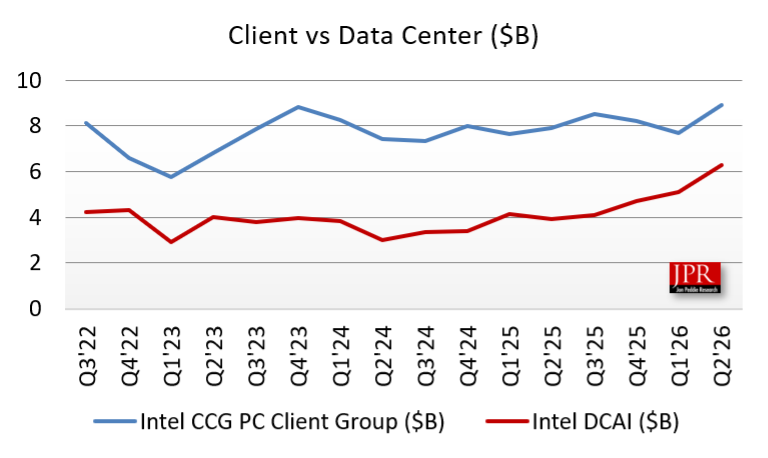
Figure 2. Intel’s data center and client sales. (Source: Intel and JPR)
Google placed an order for 3 million custom TPUs through Intel’s foundry. Nvidia is reportedly weighing Intel as a backup manufacturer as TSMC capacity tightens.
Intel bumped full-year CapEx to $20 billion, up from $18 billion. That’s confidence talking, not hedging.
What do we think?
Intel’s turnaround looks real, not just a good quarter. Margins, cash flow, and every product segment moved in the same direction at once, and 18A shipped a server chip on schedule. Google’s TPU order and Nvidia’s backup-manufacturing talks matter more than the headline numbers: Customers are voting with contracts, not analyst price targets. Foundry must prove it can hold this pace.
Intel’s Q2 looks like an inflection point, not a one-quarter bounce. A 21-point non-GAAP margin swing, 242% cash flow growth, and a first-ever 18A server chip landing on schedule don’t happen by accident in one quarter. The real signal is who’s showing up: Google buying TPU capacity, Nvidia hedging its TSMC dependence toward Intel. When your two biggest AI rivals start treating your foundry as insurance, that’s the market repricing Intel’s execution risk downward, not just sentiment catching up.
AND IF YOU LIKED WHAT YOU READ HERE, DON’T BE STINGY, SHARE IT WITH YOUR FRIENDS.