
AI has created an unprecedented opportunity for RISC-V, but the enormous scale of AI investment also introduces new risks. With China’s technology market already experiencing a sharp correction, JPR examines whether a younger processor ecosystem could be disproportionately exposed to a downturn and whether consolidation might reshape the commercial RISC-V industry even as adoption continues.
Artificial intelligence could be the making of RISC-V. That has been one of the arguments running through JPR’s analysis of the RISC-V market since the start. As per our latest RISC-V report, AI is helping RISC-V move beyond the embedded applications where it has already established itself and into markets historically dominated by Arm and x86.
But last night I sat bolt upright in bed as another possibility struck me. What if the AI investment boom propelling RISC-V forward turns out to be the very thing that cripples the emerging architecture?
The debate about an AI bubble has intensified as investment commitments reach extraordinary levels. A dramatic sell-off in Chinese AI and semiconductors has already shown that valuations can reverse quickly. For RISC-V, the consequences could be unusually significant. Unlike Arm and x86, RISC-V is still building much of the infrastructure needed to compete in high-performance and AI computing.
A substantial downturn in AI investment might, therefore, do more than slow growth. It could undermine the businesses whose survival is necessary for RISC-V to fulfil its ambitions.
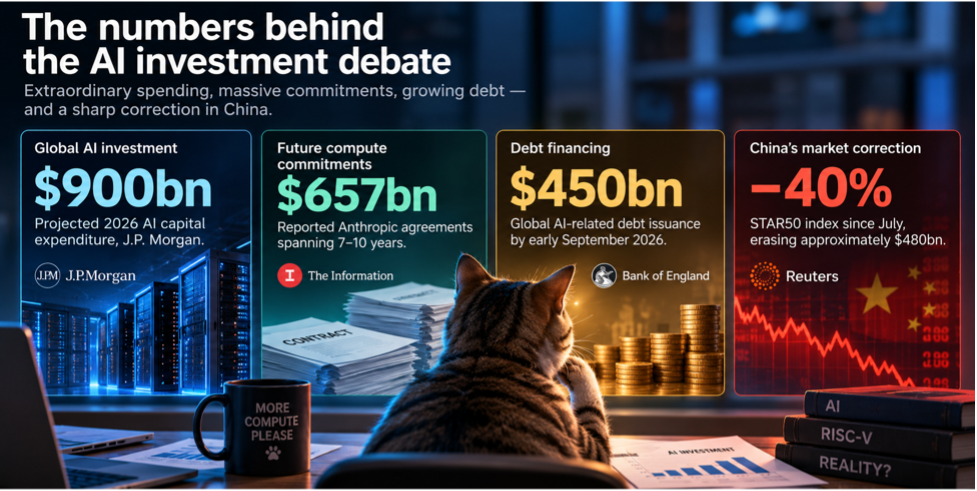
The numbers are becoming difficult to comprehend. J.P. Morgan Global Research estimates that global AI capital expenditure will reach approximately $900 billion in 2026, with cumulative spending potentially reaching $5.5 trillion by 2030. That spending is increasingly supported by financing arrangements whose sustainability depends on future demand.
The Bank of England’s September 2026 Financial Policy Committee report noted that AI-related debt issuance had reached approximately $450 billion by early September, more than double the amount raised throughout 2025. It warned that increasingly complex financing arrangements, including circular investment relationships, could amplify losses.
Perhaps the most striking example comes from Anthropic, whose preliminary IPO prospectus disclosed approximately $657 billion in compute commitments over seven to 10 years. Of those, $417 billion were described as non-cancellable. To put that in context, Anthropic reported first-half 2026 revenue of $16.3 billion.
This is not a story about companies spending money without generating revenue. Anthropic reported a second-quarter operating profit of $974 million and positive operating cash flow of $3.9 billion for the first half. Nevertheless, the gap between current revenues and the scale of future infrastructure commitments raises questions about how much growth is already assumed in investment plans.
Social and political constraints also exist. A September Pew Research Center survey found that 60% of Americans would be uncomfortable with a new data center operating in their area. The proportion believing data centers have a negative environmental impact had risen from 39% in January to 54% by August. Public opposition could well affect the timing and economics of AI infrastructure development, even if underlying demand remains strong.
None of this proves the existence of an AI bubble, but the industry is certainly making exceptionally large, increasingly financed commitments against expectations of continued growth that could be upset in many different ways.
In China, the correction has already arrived
On October 26, Reuters reported that China’s STAR50 index, which includes major AI and semiconductor companies, had fallen approximately 40% from its July peak. Around $480 billion in market value had disappeared in less than four months. Some individual semiconductor companies have suffered even sharper reversals. AI GPU developers MetaX Integrated Circuits and Moore Threads Technology, which enjoyed spectacular stock market debuts, have both roughly halved in value since July. The decline has disrupted fundraising and IPO activity in China.
Should we consider China a warning for the West? Perhaps not. China’s STAR50 index still traded at approximately 100 times trailing earnings following the correction. Chinese technology valuations rose sharply, the country’s equity market has significant retail-investor participation, and concerns about export restrictions have contributed to a rational sell-off.
Falling share prices don’t necessarily indicate falling semiconductor sales or declining AI adoption, and our friends in China say all is well on that front.
We can’t say that valuations don’t matter though: Semiconductor development is capital-intensive, and a company can have customers while remaining dependent on additional funding to reach production. For RISC-V, this could be crucial.
Why RISC-V could be vulnerable
Billions of RISC-V-based devices have shipped, particularly in embedded applications, but the commercial ecosystem supporting its expansion into AI computing is much younger than those surrounding Arm and x86.
RISC-V has made substantial progress with its ecosystem, but the investment required to create commercially competitive platforms remains significant. If bubble-hit semiconductor companies cut development budgets, companies will become less willing to undertake the additional integration and software work associated with RISC-V.
RISC-V, therefore, faces several potential vulnerabilities.
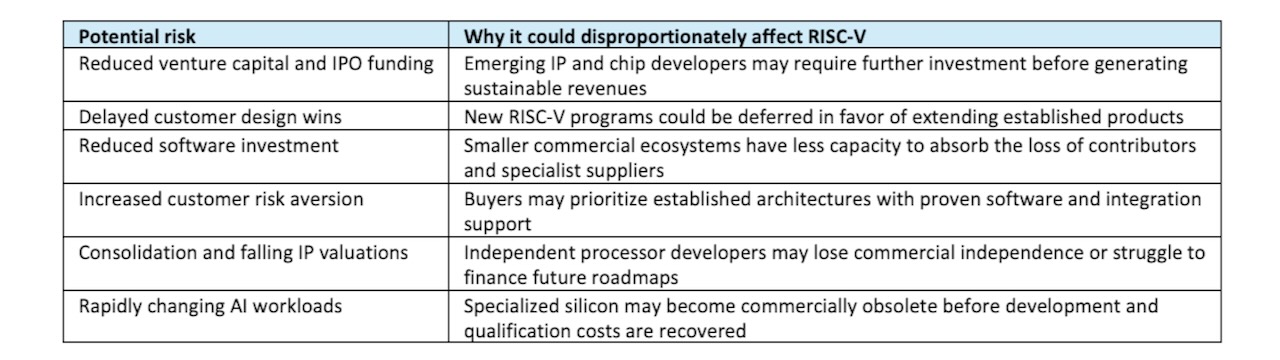
Table 1. RISC-V vulnerabilities in an AI correction.
These are possible transmission mechanisms, rather than evidence that RISC-V is already experiencing an industry-wide contraction. The timing of RISC-V’s commercial expansion makes the question particularly relevant.
As discussed in JPR’s Q3 2026 RISC-V Market Update, a Qualcomm roadmap disclosed during litigation with Arm includes potential RISC-V processors for data centers and value smartphones in 2029, followed by premium smartphones in 2031. That is a strong indicator of strategic interest from a major semiconductor supplier, but it also shows how long the road to substantial commercial deployment will be.
The companies supplying the processors, software, development tools, and supporting technologies must survive that journey. Many are independent companies and organizations whose ability to invest depends on funding and revenues. A prolonged downturn could interrupt the development cycle. Slower ecosystem development could then make RISC-V less attractive to prospective customers, further reducing commercial opportunities. The resulting feedback loop could be a killer.
What if AI succeeds but RISC-V companies don’t?
There is another risk: RISC-V could become extremely successful as a technology without creating a correspondingly profitable independent processor IP industry.
JPR’s recent quarterly reports have repeatedly identified the movement of commercial value beyond the instruction set itself. The important products increasingly combine processor IP with software, tools, specialized acceleration, memory architecture, and broader systems integration. RISC-V may become an essential component of those systems while representing a relatively small proportion of their economic value.
Consider its expanding role as a programmable control processor within AI accelerators. In a recent JPR analysis of SiFive’s Intelligence family, we examined how RISC-V processors can manage data movement, scheduling, and accelerator orchestration. Those are important functions in increasingly heterogeneous AI systems. But the value lies in how effectively the processor solves those problems, rather than simply in the use of RISC-V. The distinction becomes more significant if customers become increasingly price-sensitive.
There is also evidence of consolidation around major semiconductor companies. GlobalFoundries’ (GF) acquisition of MIPS, followed by the addition of Synopsys’ ARC processor IP business in June 2026, brings RISC-V processors, development tools, AI capabilities, and manufacturing expertise together within a larger technology platform. We do not believe GF has finished with its RISC-V acquisitions.
Similarly, Onsemi’s reported $14.5 million purchase of Codasip’s low-end RISC-V business illustrates the challenges associated with monetizing conventional processor IP. The price reflects a business divestiture, rather than Codasip’s overall valuation, and the transaction was not caused by an AI downturn.
Nevertheless, both developments are consistent with the broader movement toward greater participation by established semiconductor suppliers. If independent companies find it increasingly difficult to finance their development independently, then larger semiconductor companies will acquire the technology, talent, and IP.
RISC-V adoption might continue to increase through such consolidation. The question would be, is there still a sufficiently diverse and profitable commercial supplier ecosystem around it?
Could a correction favor RISC-V?
These are not trivial risks, but I’d like to propose a counterargument.
An AI investment correction does not necessarily mean reduced demand for AI computing. Instead of purchasing computing capacity based on expectations of future demand, buyers may focus more closely on cost per inference and demonstrable returns.
That environment could create opportunities for RISC-V. RISC-V’s modularity allows designers to select capabilities appropriate to particular workloads. A well-designed RISC-V solution offers attractive economics in applications where the workload is understood and the implementation can be optimized accordingly. And there are clearly companies that have been around long enough to assess the RISC-V market and speak to all the notable buyers moving in that direction, SiFive and Semidynamics among them.
An AI correction could also accelerate the shift toward smaller models, distributed inference, and AI at the edge, where lower deployment costs and reduced dependence on cloud infrastructure are desirable. These are markets in which RISC-V has technical advantages and established embedded experience.
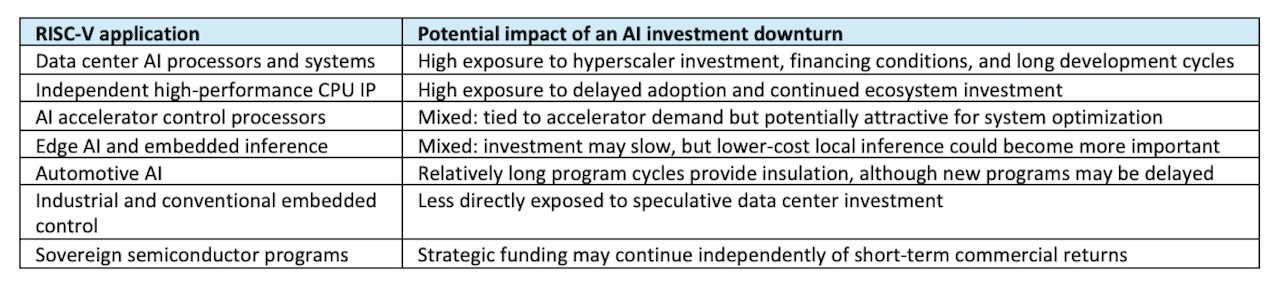
Table 2. JPR qualitative assessment of potential exposure, not a forecast.
There are important structural reasons why RISC-V development could continue through a correction. Governments and large semiconductor companies are increasingly interested in architectural independence and control over their technology roadmaps. Those objectives will not disappear just because AI valuations decline.
What do we think?
Well, arguably this has all been What we think. The facts today do not support a firm call on whether there will be a major correction or just a continued cycle of ups and downs. Perhaps the Anthropic IPO will give us the answer.
The risk for RISC-V is not that AI stops being useful or that the open instruction set somehow disappears. It is that, as semiconductor history repeatedly demonstrates, the technologies which survive an investment boom are not necessarily still controlled by the companies that pioneered them.
JPR has previously argued that AI could be the making of RISC-V, and we think that argument remains compelling. AI is creating new requirements for specialized computation. RISC-V offers an attractive architectural foundation for addressing those requirements.
We think RISC-V’s flexibility and independence should make it more attractive if an investment correction accelerates a transition already visible in the industry, with major semiconductor companies taking a larger role and commercial value moving toward complete systems.
AI would still be the making of RISC-V, while potentially unmaking some of its pioneers.
LIKE IT? WE’VE GOT LOTS MORE. TELL EVERYONE YOU KNOW. WE’D LOVE TO HEAR FROM YOU AND THEM.