
SiFive is positioning its Intelligence-series RISC-V processors as programmable controllers for custom AI accelerators. The approach illustrates how RISC-V’s commercial value is moving beyond the ISA towards specialized system integration, data movement, and accelerator orchestration.
(Source: SiFive)
As AI workloads grow more complex, attention is increasingly turning to the processors that manage specialized accelerators, rather than the accelerators’ performance alone.
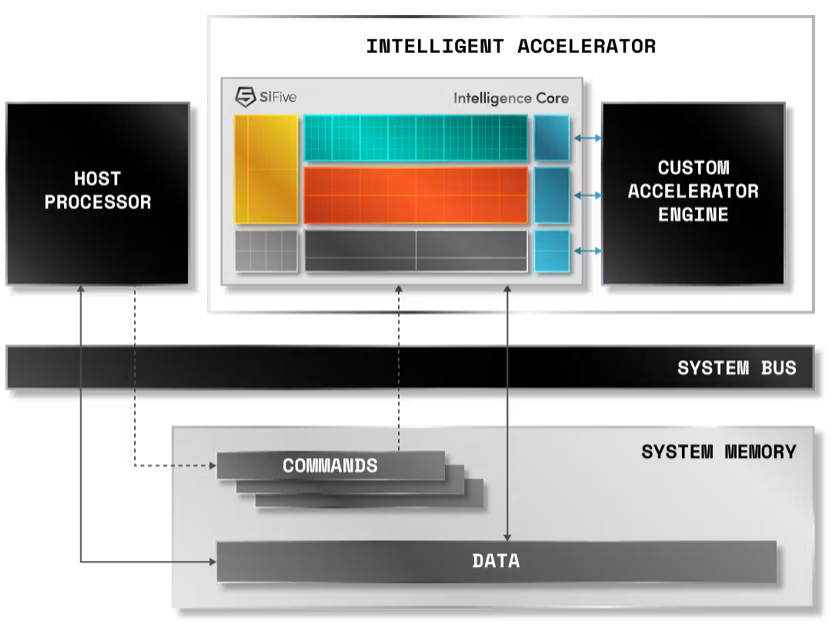
Clifton Robin, director of technical product marketing, argues that programmable RISC-V processors can provide an effective control layer for custom AI accelerators, handling data movement, scheduling, and coordination, while allowing dedicated compute engines to concentrate on their primary tasks.
According to Robin, there are several limitations in conventional accelerator control architectures. Hardwired state machines can be difficult to modify as algorithms change, shared buses create potential bottlenecks, and relying on the host CPU for low-level orchestration consumes processing resources and adds latency.
SiFive proposes using its Intelligence-series processors as Accelerator Control Units (ACUs), providing a programmable interface between the host processor and custom accelerator hardware rather than a generic state machine/DMA approach.
The approach combines RISC-V scalar and vector processing with three interfaces designed to reduce the overhead of accelerator control and data movement.

The interfaces allow the RISC-V processor to prepare and transfer data, dispatch accelerator operations, and perform ancillary calculations, such as activation functions or data formatting. Changes to the control logic can be implemented in software or firmware rather than requiring modifications to fixed-function hardware.
There are several Intelligence family processors. The X100 series targets control-intensive applications where low latency and modest area are priorities, while the X200 and X300 series offer greater vector bandwidth and computational capacity for more demanding workloads.
Google data centers already use the Intelligence X200 as an AI compute host, and there is an X100 license to an unnamed Tier 1 US semiconductor company for industrial edge AI applications.
What do we think?
This is a useful illustration of a theme running through our latest RISC-V Quarterly Report: The value is moving beyond the ISA. SiFive is selling a way to solve a practical systems engineering problem: how to control specialized compute engines, move data efficiently, and retain flexibility as AI workloads evolve. The differentiation lies in SiFive’s implementation. What the processor does, and how effectively it fits into the broader architecture, matters much more than the instruction set.
RISC-V is entering a more mature phase. Customers are not simply looking for an alternative CPU architecture; they are looking for proven IP that reduces effort, risk, and time to market. SiFive recognizes that the opportunity is increasingly to provide a useful part of a larger computing platform.
Anyway, this seems to be a signal that RISC-V does not have to displace Arm or x86 as the main processor to gain a meaningful position in AI infrastructure. It can find its way into the control plane of increasingly heterogeneous systems.
LIKE WHAT YOU’RE READING? TELL YOUR FRIENDS; WE DO THIS EVERY DAY, ALL DAY.